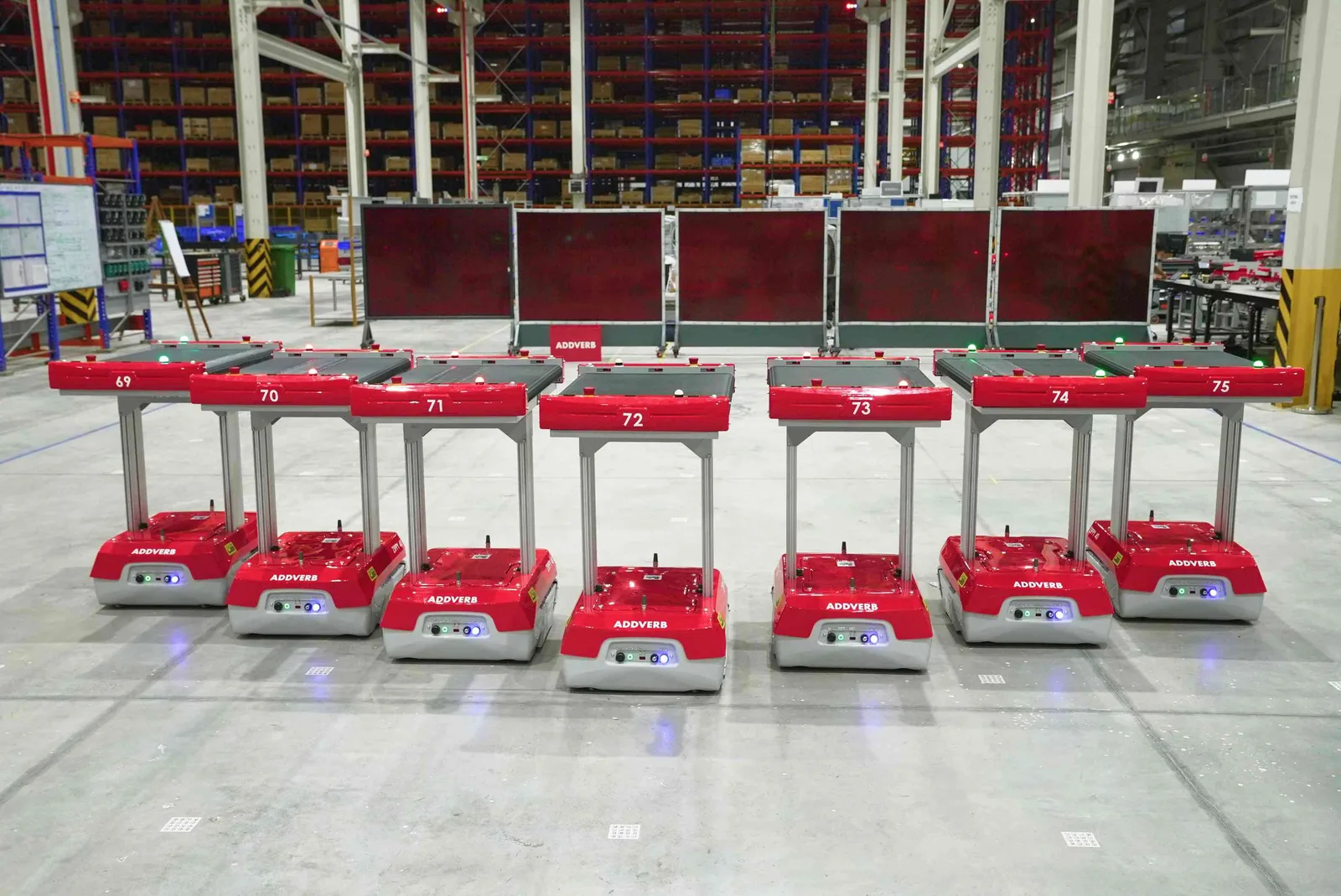
Flexible Sortation Use Cases for Smart Warehouse Operations
Highlights
• Sortation is now the warehouse layer most exposed to volatility, SKU proliferation, and carrier change.
• Flexible sortation has driven up to 300% fulfillment speed gains and 25–50% lower fulfillment cost in early deployments (BCG, McKinsey).
• Inside: four use cases, three-layer architecture, Zippy portfolio, five customer deployments.
Executive Summary
Warehouse sortation has quietly become the single most consequential design choice in modern fulfillment. It governs order cycle time, labor intensity, SLA adherence, and cost per shipment — and it increasingly determines whether an operation can absorb the next peak, the next SKU expansion, or the next carrier change without a capital project.
But the environments that built the case for fixed sortation are becoming rarer. E-commerce has pushed SKU counts up by orders of magnitude, compressed peak windows, and introduced a level of returns volume that no conveyor line was ever designed for. At the same time, warehouse labor is scarce, expensive, and increasingly unwilling to do repetitive manual sort work.
Key stat
$890B in U.S. retail returns in 2024 — an effective reverse-logistics operation bigger than the GDP of many G20 countries.
Source: National Retail Federation, 2024
We cover:
How warehouse variability has changed the economics of fixed vs. flexible sortation.
The four use cases where flexible robotic sortation is delivering the clearest ROI today: batch picking and de-batching, order consolidation, outbound distribution, and reverse logistics.
Real-world deployments at Maersk, Lenskart, DHL, Mondial Relay, and Landmark Group showing measurable throughput, accuracy, and cost outcomes. Each is documented with the operational challenge, the deployed configuration, and the post-deployment results.
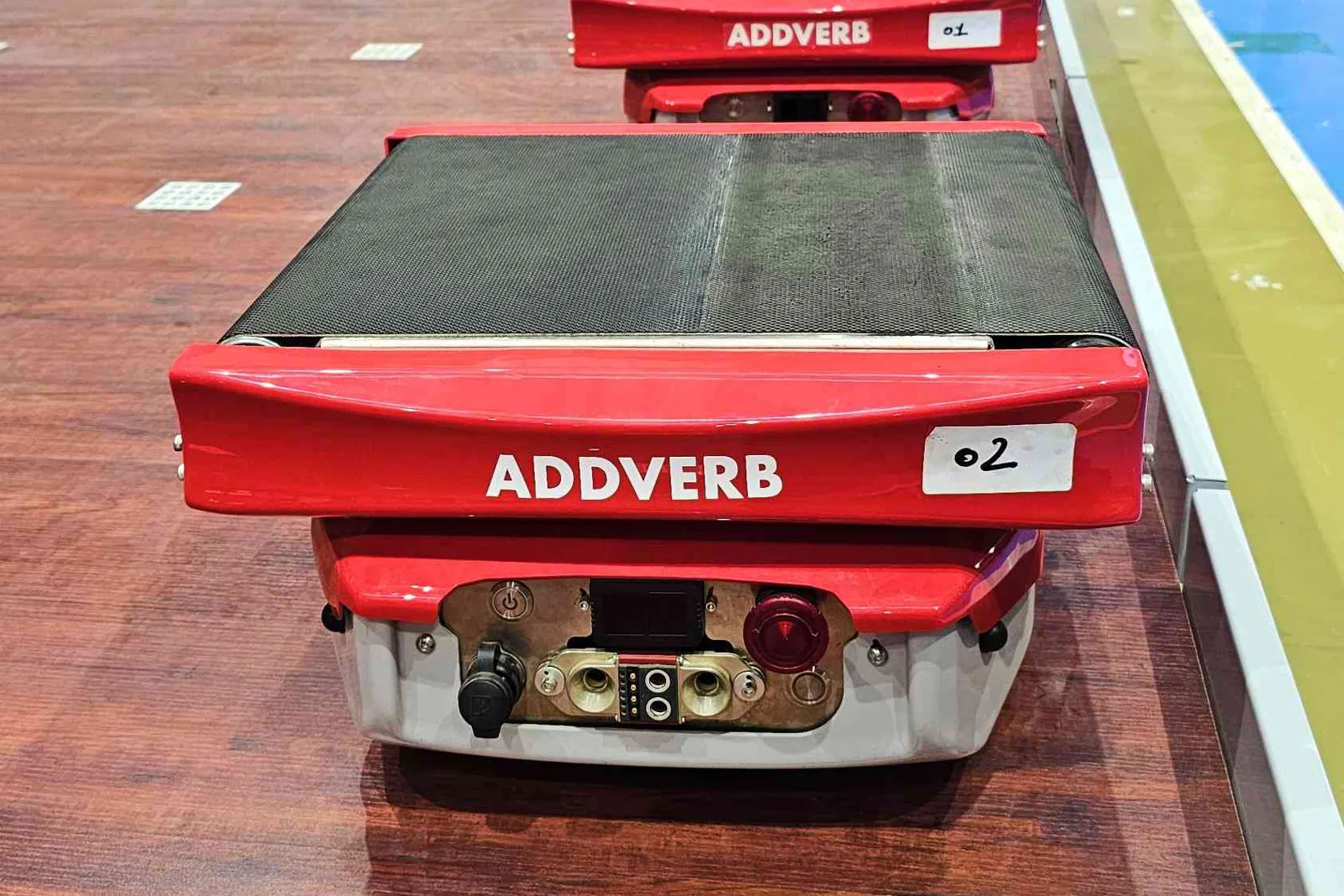
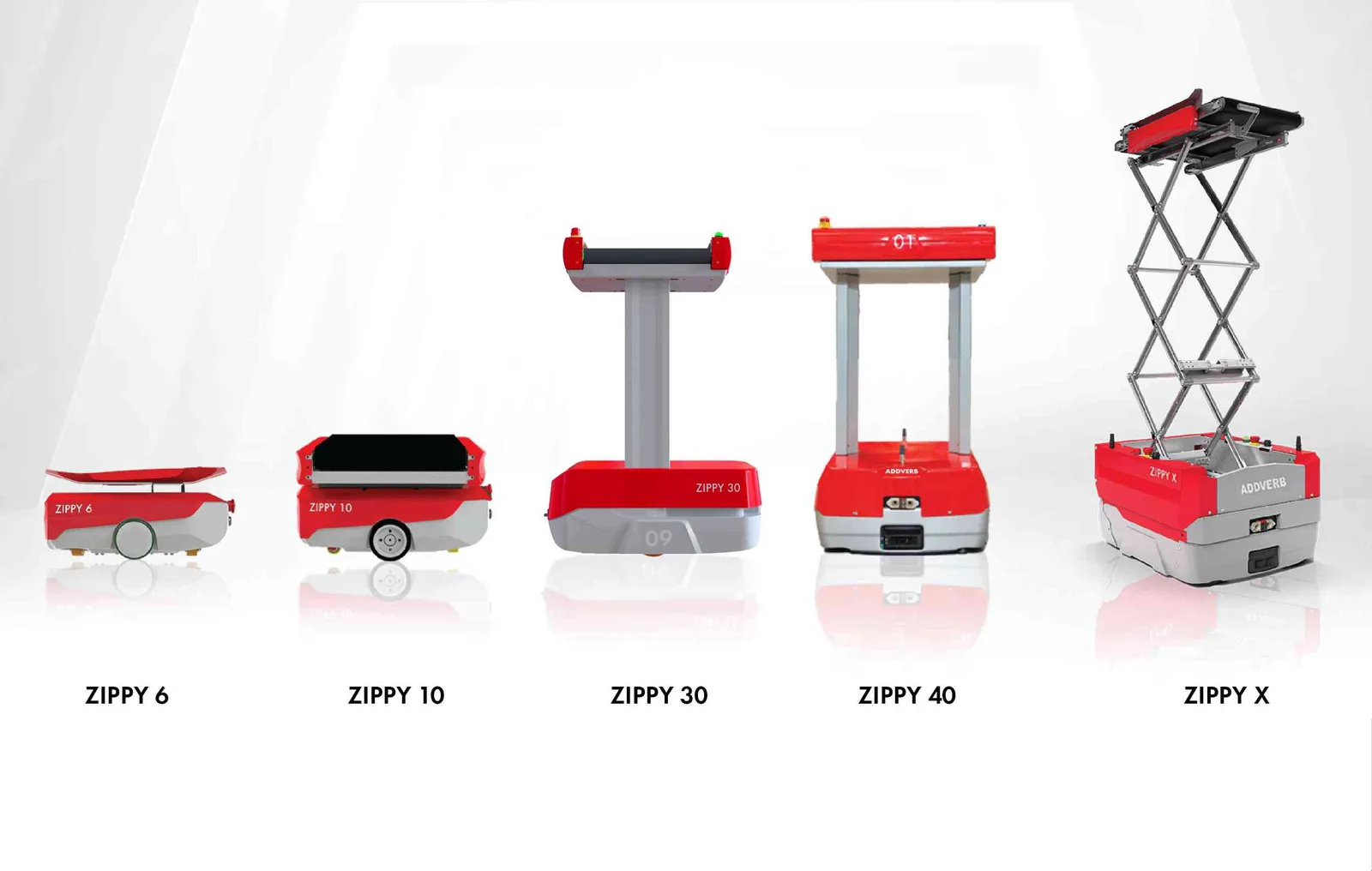
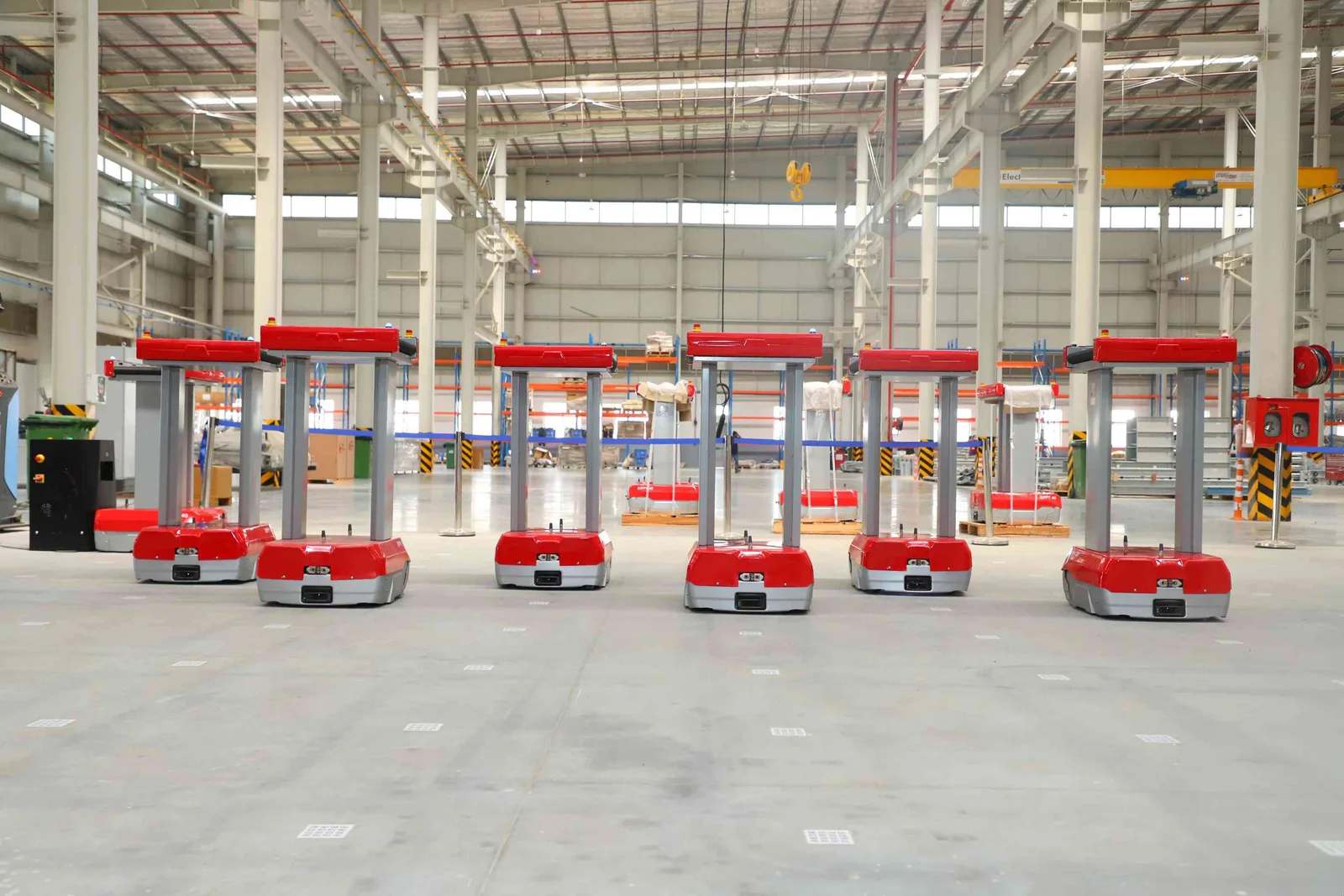
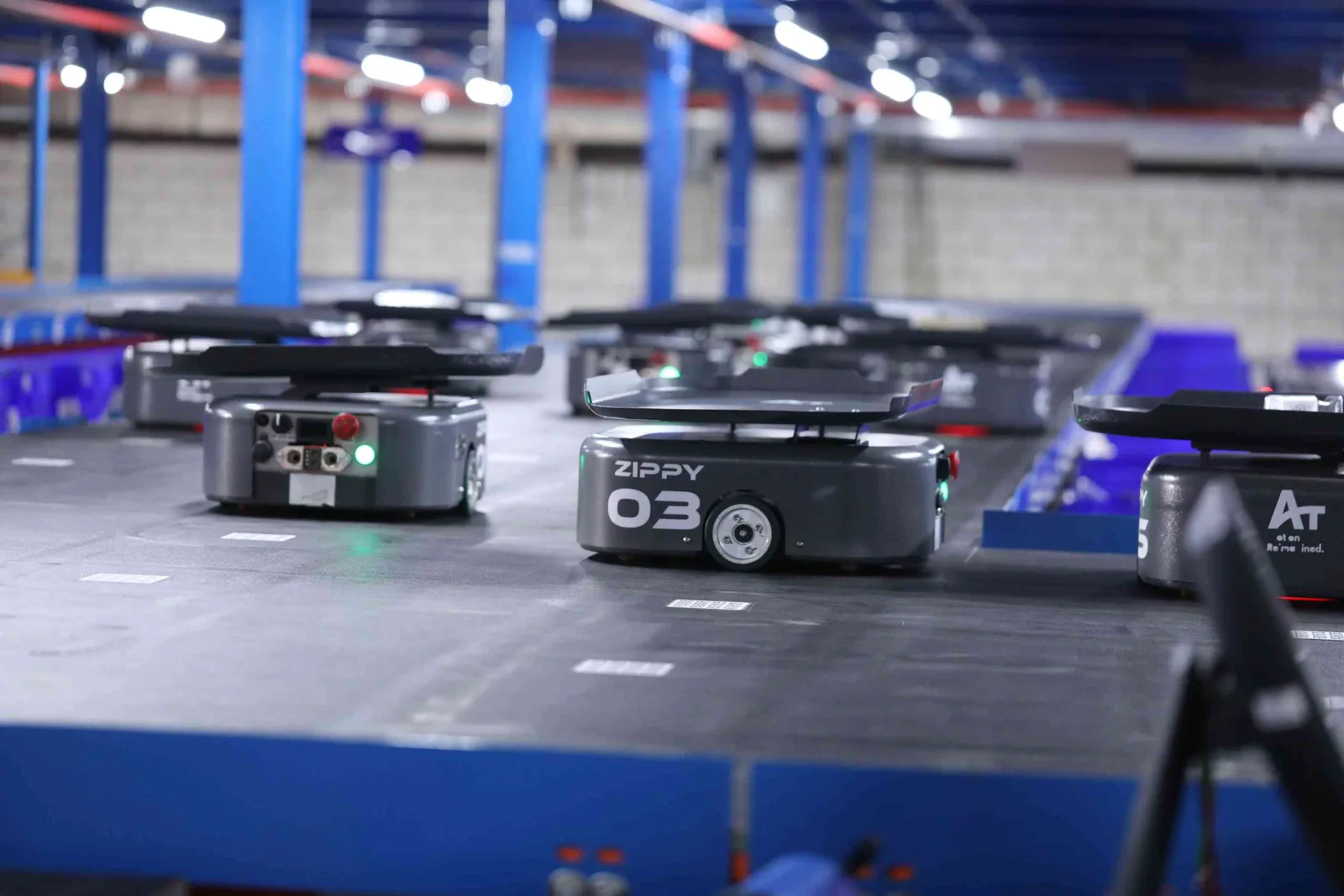
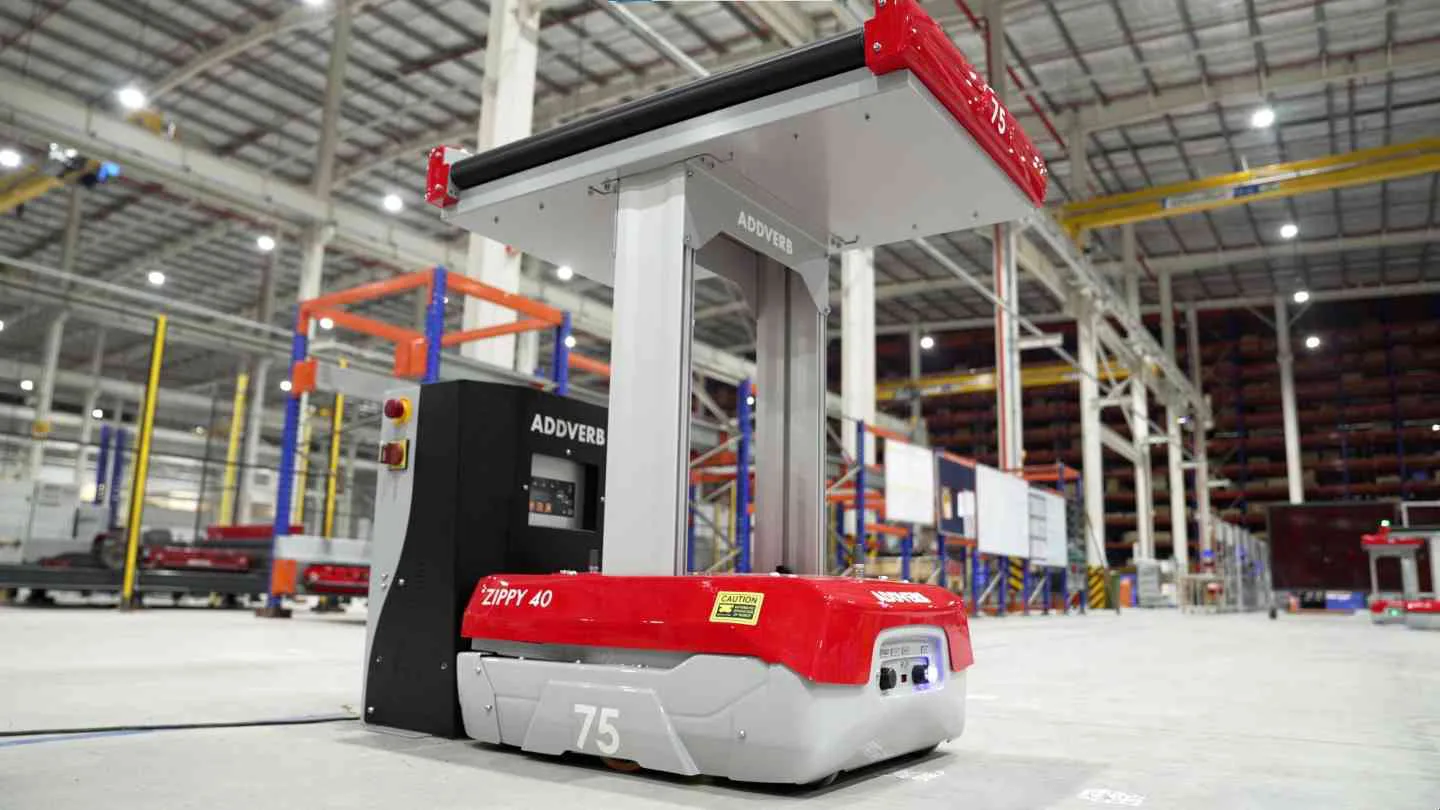
Addverb's flexible sortation portfolio — table-top and floor-based Zippy robotic sorters — and how their 40 kg payload capacity fit with varied SKU formats and mixed-architecture warehouses.
The Sortation Imperative
From downstream mechanics to strategic capability
Every parcel, carton, tote, and polybag that leaves a modern warehouse is the output of at least one sortation decision — and usually three or four. Which pick wave? Which consolidation zone? Which carrier? Which dock door? Which SLA?
For most of warehousing's history, sortation was a mechanical activity downstream of picking. The job of the conveyor line was to move items quickly and predictably from A to B. That framing worked because warehouse flows were themselves predictable: bulk replenishment, stable SKU counts, and a handful of destinations.
Key takeaway
Sortation is no longer the last step in fulfillment. It is the first strategic lever — the place where variability either gets absorbed or gets passed downstream as mis-sorts, delays, and labor cost.
That world is gone. Today's fulfillment operation routinely handles tens of thousands of SKUs, hundreds of shipping destinations, multiple carriers per order, and returns flows that can spike 30 - 40% week-over-week after peak. Every one of those changes pushes complexity upstream — into sortation.
The result is that sortation has shifted from a mechanical function to an operational capability. It is one of the few areas in the warehouse where the right architectural choice compounds into throughput, labor, cost, and customer-experience gains simultaneously — and the wrong choice locks in capex for a decade.
What Has Changed in the Warehouse
Five structural shifts reshaping sortation design
The assumptions that underpinned conveyor-era sortation design — stable volumes, uniform items, predictable destinations — no longer hold in most e-commerce and omnichannel operations. Five shifts in particular have made flexibility a first-class requirement rather than a nice-to-have.
01
SKU Proliferation
Warehouses that carried 5k - 10k SKUs a decade ago routinely now carry 50k - 200k. That changes the math on fixed lanes: every new destination requires either a physical change or a compromise on routing logic.
02
Peak Compression
Cyber Week, 11.11, and regional mega-sales events now concentrate 6 - 10x normal volume into windows of hours, not days. Fixed systems either over-provision (burning capex) or overflow (burning labor and SLA).
03
Returns volume
At a 20%+ return rate for e-commerce, the returns side of a warehouse is no longer a side operation; for many operators it is a parallel fulfillment center that also needs sortation intelligence.
04
Carrier Fragmentation
Outbound no longer means one carrier and two service levels. Most mid-to-large operations now split shipments across 4 - 15 carriers with different cut-offs, label specs, and service windows.
05
Labor scarcity
Warehouse labor is the single biggest input cost for most operations and the single least available input. Manual sort tables are the first place this pain shows up.
Key stat
78% of warehouses report labor shortages driving operational costs up 15 - 25%.
Source: BCG, Amplify Your Warehouse Automation ROI (2023)
Fixed vs. Flexible: A Side-by-Side View
Most serious operations will not replace fixed conveyors outright; they will layer flexible sortation on top to absorb variability, extend existing lines, and unlock new applications. The decision is rarely binary — it is architectural.
Dimension
Fixed Conveyor Sortation
Flexible Robotic Sortation
Best throughput
Extremely high, stable volumes (tens of thousands of units/hr)
High throughput with graceful degradation; tuned to live demand via software
Footprint & layout
Fixed; requires structural design and long conveyor runs
Operates on flat floors; fits within existing facility footprints
Low at steady state; high during mis-sort recovery
Low overall; eliminates most manual sort tables
Four Use Cases Where Flexible Sortation Wins Today
Quite often, flexible robotics solutions are combined with fixed solutions like conveyors for material inbound and outbound. In the following section, we will take a deeper look at how these four use-case redefine the material flow in intralogistics:
Order consolidation — software defined assembly of multi-zone, multi-time orders
Outbound distribution — real-time routing to carriers, service levels, and cut-offs
Reverse logistics — conditional sortation based on item condition and disposition
Key stat
20-50% service level improvement and 25 - 50% fulfillment cost reduction reported by companies that fully embraced warehouse automation.
Source: BCG, Amplify Your Warehouse Automation ROI (2023)
Use Case 1: Batch Picking & De-Batching
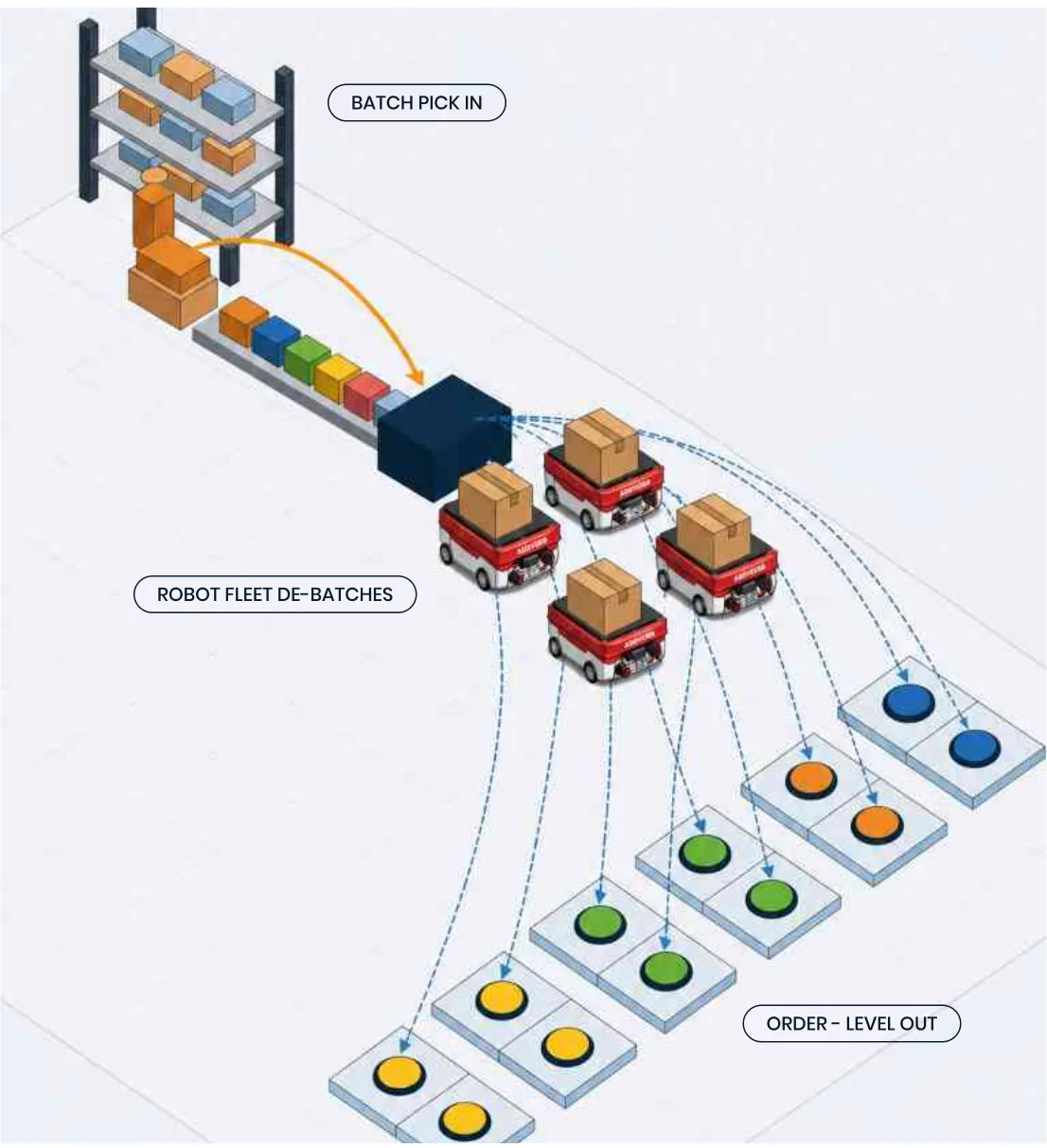
Batch picking — grouping multiple orders into a single pick tour — is one of the highest-leverage productivity plays in a warehouse. Best-in-class operators routinely hit 250+ picks per hour per picker against a baseline of 120 - 175. The catch is that batch picking only helps if you can de-batch efficiently downstream: the mixed tote that saved picker time becomes a bottleneck if it then lands on a manual sort table.
How flexible sortation reshapes the flow
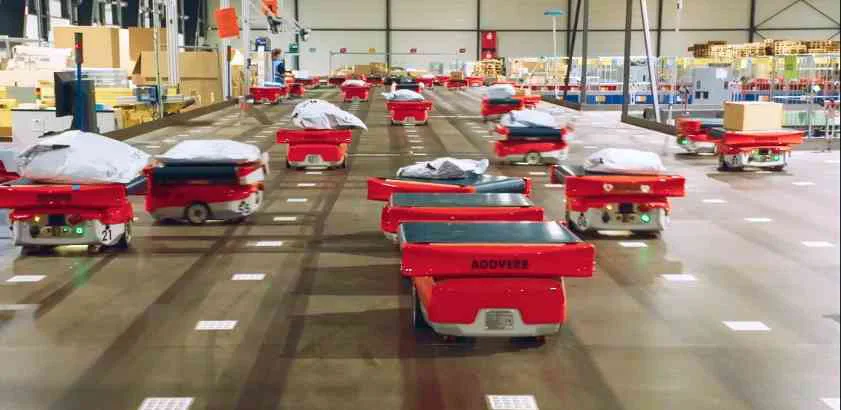
Sorting robots act as intelligent de-batching agents. As each pick tote arrives, items are inducted onto individual robots, which route them in parallel to order-level destinations. The more orders per batch, the more leverage the robots generate — the opposite of a manual sort table, where complexity taxes throughput.
Key stat
Upto 300% improvement in order fulfillment speed reported with automated picking and sortation systems.
Source: McKinsey & Company
The operational problem
Batch picks drive productivity, but create downstream sort complexity
Manual sort tables become labor and error-heavy at scale
Mis-sorts cascade into mis-ships and customer credits
Parallel de-batching across dozens of robots at once
Order-level sort accuracy without manual intervention
Preserves the productivity gains of larger batches
Scales by adding robots rather than tables or headcount
Batch Picking & De-Batching
One pick wave, many orders — sorting robots as parallel de-batching engines
Use Case 2: Order Consolidation
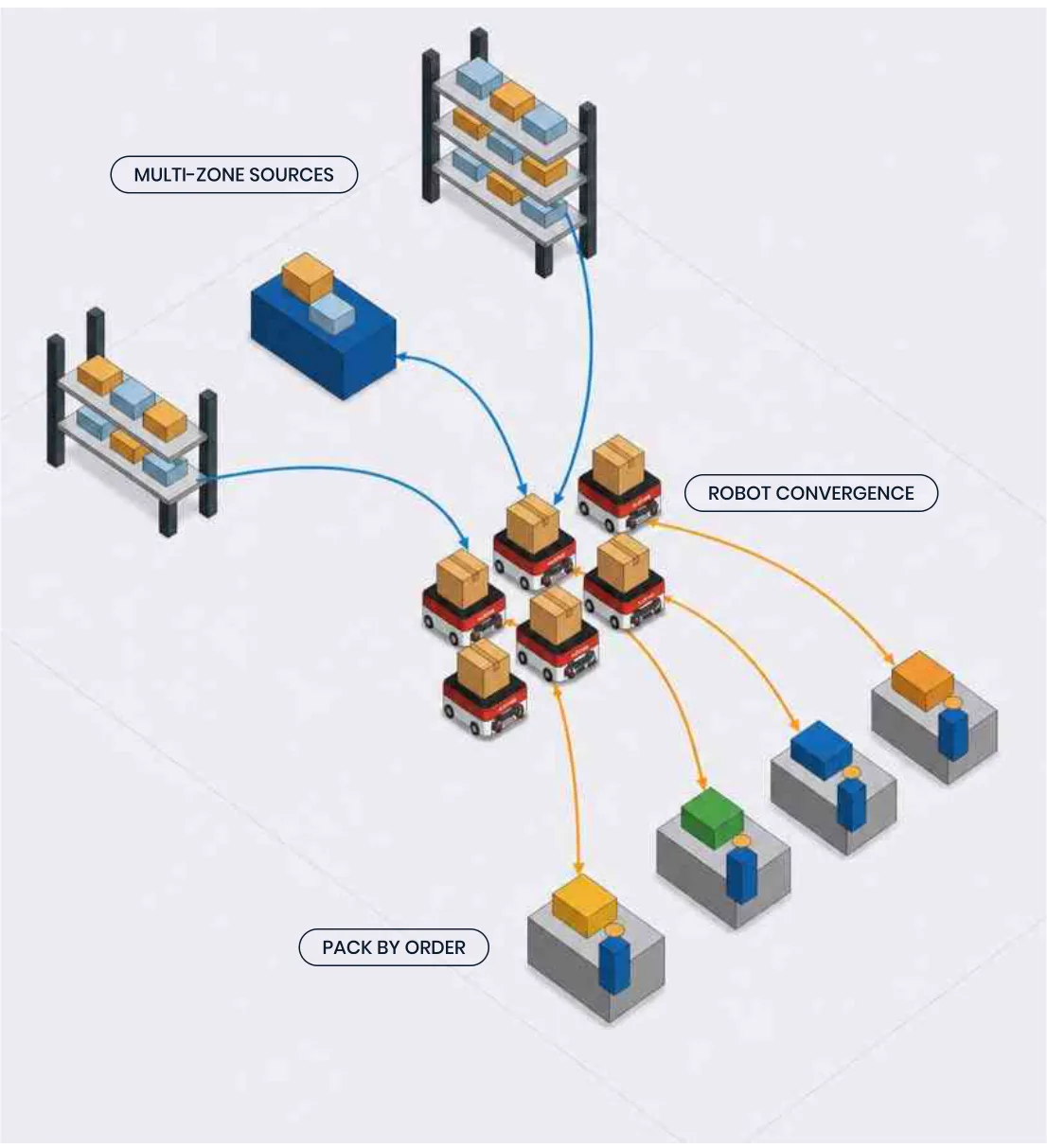
Order consolidation is where warehouse complexity compounds. A single outbound order can involve items from cold storage, mezzanine picks, automated GTP, and returned-stock put-aways — all landing at the consolidation area at different times. Fixed consolidation uses physical lanes and accumulation zones, which work well at steady state but crumble under variable release patterns and peak demand. When sources flow unevenly, lanes back up and orders sit waiting. Coordination becomes the bottleneck.
How flexible sortation reshapes the flow
Robotic consolidation treats the order as a digital entity, not a physical lane. As items arrive from different zones, robots route each one to a consolidation destination determined in real time by packing-station availability, congestion, priority, and SLA. The result is a consolidation layer that adapts moment-to-moment rather than at the pace of physical reconfiguration.
Key stat
2-3 days → 2.5 hours order consolidation time for Lenskart after deploying Addverb's robotic sortation — now handling 150,000 orders/day at 99.99% accuracy.
Source: Addverb deployment data, Lenskart India
The operational problem
Multi-zone orders arrive at different times
Fixed lanes force capacity trade-offs during peaks
Accumulation zones consume floorspace and capital
Re-routing for priority orders is slow and manual
With flexible sortation
Software-defined consolidation by order, not by lane
Real-time station selection based on load and cutoff
Higher packing-station utilization with less floor
Priority orders promoted in-flight, not by re-picking
Order Consolidation
Multi-zone items converged into order-level packing by software, not by lanes
Use Case 3: Outbound Distribution
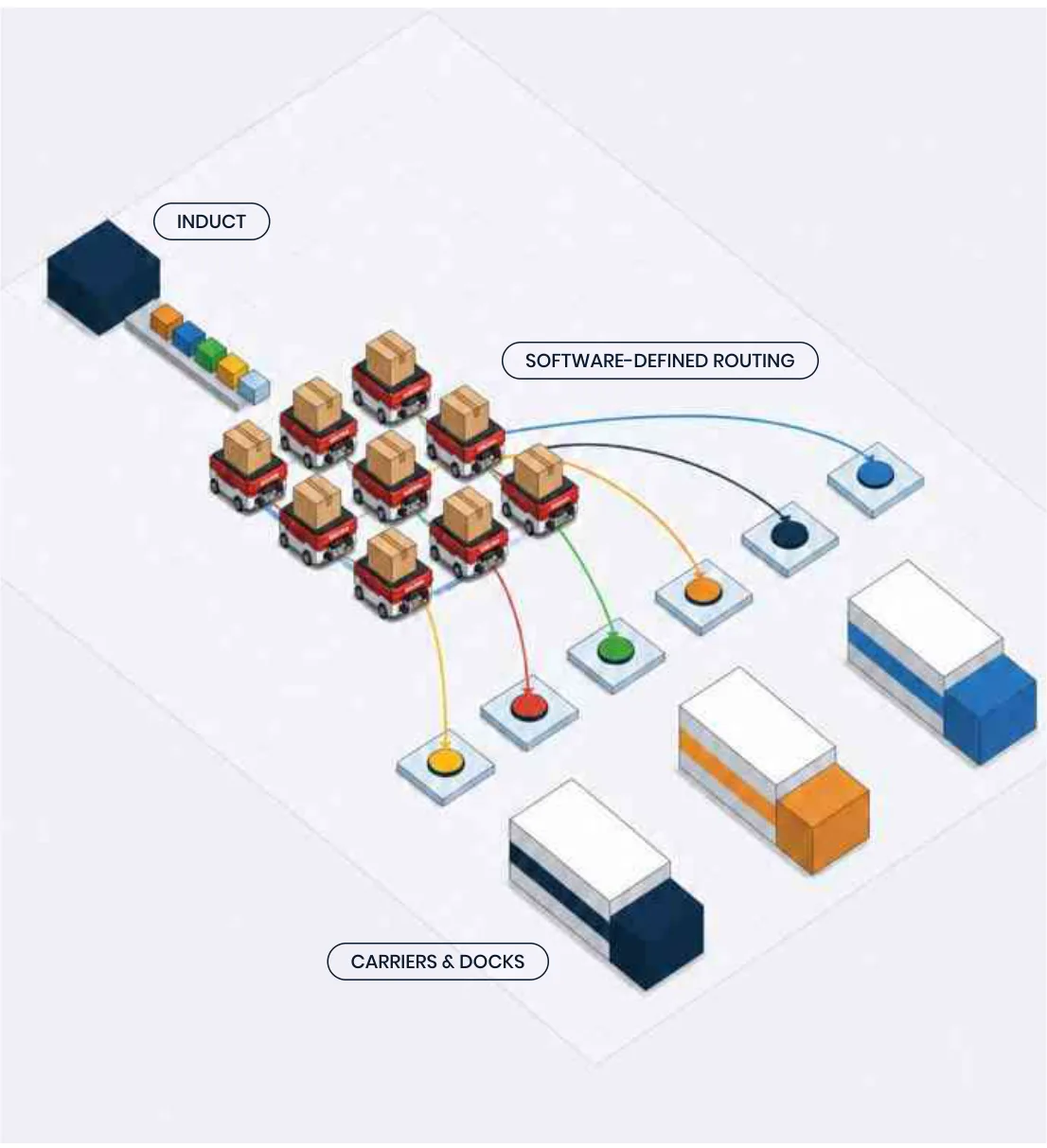
Outbound has become the most dynamic sortation layer in a modern warehouse. Most mid-to-large operations now split shipments across multiple carriers, service levels, and geographies — each with its own cut-off, label spec, and dock assignment. When a carrier adds a new service or a 3PL wins a new account, the sort logic needs to follow within days, not quarters. Hard-wired sort logic turns every routing change into a capital project. Carriers and customers move faster than that.
How flexible sortation reshapes the flow
Sorting robots allow outbound destination logic to change in real time without physical reconfiguration. A new carrier can be added as a new chute or dock assignment; a cut-off can be moved simply by re-prioritizing the queue. For 3PLs especially, this is the difference between a solution that grows with the book of business and one that locks the operation into today's customers.
Key stat
6-7 → 280 sortation destinations for Mondial Relay after deploying 72 Zippy robots — achieving 3,000+ sorts/hr within weeks of go-live.
Source: Addverb deployment data, Mondial Relay France
The operational problem
Dynamic carrier mix with different cut-offs
Mixed parcel profiles stress fixed diverters
Cut-off misses cascade into next day commitments
Every new service level triggers physical change
With flexible sortation
Destination logic changes via software, not steel
Throughput stays stable across parcel profiles
Dynamic prioritization of near cut-off orders
New carriers and services onboard in days
Outbound Distribution
Real-time routing across carriers, service levels, and dock doors
Use Case 4: Reverse Logistics
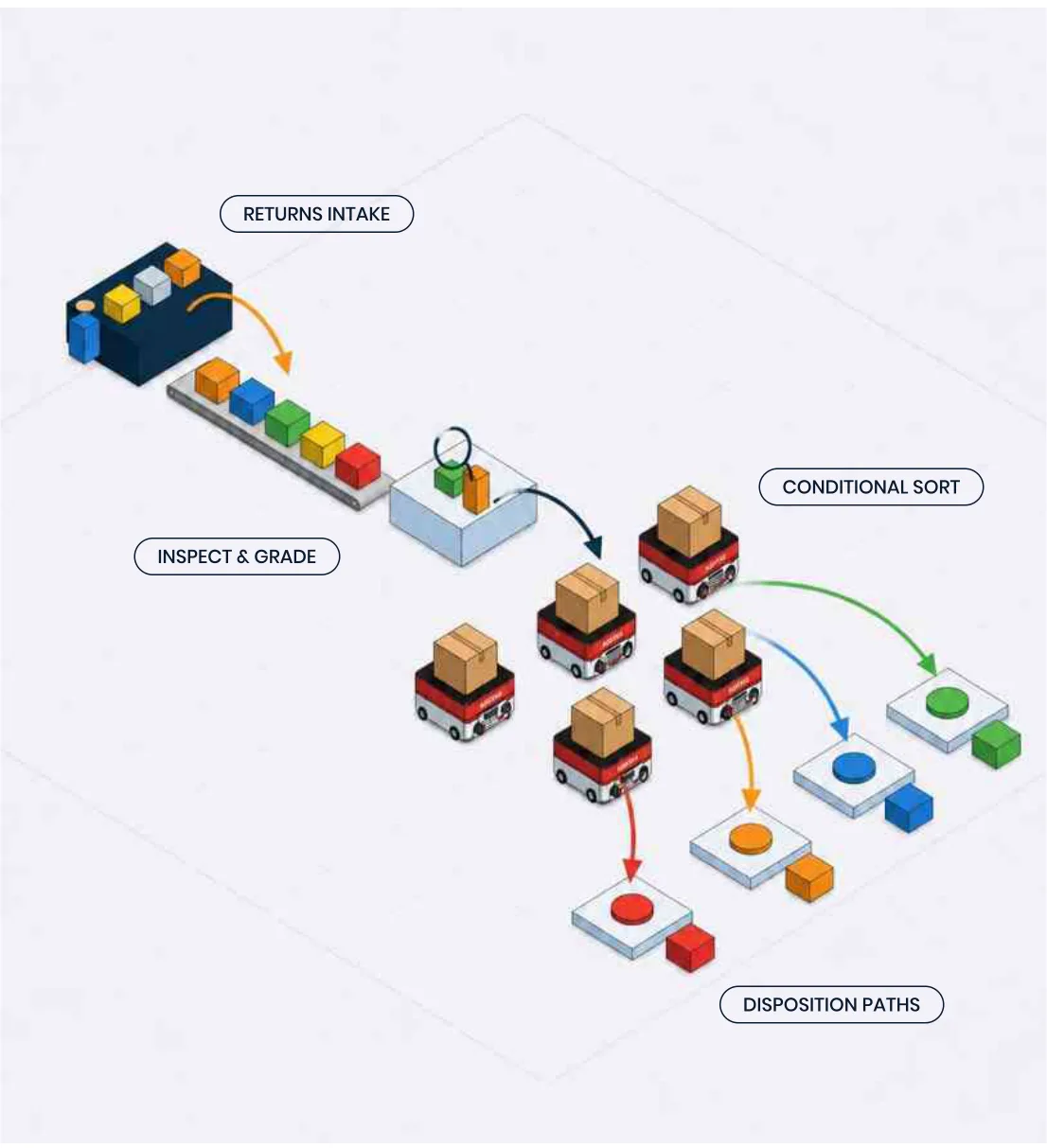
Returns is where most warehouses have the least automation and the most upside. Every returned item needs inspection, disposition (restock, refurb, liquidate, scrap), and routing to the right next step — often across multiple conditions and SKU values. That is conditional sortation by any other name, and it is precisely what rule-driven fixed systems were never designed to do. Returns volume keeps climbing. Every hour an item sits ungraded is recoverable margin walking out the door.
How flexible sortation reshapes the flow
Robotic sortation makes conditional routing the default. Inspection outcomes, SKU value, and business rules feed into live destination logic — so an item inspected as restockable goes straight to put-away, while a damaged item goes to refurb or liquidation without manual rehandling. The impact compounds: faster return-to-sellable cycles, less manual handling, and better inventory recovery.
Key stat
20.4% average U.S. e-commerce return rate in 2024 — every point of improvement in reverse logistics translates directly into working capital and margin.
Conditional routing by inspection outcome and rules
Reduced manual handling and rework
Faster return-to-sellable cycles
Traceable, auditable disposition per unit
Reverse Logistics
Conditional sortation from intake through inspection to four disposition paths
Designing Sortation for Variable Operations
The operations getting the most out of sortation today are not choosing between fixed and flexible — they are designing architectures where each layer does what it does best. In practice, that tends to look like this:
Layer 01
High-Volume Fixed Conveyor Backbone
Where flows are predictable and volumes are at the top of the scale — parcel hubs, national DCs with single dominant flows — fixed conveyor systems remain the most cost-effective backbone. They are mature, understood, and economical at the right volumes.
Layer 02
Flexible secondary and variability-absorbing sortation
Downstream of primary sort, or in flows the primary was never designed for — returns, store replenishment, DTC, multi-carrier outbound, peak overflow — flexible robotic sortation absorbs the variability without triggering a capital project.
Layer 03
Software-defined orchestration
Both layers are governed by a Warehouse Execution System (WES) that treats orders as digital entities and dispatches work to whichever sort layer is best-suited at that moment. This is the layer that converts mixed infrastructure into a single, coherent operation.
Key stat
By 2030 50% of new warehouses in developed markets will be designed as 'robot-centric', human-optional facilities.
Source: Gartner (2026)
The result is an operation that does not have to choose between the throughput of a conveyor and the flexibility of a robot fleet — and does not have to rip out one to add the other.
Addverb's Approach to Flexible Sortation
Addverb approaches sortation as a system-design problem, not a product-selection exercise. In most facilities, the question is not whether to replace conveyors — it is where in the flow software-defined sortation earns its place.
Three principles
01
Software-defined performance
Every sortation decision — destination, priority, cut-off — should be reconfigurable in software. The Concinity WES orchestrates robot fleets, conveyors, and human work against live order intelligence and SLA commitments.
02
Modular hardware architecture
Zippy, SortIE, Quazzy, Quadron, and Dynamo AMRs are designed to be deployed incrementally. An operation can start with a single flow — for example, DTC outbound — and extend into consolidation, returns, and batch de-batching without a second capital cycle.
03
Seamless integration with existing systems
Addverb's sortation stack integrates with standard WMS, host ERP, and carrier systems. The goal is to layer flexibility into an operation without disrupting what already works — most of our flagship deployments run alongside existing conveyor, put-wall, and manual processes.
Key takeaway
Flexibility is a choice made once at the architecture level, and cashed in every time the business changes — a new SKU, a new carrier, a new peak — for the life of the facility.
Addverb's Flexible Sortation Portfolio
The table below summarizes the core Addverb offerings that together make up the flexible sortation stack. Each component is production-proven, field-serviceable, and designed to work with both Addverb and third-party systems.
Variant
Max Payload
Max Parcel Size
Platform
Primary Use Case
Zippy 6
6 kg
400 × 300 × 200 mm
Tabletop
High-speed sortation of light apparels, polybags, small e-commerce parcels, circular and irregular shaped items
Zippy 10
10 kg
400 × 300 × 200 mm
Tabletop
Mid-weight e-commerce cartons and parcels on a tabletop deck — typical D2C and 3PL outbound
Zippy 30
30 kg
600 × 400 × 400 mm
Tabletop or Floor
Heavier cartons across mixed-architecture warehouses; flexible deployment as tabletop or floor sorter
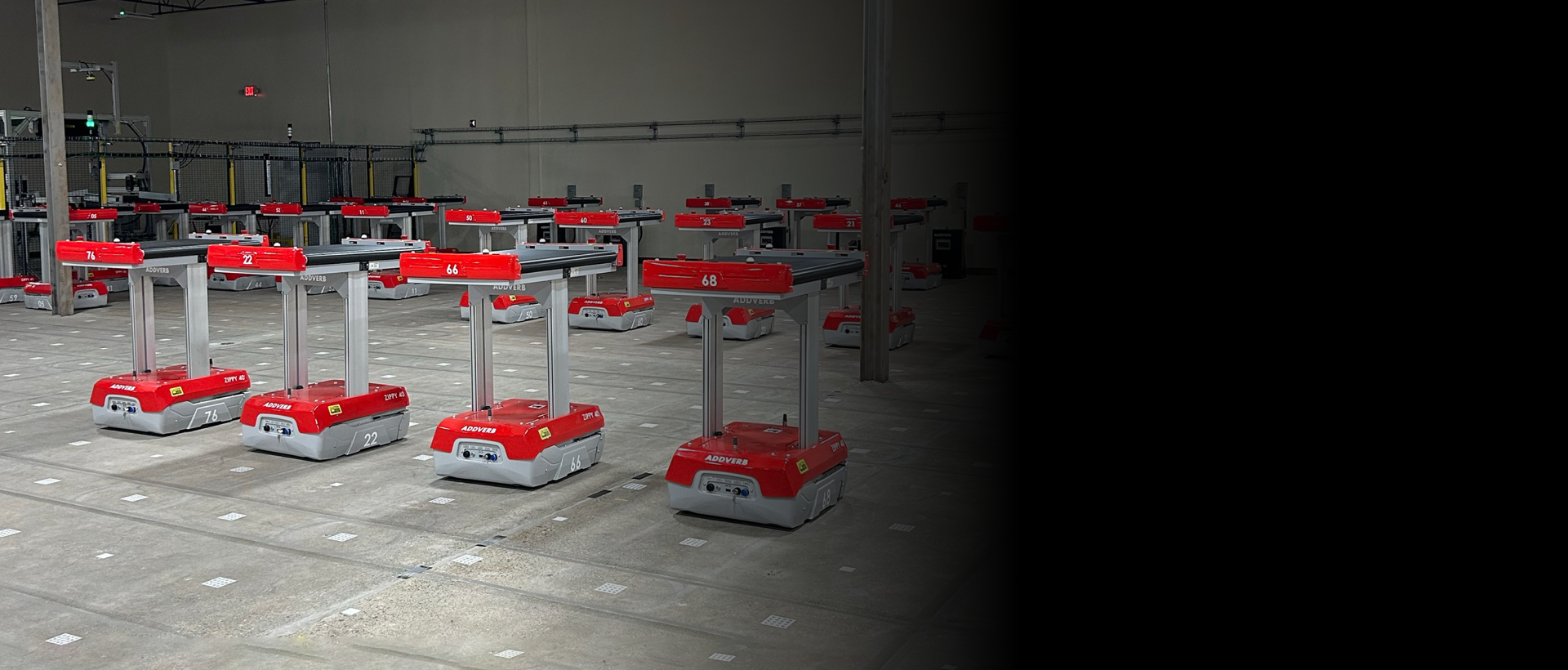
Zippy 40
40 kg
800 × 600 × 400 mm
Floor
Bulky parcels, retail bulk, B2B and wholesale fulfilment; wide-belt option for oversized loads
Zippy X
15 kg
600 × 400 mm
Floor
Multi-level sortation into bins, gaylords, or stacked racks where transfer height varies (600–1600 mm)
Selected Deployments
The following case studies illustrate how flexible sortation has delivered measurable results across each of the four use cases. Full versions of these and additional case studies are available on request.
Mondial Relay — Outbound Parcel Sortation
Parcel Logistics | France
Challenge
Space constraints ruled out a conveyor-based expansion just as parcel volumes and destinations were growing. The operation needed a solution that fit inside the existing footprint and adapted to changing parcel flows.
Solution
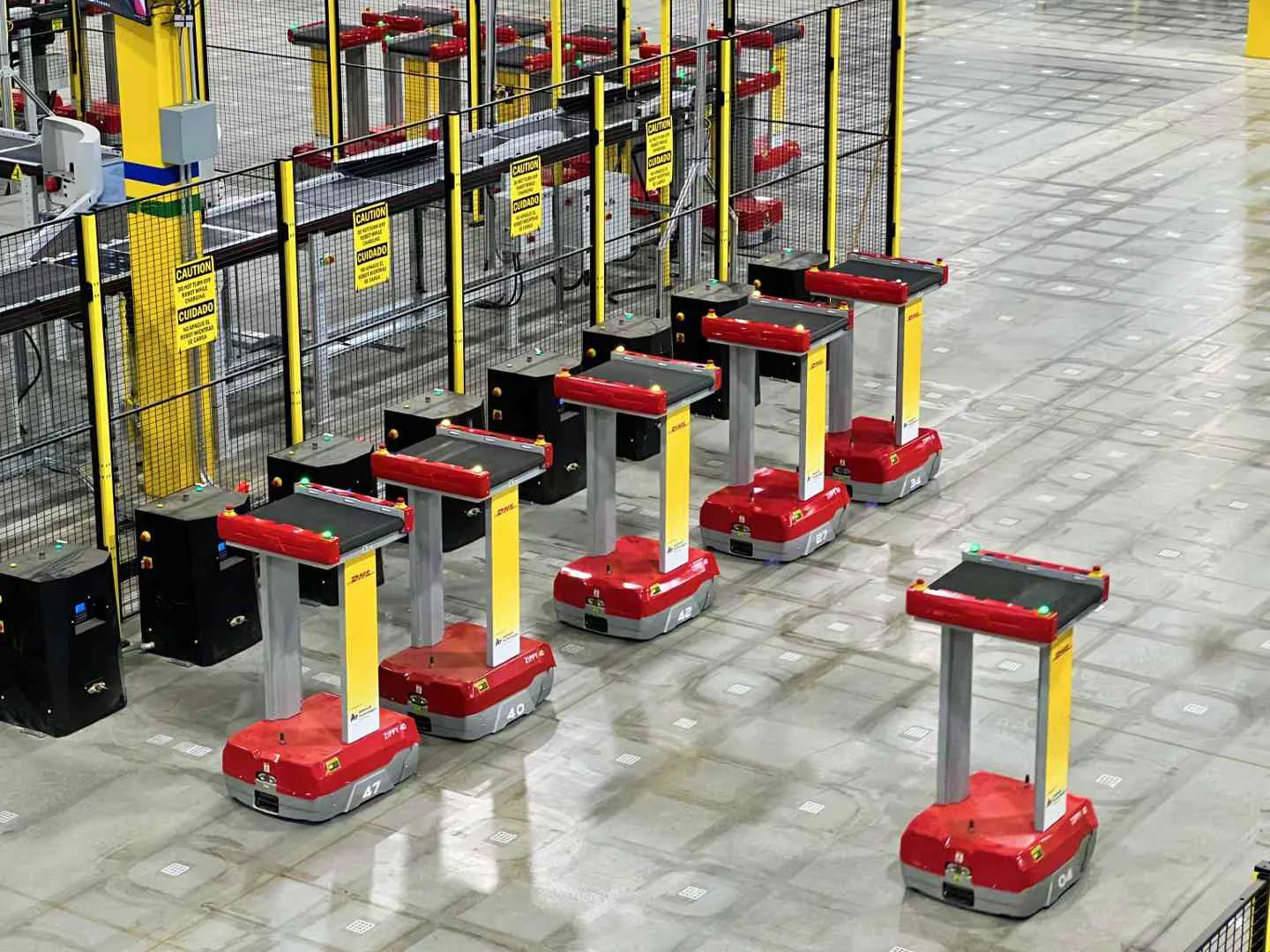
Deployed 72 Zippy robots with ground-marker navigation, dynamic re-routing, obstacle detection, and a safety-door mechanism — achieving high-precision parcel sortation without long conveyor runs.
Outcomes
01
Destination count expanded from 6-7 to 280
02
Throughput elevated to 3,000+ sorts per hour
03
Over 80% of target throughput in the first week after go-live
04
100% sorting accuracy
DHL Supply Chain — Outbound Distribution, 24/7
3PL / Apparel | USA
Challenge
A 24/7 sortation operation for a major apparel retail brand faced persistent labor shortages, long turnaround times, and limited ability to scale during peaks.
Solution
End-to-end automated sortation with material movement, sorting and storage integrated on a single enterprise platform — including a 'round-robin' parcel distribution pattern for balanced load.
Outcomes
01
Throughput rose from ~20 to 100+ units per hour per lane — a 300%+ increase
02
99.99% order fulfillment accuracy
03
Reduced labor dependency on a chronically short-staffed operation
04
1,000 sorts/hour achieved at full scale
Maersk — Multi-Flow 3PL Fulfillment
3PL / Fashion & Apparel | Australia
Challenge
A diverse B2B and B2C inventory of shoes, apparel, and accessories required a flexible automation solution covering storage, retrieval, batch picking, and returns in a single facility.
Solution
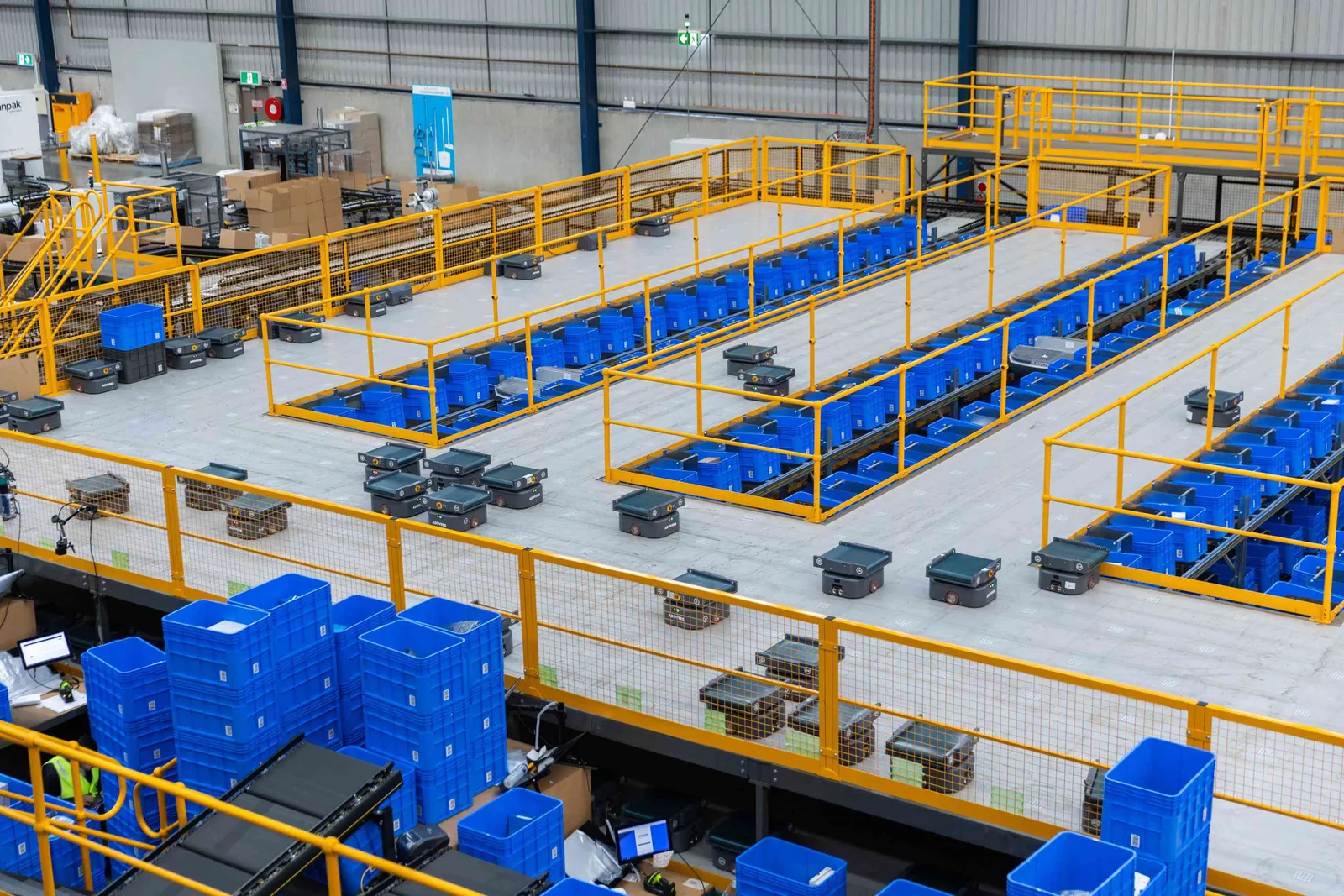
Combined Sorting Robots, AMRs, ASRS with Pallet and Carton Shuttles, and a Multi-Carton Robot system — across a 330,000 sq. ft. facility run by the Concinity (WES).
Outcomes
01
3,600 eaches per hour sortation throughput
02
100,000 pieces dispatched per day
03
16,500 pallet positions and 86,400 tote positions
04
Double-layer sortation system with 300 bin locations (150 per level)
Landmark Group — Batch Picking & De-Batching
E-commerce / Omnichannel Retail | Kuwait
Challenge
High-volume B2C operations with a wide SKU mix — home décor, apparel, accessories — needed adaptive automation that could preserve batch-picking productivity while handling item-level sort variability.
Solution
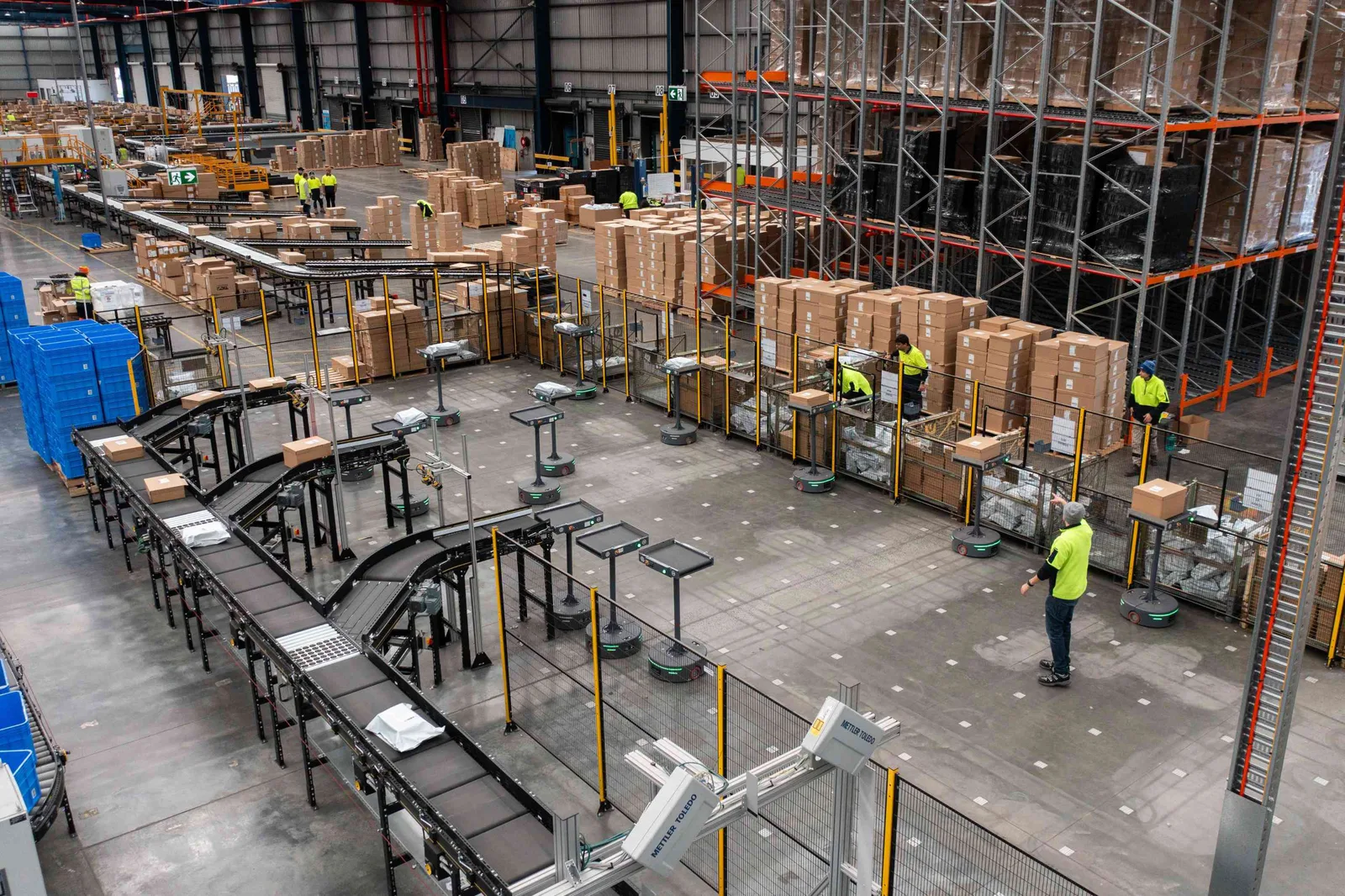
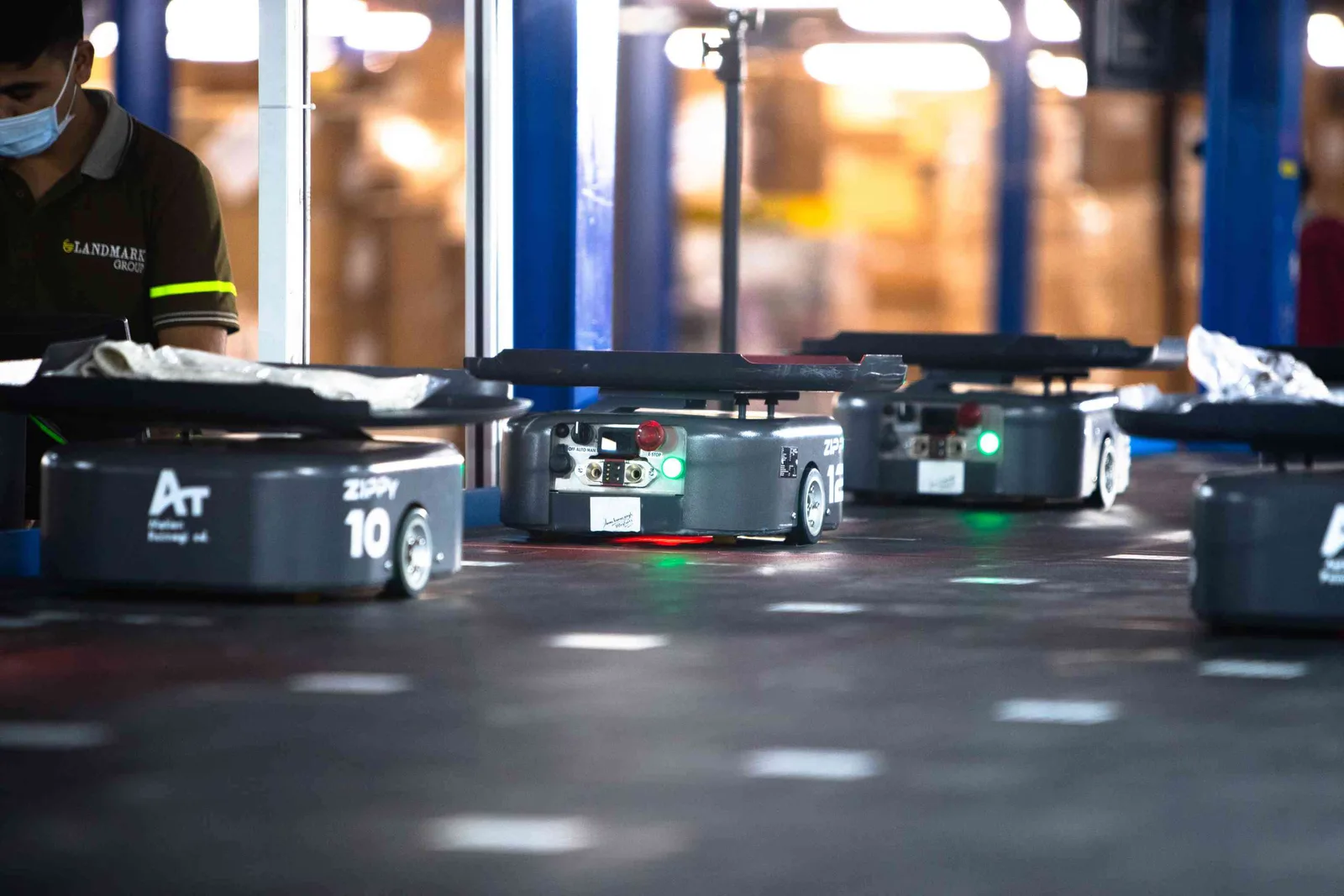
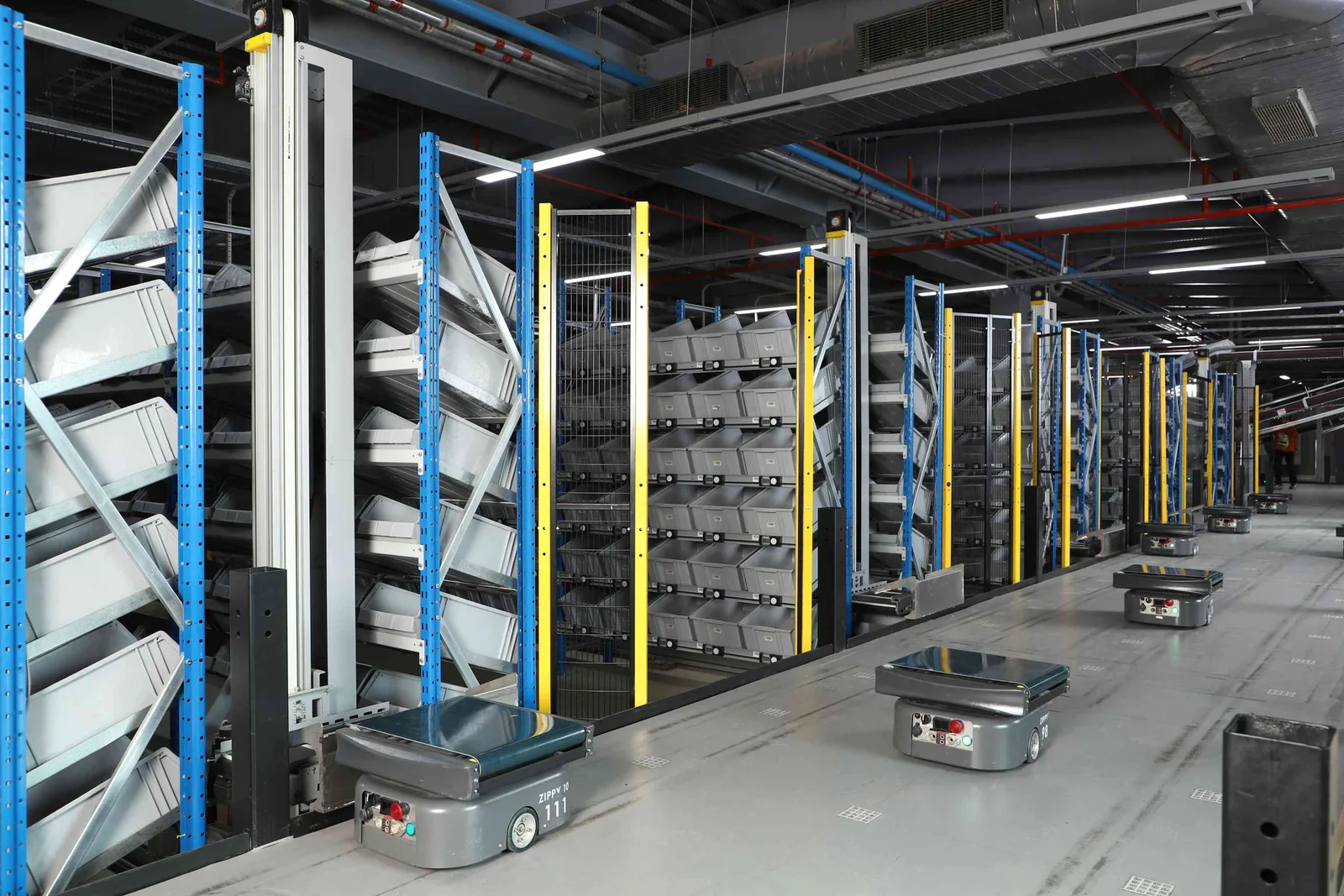
Deployed the patented Quazzy system (Quadron carton shuttle + Zippy sorting robot) with integrated conveyors and DWS scanners — orders picked in batches, split into bulky and non-bulky, then sorted into order-level destinations.
Outcomes
01
300% throughput boost to 1,000 sorts per hour
02
Sorting accuracy improved 3x
03
100 totes per hour throughput on the carton shuttle system
04
Labor costs reduced by 25%
Lenskart — Order Consolidation at E-Commerce Scale
Eyewear / D2C | India
Challenge
Order consolidation was taking 2 - 3 days across a diverse eyewear inventory. The business needed to collapse that cycle to hours while guaranteeing near-perfect accuracy for a sensitive product category.
Solution
Integrated facility design combining the Quadron ASRS, 40+ goods-to-person stations, SortIE and Zippy sorting robots, and Dynamo — orchestrated by the Concinity (WES). The facility serves 3200+ stores nationwide.
Outcomes
01
Order consolidation time reduced from 2 - 3 days to 2.5 hours
02
99.99% fulfillment accuracy
03
150,000 orders dispatched per day
04
55,000 storage positions, 60 GTP stations
What these deployments have in common
Each of these projects began with a single use case — consolidation, outbound, batch de-batching, or returns — and expanded as the operation realized compounding benefits. That is the signature pattern of flexible sortation: modest first-phase ROI becomes a multi-use-case platform by year two.
Key takeaway
Flexible sortation ROI is almost always larger in year two than in the original business case — because software-defined systems grow into adjacent flows without a second capital cycle.
The Future of Warehouse Sortation
From rigid to adaptive
The next phase of warehouse automation will not be defined by faster machines alone — it will be defined by systems that adapt, learn, and scale over time. Conveyor-based and robotic sortation will continue to coexist. The question leaders are asking now is not which to choose, but how to weave them into a single, software-defined fabric that can absorb whatever tomorrow's business looks like.
Tomorrow's leading operations will not be the most automated — they will be the most adaptable. Flexibility, in the end, is the only form of throughput that compounds.
Three trends worth watching
AI-driven orchestration across mixed infrastructure — 7 - 15% additional network capacity unlocked by better variability management alone (McKinsey)
Polyfunctional robots that handle sortation, packaging, and replenishment on the same platform (Gartner 2025 Top Supply Chain Trends)
Automation becoming the largest single category of logistics capex — reaching 33%+ of capital spending in fulfillment (McKinsey)
Key stat
25% of capital spending on average will go to automation over the next five years — with logistics and fulfillment leading at over one-third.
Source: McKinsey & Company, Getting Warehouse Automation Right (2024)