
Table of Contents
The emergence of automated warehouse robots has drastically changed the way modern facilities manage inventory, move goods, and maintain operational flow. Many modern firms have transitioned from manual workflows to a robotic warehouse automation system.
In fact, one global logistics study estimated that warehouse automation will reach over 41 billion USD by 2027, while robotics adoption is increasing at a record pace. This indicates how robotics has become crucial for boosting warehouse efficiency and productivity, but it also shows why organizations should approach automation with clarity and careful planning.
This journey towards complete automation brings its own set of technical, operational, and integrational challenges. Understanding and addressing them with the right strategy is vital to building a scalable and future-ready warehouse.
Key Challenges Companies Face in Warehouse Robotics Implementation
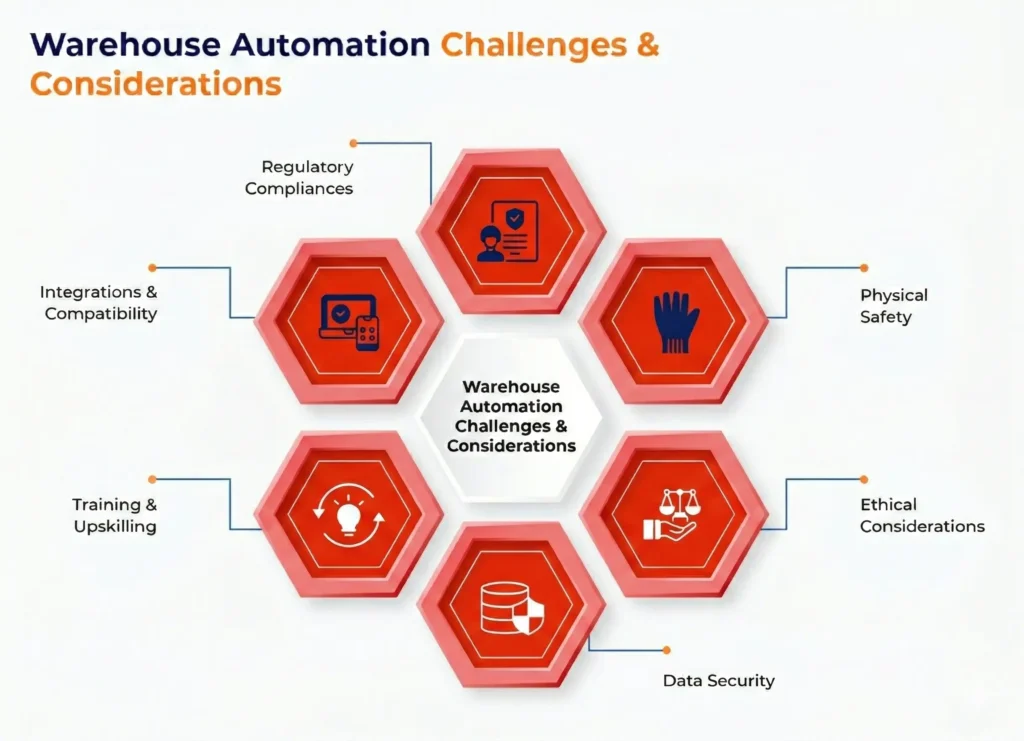
Businesses adopting automated warehouse robots often face several barriers. The major challenges usually relate to integration complexity, process compatibility, workforce readiness, and infrastructure limitations.
1. Integration with Existing Systems
One major challenge regarding robotics in warehouse management is integrating robots with legacy systems that are outdated or lack API support. Since robotics relies on real-time communication, these older systems often become a barrier.
2. Inconsistent Warehouse Layouts
Many warehouses were never designed with robotics in mind. Narrow aisles, complicated racking layouts, and irregular zones combine to create a challenging environment for safe and efficient navigation with robots.
3. High Initial Investment and ROI Concerns
Automation requires capital investment at the forefront, right from deploying hardware to integrating software. Most organizations face challenges in estimating the returns on investment, especially when operational data is not well-structured.
4. Barriers to Workforce Adaptation
Resistance to the shift towards automated warehouse robots exists among some employees due to the potential learning curve and concerns about loss of jobs. Training deficits can complicate adaptation to an automated environment for the teams.
How to Overcome Obstacles in Warehouse Automation
Organizations that succeed with robotics typically adopt a modular, data-driven approach supported by strong software orchestration and workforce enablement.
1. Use Integrated Automation Software
Robots deliver maximum value when governed by a unified software ecosystem rather than operating as isolated assets. System-level orchestration ensures real-time visibility, dynamic task allocation, and seamless coordination between inventory, equipment, and people.
Addverb’s integrated software stack enables this orchestration:
- Optimus – Warehouse Management
- Mobinity – Warehouse Control
- Concinity – Warehouse Execution
- Movect – Fleet Management
Together, these systems enable synchronized decision-making across robots, storage systems, and workflows. This reduces manual intervention, improves throughput predictability, and can increase overall system efficiency by 20–30% compared to fragmented deployments.
2. Choose Automated Warehouse Robots with Dynamic Navigation
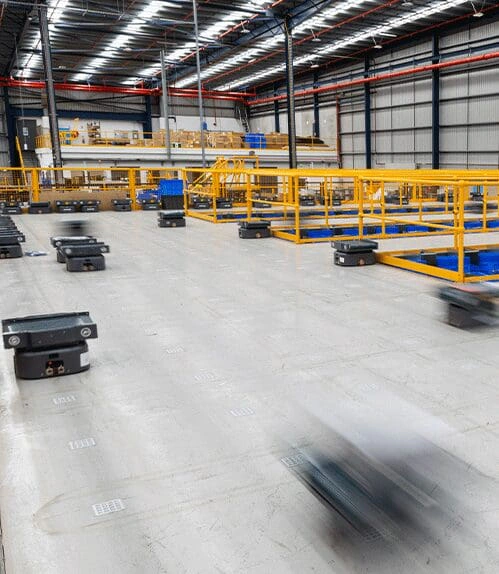
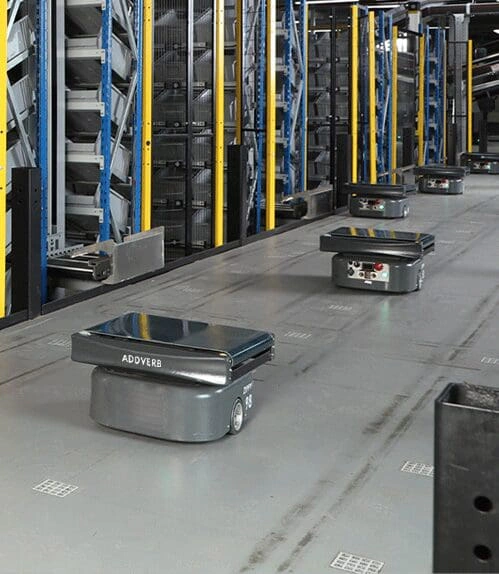
In environments where layouts change frequently, robots must adapt without constant reprogramming. Autonomous Mobile Robots (AMRs) equipped with LiDAR, real-time mapping, and obstacle detection are particularly effective in such scenarios.
Addverb’s AMRs are designed to operate in dynamic, mixed-traffic warehouses. With real-time path planning and intelligent sensing, they can safely navigate unpredictable spaces, reducing commissioning time and maintaining throughput even as layouts evolve.
This flexibility is critical in facilities where SKU mix, storage zones, or order profiles change seasonally.
3. Scale Automation in Phases
Warehouse automation delivers better results when implemented incrementally rather than as a single large-scale rollout. Phased deployment allows organizations to validate assumptions, stabilize operations, and generate early ROI.
Typical successful programs begin with high-impact use cases such as inbound pallet movement, goods-to-person consolidation, or fast-moving SKU storage. Industry data shows that phased automation can reduce deployment risk by up to 40% while accelerating ROI realization.
Addverb supports phased automation through modular solutions such as:
- Dynamo – AMRs for inbound and internal movement.
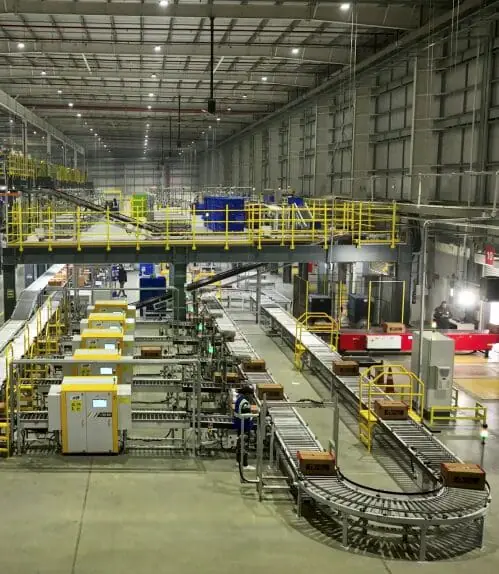
- Zippy – robotic sorters for order consolidation.
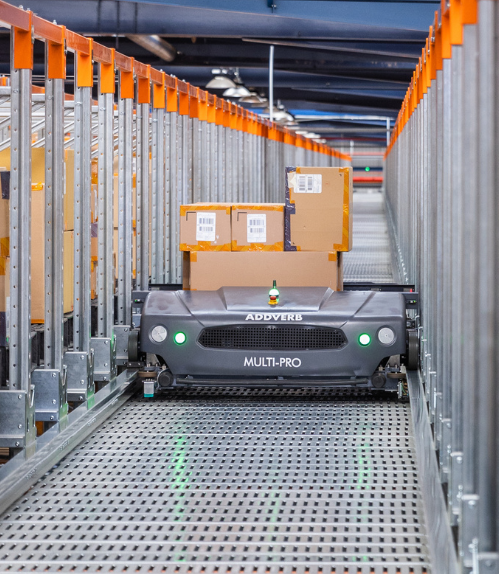
- ASRS solutions like Multi-Pro and Cruiser 360 for scalable storage automation.
4. Invest in Workforce Upskilling
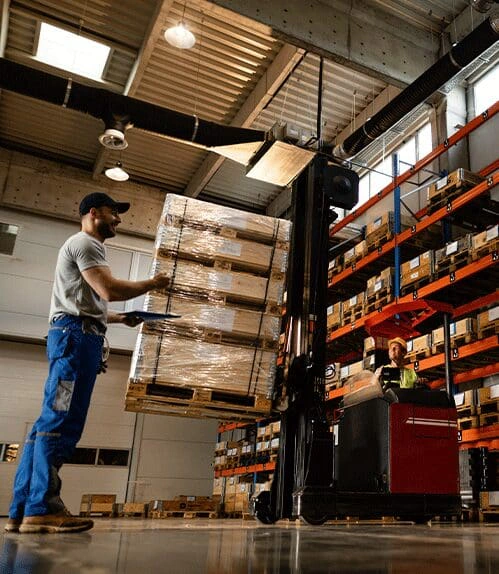
Automation works best when humans and robots complement each other. While robots handle repetitive, high-frequency tasks, people focus on supervision, exception handling, and decision-making.
Well-designed interfaces significantly shorten learning curves. Addverb’s Pick-to-Light systems (Rapido), intuitive AMR controls, and user-friendly ASRS interfaces are built for rapid operator adoption. Facilities that combine automation with structured training programs have reported 15–25% productivity improvement within the first year, along with higher workforce acceptance.
Upskilling transforms automation from a perceived threat into a productivity enabler.
Technical and Operational Problems in Warehouse Robotics
Technical issues may disrupt operational functionality even when they have been properly accounted for before implementation.
Battery Lifecycle and Charging Management
Movect enables continuous as well as coordinated charging and maintenance for AMRs. This optimises charge schedules and ensures an uninterrupted workforce along with robot productivity.
Network Stability
Robotics heavily relies on Wi-Fi and private 5G for operations. Low connectivity affects navigation by increasing idle time. Addverb’s AMRs has 5G enablement and it relies on LiDAR, ground markers, bus-bar power, and SLAM, which reduce dependency on uninterrupted Wi-Fi.
Data Synchronization Delays
The need for real-time interaction among storage software and robots practically requires integration into system software. Addverb has opted for an integrated approach, leading to highly reduced synchronization delays at the execution layer.
Real-World Examples of Warehouse Robot Implementation Solutions
Addverb has deployed its solutions globally and has increased warehouse productivity.
Example 1: Large E-Commerce Fulfillment Facility
Landmark Group upgraded its e-commerce fulfilment centre with Addverb’s robotic sorters (Zippy), Carton shuttles (Quadron), and the WES (Concinity). This combination helped them boost their throughput to 1,000 sorts per hour, transforming their fulfilment efficiency. Moreover, by automating sorting and storage, the facility reduced manual errors and created a smooth, high-velocity workflow across inbound and outbound operations.
Example 2: FMCG Manufacturing Plant
PepsiCo built its largest automated facility in India using Addverb’s crane-based ASRS (Skyron), mother-child shuttle (Multi-Pro) and a Pick-by-Light (Rapido) system, all coordinated by Addverb’s WCS (Mobinity).
This smart setup enabled efficient mixed-case (rainbow) pallet formation in a compact 36,000 sq ft footprint. With this solution, the site hit a throughput of 300 pallets/hour while fully automating what had been manual case-picking and palletising.
Best Practices For A Successful Warehouse Automation
In successful implementations, the employment of robotic warehousing is greatly dependent upon complying with established best practices.
Start with Specific Process Charts
One should perform a study of the currently flowing raw material, SKU-wise travel times, and the location of bottlenecks before learning about robots.
Choose Automated Warehouse Robots in Tune with Your Needs
AMRs like Dynamo are great for pallet staging, while Quadron shuttles are the ideal fit for fast, efficient tote movement.
Integrate Compatible Software
As far as robotics projects go, interoperability with upper software layers like WMS, WES, WCS, or FMS increases the productivity and collaboration of operations across multiple automated warehouse robots.
Build Robust Data Structures
When data is good, robotics has a real impact on warehouse efficiency, so data integrity is paramount in making automated robotics worthwhile. Use Addverb’s data governance framework, IoT-enabled sensors as well as real-time telemetry from robots to ensure clean, reliable datasets.
Begin with a Pilot Run and Test of the Lower Scale
This step helps to identify structural problems, network blind spots, and operational frictions before scaling it up.
Why Warehouse Automation Is Accelerating but Still Underpenetrated
Industry research from McKinsey highlights a clear gap between automation potential and real-world adoption. Today, only around 20 percent of warehouses in North America use any form of automation, despite growing operational pressures. At the same time, momentum is building.
McKinsey notes that nearly 70 percent of leading distribution and supply chain executives plan to invest close to USD 100 million in warehouse automation over the next five years, driven by labour shortages, rising service expectations, and the need for higher throughput reliability.
The firm projects warehouse automation adoption to grow at a compound annual growth rate of approximately 8 percent, yet even by the late 2020s, fewer than one in four warehouses are expected to be meaningfully automated, underscoring the importance of phased, modular automation strategies rather than large-scale, one-time transformations.
Conclusion
A report by the International Federation of Robotics shows a huge year-on-year growth in professional and service robots that are largely used in logistics/warehousing globally, across sectors. Automated Warehouse Robots are, thus, a cornerstone technology for warehousing in the next generation.
The true power of robots in warehouses lies in the strategic combination of smart software, flexible navigation technology, and a well-trained, skilled workforce. By addressing integration challenges and following a structured deployment strategy, an organization can successfully transition into an automated environment.
Standardized operations by Addverb’s robotic solutions, collaborating with WMS (Optimus), WCS (Mobinity), WES (Concinity), and FMS (Movect) deliver a scalable automation ecosystem that enhances warehousing efficiency. Early adopters of robotic applications will always result in future-ready warehouses.
FAQs
1. What warehouse tasks can robots perform in an automated framework?
Robotic automation in warehouse applications is most effective at multiple levels of supply chain operations, which include order picking, sorting, replenishment, put-away, and interzone material movements. Robots can also handle repetitive tasks, leaving humans to handle second-level decisions.
2. How do AMRs go about navigating intricate warehouse environments?
It takes a collection of sensors, LiDAR, SLAM-based mapping, and other smart technologies to help Automated Mobile Robots navigate the complexity and dynamism of warehouses. Addverb’s AMR (Dynamo) has been designed to navigate around dynamic, moving obstacles and crowded aisles. It follows real-time path planning to keep movement safe and unaffected by disruptions.
3. Can warehouse automation be used for older or manually designed facilities?
Definitely, but it still needs to be a thorough evaluation first. A lot of the older warehouses have their own specific issues caused by narrow aisles, varied racking heights, and layouts that are not very ergonomic for picking, movement and others. Choosing robots that are flexible enough and come with good navigation capabilities, redesigning certain process areas, and bringing in software that can work well with the existing system.
4. What might one use to measure ROI for warehouse robotics?
ROI values itself highly via labor savings, accuracy improvement, throughput improvement, less downtime, and faster order cycles. Companies should first analyze the current operational data, make arrangements for pilot deployment, and then compare the statistics of pre- vs post-automation.
5. Do robots replace humans in warehouses?
At Addverb, we believe in a deep collaboration between technology and people, humans are in charge of monitoring, handling exceptions, checking quality, and making strategic decisions whereas robots handle monotonous, repetitive tasks, enhancing the work of humans.