
Table of Contents
The logistics landscape is standing at a crossroads. For years, “automation” was synonymous with fixed programmable machines. But in 2026, the rise of Physical AI and Agentic Orchestration has redefined the “smart” warehouse. With the global market projected to reach $315.4 billion by 2035, businesses are no longer asking if they should automate, but how fast they can integrate intelligence.
This guide explores the defining technologies of 2026, where the warehouse of the future becomes the standard for a resilient supply chain.
The 2026 Warehouse: Key Performance Benchmarks
Facilities implementing integrated Physical AI and Digital Twin technologies are reporting:
- 300% Increase in order fulfillment speeds.
- 25–30% Reduction in total operational labor costs.
- 99.9% Accuracy in “no-touch” inbound and outbound flows.
3 Defining Pillars of Warehouse of the Future
1. Physical AI & Humanoid Collaboration
In 2026, the industry has moved beyond “caged” robotics. Physical AI allows robots to perceive, reason, and act in unstructured environments.
- Humanoid Integration: Unlike fixed machinery, humanoid robots are now designed for “brownfield” facilities—navigating stairs and narrow aisles originally built for humans.
- Safety: Advanced vision sensors allow for fluid Human-Robot Collaboration, where robots handle the “Three Ds” (Dull, Dirty, and Dangerous) while humans focus on high-level orchestration.
2. Digital Twins: The “Simulate-then-Procure” Model
The era of “CapEx Guesswork” is over. Future-ready warehouses are built virtually with a digital twin before a single brick is laid.
- Predictive Modeling: A Digital Twin is a high-fidelity virtual replica used to run “what-if” scenarios for seasonal surges or supply chain disruptions.
- ROI Validation: Using simulation, operators can verify the mathematical precision of an investment, eliminating up to 90% of process-related automation failures.
3. Agentic AI & Self-Correcting Orchestration
While traditional automation follows rigid rules, Agentic AI makes real-time decisions.
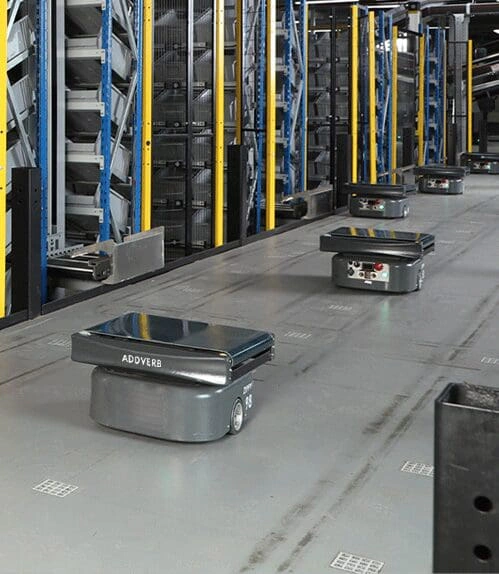
- Real-Time Rerouting: If an AMR (Autonomous Mobile Robot) detects a spill or obstruction, an Agentic WES (Warehouse Execution System) instantly recalculates the path for the entire fleet and adjusts picking priorities without human intervention.
Future-Proofing with Addverb’s Ecosystem
Addverb is leading this transformation by evolving from a hardware provider to a unified AI Control Center provider.
Modular Robotics for Dynamic Scaling
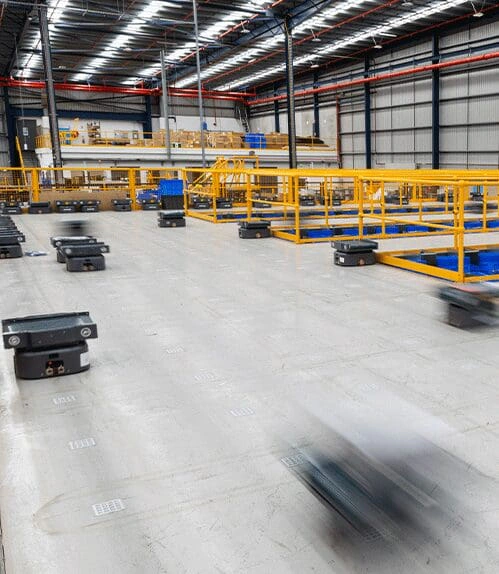
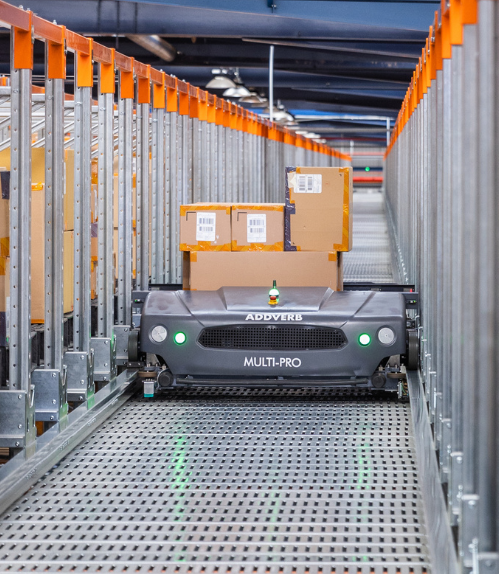
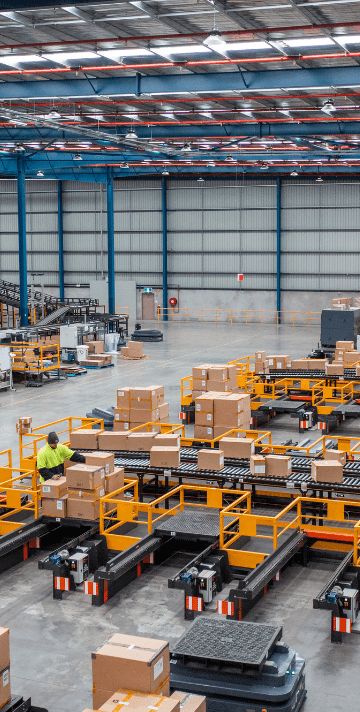
- Dynamo, Zippy & Veloce: Our autonomous mobile robots, robotic sorters and multi-carton picking robots now feature modular designs, allowing a single fleet to adapt from sorting to picking in minutes.
- Cruiser Series: For high-density storage, the Cruiser 360 pallet shuttle integrates with Optimus WMS to maximize vertical space utilization.
Sustainability as a Core Metric
By 2026, sustainability is a top-three KPI for 80% of logistics leaders. Addverb’s smart HVAC integration and energy-efficient shuttle systems help facilities reduce carbon footprints and energy consumption by up to 18%.
“True intelligence in the warehouse goes beyond robotics—it’s about creating a proactive engine that predicts demand surges rather than reacting to them.” Addverb Innovation Lab
Conclusion: The warehouse of the future isn’t a distant dream—it is a competitive requirement being built today. By shifting from reactive automation to proactive, AI-driven orchestration, companies unlock levels of efficiency and scalability that were previously impossible. As the industry moves through 2026, the winners will be those who bridge the gap between physical hardware and digital intelligence to create a truly resilient, self-optimizing supply chain.
Ready to future-proof your operations? Contact Addverb’s experts today to see how our Optimus WMS and AI-driven robotics can transform your warehouse into a high-performance fulfillment engine.
Founded in 2016, Addverb offers complete robotics solutions for warehouse and industrial automation, with a strong global presence through its subsidiaries worldwide. The company provides a range of in-house automation products, including Autonomous Mobile Robots, ASRS, and sorting technologies. It serves over 350+ clients, including well-known companies such as Coca-Cola, Amazon, and DHL.