


ON THIS PAGE
The commissioning report on your automated warehouse systems reads well. Pallet cranes run close to 95% of capacity and the goods-to-person stations clear hundreds of order lines an hour. Every dial in the control room is green. Then you walk to outbound and find case totes parked beside an empty pallet square, waiting for the high-bay pallet that belongs to the same order.
Picking is working. Synchronisation is what fails, and it fails harder the closer each machine runs to full capacity. An outbound sequencing buffer is automated storage that holds picked pallets and totes between the pick zones and the dock, then releases them in the order the trailer has to be loaded.
Let’s see why utilisation is the wrong number to justify the capex, what queueing maths says, and how to budget for the outbound sequencing buffer.
Key takeaways
- Utilisation measures each machine alone. Dispatch depends on the moment two machines’ output has to meet.
- In Kingman’s queueing approximation, the utilisation term is 4 at 80%, 9 at 90% and 19 at 95%.
- Floor staging turns that waiting into lost floor space and truck time. Material handling 24/7 trade report puts floor-staged truck turnover at often two hours or more, against as little as 10 minutes with an ASRS buffer.
- Put the outbound sequencing buffer and its release logic in the same capex line as the pickers.
- Judge the investment on orders dispatched per dock-door hour.
Why is utilisation the number that sells automation?
Because it is the easiest number to defend in a capital committee. A pallet crane, shuttle or goods-to-person station costs money every hour whether it moves or not, so idle time looks like waste and utilisation looks like return. Dashboards show it, and the warehouse control system (WCS) reports it with no extra instrumentation. The trouble is that each figure describes one machine. Your customer does not receive a machine’s output. They receive an order, and an order that needs one full pallet and four split cases leaves the building only when both halves reach the same door.
Why does a mixed order stall at 95% utilisation
Call it Order #402. In a manual building, synchronisation is a radio call. The pallet pick is running late, so the supervisor tells the mezzanine to hold the case picks, and both halves reach the dock together. Low tech, and it works.
Automate both zones, set each to maximum utilisation, and that coordination disappears. The cases finish on the goods-to-person cycle and the pallet comes down on the crane’s cycle, with neither zone aware of the other. The totes sit in staging for most of an hour. When the trailer reaches the door, three people walk two bays to marry up one order.
Queueing maths explains why this gets worse near the top of the dial. Kingman’s 1961 approximation for waiting time in a single-server queue multiplies a variability term, the service time and a utilisation term, ρ/(1-ρ). That term is 4 at 80% utilisation, 9 at 90% and 19 at 95%. Moving a crane from 90% to 95% roughly doubles the expected queue for five points of extra output. It is a single-server approximation, so read it as a shape rather than a model of your site: waiting time climbs steeply as utilisation approaches 100%.
The bottleneck moves to the dock
Faster picking without synchronisation moves the constraint a few dozen metres downstream, where the dashboard does not look. A Material Handling 24/7 report described it plainly: picking processes run to within minutes of their standards, then product sits at the dock, sometimes for hours. System Logistics’ chief executive, quoted in the same piece, said truck turnover with floor sequencing is often two hours or more. The article adds that ASRS buffers releasing pallets or cases in order have cut turnover to as little as 10 minutes, with staging shrunk to as few as six pallet locations.
The direction is what matters. For a finance reader, the cost of a missing buffer lands in floor space, dock labour, truck detention and missed cut-offs, and none of it appears in the utilisation figure that justified the project.
Also Read: WES vs WMS vs WCS: understanding the key differences
Three ways to hold outbound freight, compared
| Option | Floor space used | Releases in load sequence? | Relative capex | Fits when |
| Floor staging lanes | Highest, and grows with order mix | Only by manual search | Lowest | Single-mode orders, few departures, long loading windows |
| Conveyor accumulation loop | Moderate; loop length sets capacity | Yes, within the loop’s capacity | Moderate | Cases and totes with short dwell times |
| Tote or pallet shuttle buffer | Lowest per position, because it uses height | Yes, in whatever order the software requests | Highest | Mixed pallet and case orders, fixed trailer departures |
The cheapest row to buy is the most expensive to run once order mix gets complicated.
How do you decouple pick zones without losing the order?
Separate them on purpose, then rejoin them at one controlled point. Three design rules do it.
Let each zone run at its own batch size
Pallet retrieval and case picking have different cycles and different ideal batch sizes. Forcing them into lockstep throttles the faster zone to the speed of the slower one. Let each run at its own density and give the timing difference somewhere to wait.
Hold work-in-progress in height
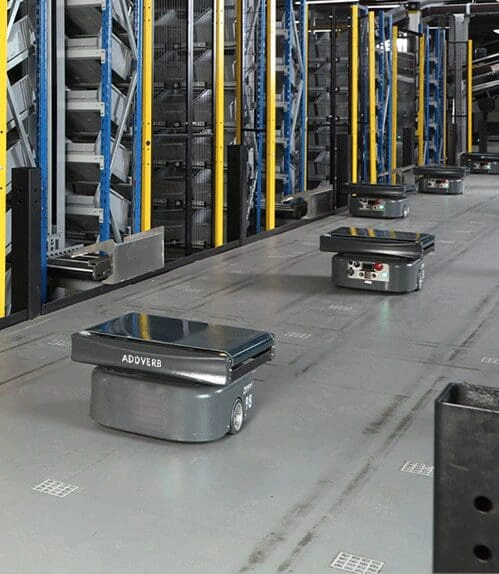
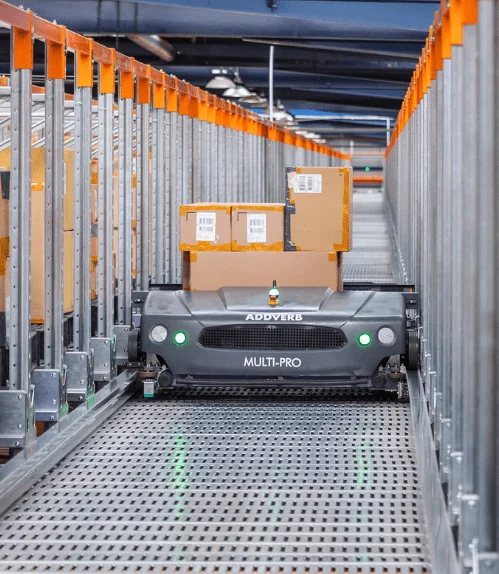
Staging floor is floor you are not storing or picking from. Multi-deep tote shuttles, pallet shuttles or conveyor loops hold the waiting half of an order on racking. Addverb’s Quadron carton shuttle, for example, stores cartons and totes up to 50 kg double-deep and can retrieve them in a programmed sequence.
Release in load order, triggered by the dock
Connect the warehouse execution system (WES) to your dock or yard management system. When a trailer is confirmed on the door, the buffer releases freight in reverse drop order, last stop first, so it goes straight into the trailer. At the Hindustan Unilever distribution centre in Chennai, picked crates are sequenced and loaded by destination, which supports deliveries to 28,000 kirana stores within 24 hours alongside a pick rate of 9,500 picks per hour.
When is high utilisation still the right target?
When there is nothing to marry up. If your orders are single-mode (all full pallets, or all cases from one zone), no half-order waits for another, and running each machine hard is a sensible goal. If the dock has slack, with a few departures a day and long loading windows, floor staging is cheaper than any buffer.
The buffer has real costs. Rack positions holding work-in-progress are positions not holding sellable stock. The release logic is more software to specify and test. And an undersized buffer becomes the new bottleneck, which is worse than no buffer because it looks like a solution. Size it from your own order profile and departure schedule; a vendor’s rule of thumb knows neither.
Which KPI should the investment case use?
Orders dispatched per dock-door hour. Your customer feels it, and it cannot look good while the staging floor is full. Pair it with two supporting measures: staging dwell time for mixed orders, and truck turnaround from door-on to door-off. Keep equipment utilisation as a diagnostic for maintenance and capacity planning, and take it out of the headline.
Author : Vinayak Shete