



ON THIS PAGE
Someone has asked you to recommend conveyor, AGV or AMR for a facility, and you already know the honest answer is “it depends.” The problem is that “it depends” does not survive a steering committee.
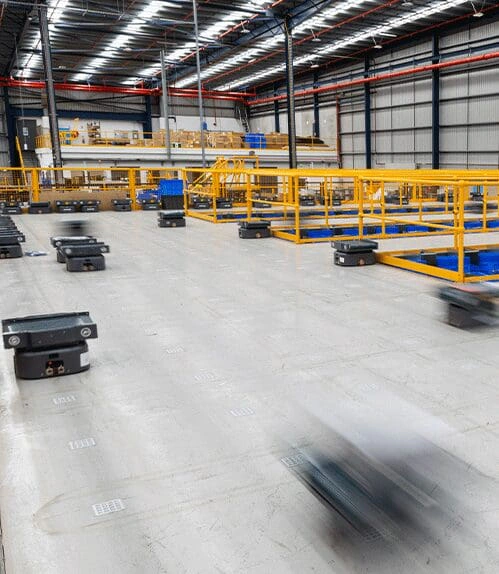
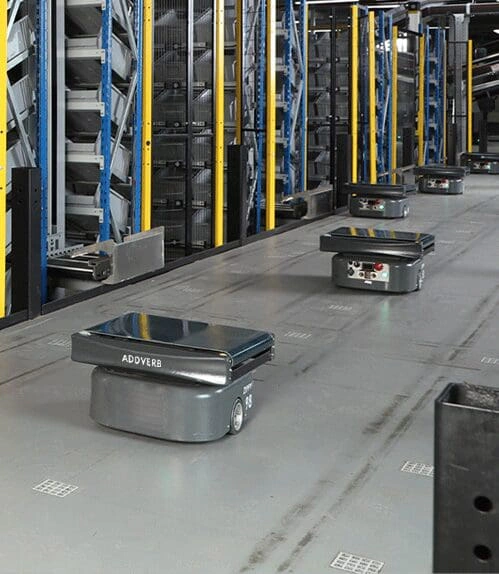
AGV or AMR, both are mobile robots that move material without a driver, and the difference is navigation: an automated guided vehicle (AGV) follows a fixed, pre-mapped route, while an autonomous mobile robot (AMR) builds its own map and plans around obstacles in real time. Conveyors do not move at all. The product does.
What follows is the diagnostic engineers actually use: five questions that decide the answer, and the trade-off most specifications get wrong.
Key takeaways
- The technology decision is a zone allocation decision. Most high-throughput facilities run all three.
- Conveyor wins on single-point throughput. AGV wins on heavy, repeatable routes. AMR wins on layout volatility and shared floor space.
- Install time separates them more than capability does: 8 to 24 months for a conveyor build, 3 to 9 months for an AGV fleet, 2 to 8 weeks for an AMR deployment.
- The costliest mistake is underestimating how much your layout will change in five years.
Why “which technology” is the wrong question
The versus framing is useful for understanding technology boundaries and misleading as a procurement method. By Q2 2025, more than 220,000 combined AGV or AMR units were operational in logistics facilities globally, with AMRs at 65% of new installations. Those AMRs did not replace the conveyors in those buildings. They took the zones the conveyors were bad at.
Hybrid fleets rose 46% across Tier-2 logistics operators between 2023 and 2025. That is not indecision. It is what flow analysis produces when it is run zone by zone.
What does each technology actually do differently?
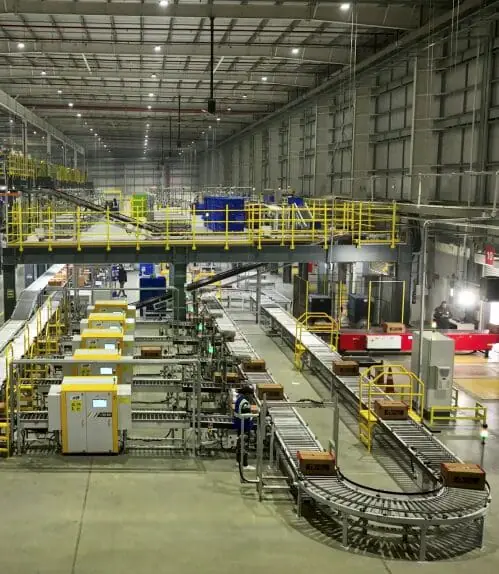
A conveyor moves product along a fixed path using belts, rollers, chains or slats under variable-frequency motor control. The operating principle that matters: the line never stops. At 2 m/s there is no cycle time per unit, no duty cycle limit and no charging window. That is the basis of its throughput advantage over anything mobile.
An AGV follows a route set by magnetic tape, laser triangulation off reflective targets, or QR codes read from the floor. A warehouse control system dispatches tasks and prevents collisions through zone reservations. Safety laser scanners are mandatory under ISO 3691-4 and ANSI/RIA R15.08.
An AMR builds its own map using SLAM (simultaneous localization and mapping). Its LiDAR scanner sweeps 360 degrees measuring distance to walls and obstacles, and the algorithm fuses those readings with wheel odometry to keep the map live. When a pallet appears in the aisle, the autonomous mobile robot routes around it and continues.
The consequence is short. An AGV that meets a parked forklift stops and raises an alarm. It does not reroute. That one difference decides more specifications than payload or speed ever will.
Conveyor or AGV or AMR: by Parameters
| Parameter | Conveyor | AGV | AMR |
| Navigation | Fixed belt, roller or chain | Magnetic tape, laser, QR code | SLAM, dynamic routing |
| Throughput | Very high, continuous flow | Medium, loop cycles | Medium, scales with fleet |
| Install time | 8 to 24 months, civil works | 3 to 9 months | 2 to 8 weeks |
| Layout change | High cost, physical rebuild | Medium, re-routing fieldwork | Low, software update |
| Obstacle handling | Not applicable, fixed path | Stops and waits | Routes around |
| Annual OPEX | Lower after payback | 10 to 15% of capital cost | 20% of capital cost |
| ROI timeline | 3 to 7 years | 6 to 18 months | 12 to 24 months |
Read the ROI row with suspicion. A conveyor in a 24/7 facility with a 20-year design life can beat an AMR fleet on lifetime economics once battery replacement and software licensing are counted. Payback and full-cycle cost are different questions, and only one appears on most vendor slides.
See how conveyors, AGVs, and AMRs work in sync for a 3PL warehouse operation.
Where does each one fail?
Conveyor fails on flexibility and on single points. Once installed the system is architecturally fixed, and changing a flow path means relocating belt runs, drives, merges and diverts at real cost and real downtime. A long run is also only as reliable as its weakest component: one failed motor on a critical merge halts the line until maintenance arrives. Redundant paths fix that and add cost.
AGV fails on dynamic traffic and on change. Route changes are fieldwork plus re-commissioning, not a software release, so an AGV installation shares some of a conveyor’s inflexibility. By mid-2024, 47% of AGV models introduced in that period included 5G and remote diagnostics, which improves monitoring and changes nothing about the path-following architecture underneath.
AMR fails in three places vendors rarely lead with. Single-point throughput is the first: add robots to a workstation and the station’s own ability to queue and process arrivals becomes the ceiling, which no fleet size fixes. Cold chain is the second, because lithium-ion cells lose capacity below 0°C and can fail to charge below -20°C, while a sealed belt runs at -25°C to -30°C. Consistency is the third: a facility that relocates racking seasonally needs re-mapping, an operating cost nobody budgets at PO stage.
Also read: automated distribution centre case study
How do serious facilities allocate zones?
The typical high-throughput DC gives conveyor the high-speed sortation spine, from inbound unloading to sorting lanes and packing to dock allocation. AGVs take heavy pallet movement between receiving and storage, and between pick zones and outbound staging. AMRs take the picking zones where routes change with order profile and where people and robots share floor space.
Two deployments show why allocation, not technology, is the decision. At Swissport Basel Airport the requirement was roughly 200 pallets per hour, all picked up simultaneously, which no AGV fleet could meet economically at that moment. Conveyor was not preferred there. It was the only architecture that met the spec.
At the other end, a pharmaceutical client deployed a 12-unit AMR fleet into an active manufacturing building over one long weekend, with no civil works and no floor modification. That disruption profile is why AMRs dominate brownfield retrofits, and why pharmaceutical warehouse operations reached 15% of global AMR deployments by 2024.
Five questions before you specify anything
- What is your throughput at peak, average and minimum?
If peak throughput through a single point exceeds what a fleet can deliver economically, conveyor is in the mix. Bursty volume favors mobile. - How stable is your layout over five years?
Stable flows and known product types point to conveyor and AGV. New fulfillment models and frequent SKU change point to AMR. - How much human traffic shares the zone?
Dedicated zones with no human access suit conveyor and AGV. Shared workspaces suit AMR. - What is your payload requirement?
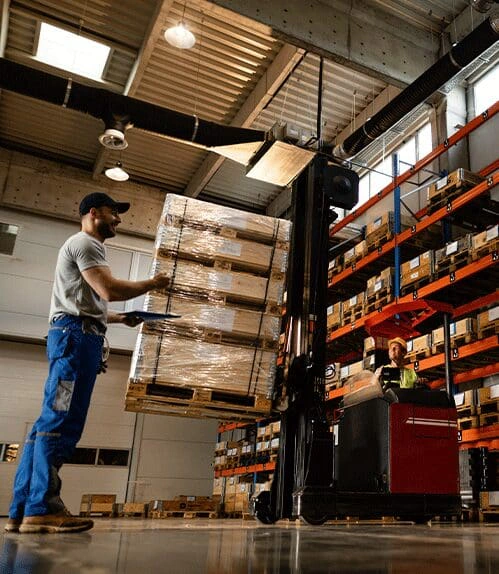
Fixed-route heavy work, commonly 500 kg to 2,000 kg in automotive plants, is autonomous forklift and AGV territory. AMR payload classes now overlap that range, so check the model, not the category. - What is your disruption tolerance?
Greenfield with a long lead time leaves all three open. Brownfield with live operations starts with AMR.
What does a layout change actually cost you?
Almost every specification gets the throughput math right. The row that gets mishandled is layout change cost, because operations teams underestimate how much a facility moves in five years under SKU growth, new fulfillment models and ordinary process improvement.
So price it. Count the flow-path changes you honestly expect over five years, multiply by the cost of one change in each technology, and add it to capital. The technology that costs most to change carries the highest hidden ten-year cost, and that one line has reversed more specifications than any throughput comparison.
Answer the five questions for each zone rather than for the building, and the vendor shortlist writes itself. Which of the three is your specification weighted toward, and have you stress-tested the assumption behind that weight? If you want it tested against your real site conditions, talk to an Addverb automation engineer about your facility and we will help your find the right combination between conveyors, agv or amr.
Frequently asked questions
- What is the difference between an AGV or AMR?
An AGV follows a fixed, pre-mapped route using magnetic tape, laser reflectors or floor-mounted QR codes, and stops when something blocks it. An AMR builds its own map with SLAM and LiDAR and plans a new route around obstacles in real time.
- Can AGVs and AMRs work in the same facility?
Yes. Hybrid AGV and AMR fleet operations rose 46% across Tier-2 logistics operators between 2023 and 2025, coordinated through a common warehouse control or execution layer.
- Is a conveyor still worth installing?
For high, consistent throughput on flow paths that will not change for the system’s life, yes. Conveyor has the highest single-point throughput of any option, because the line runs continuously with no charging window.
- Which technology works in cold storage?
Conveyor, most reliably. A sealed motor-driven belt operates at -25°C to -30°C, while lithium-ion cells in mobile robots lose capacity below 0°C and can fail to charge below -20°C.
Author : Sudeep Ghosh