



ON THIS PAGE
A few weeks ago a consultant told me that the ASRS storage system on his project should focus on the fast movers. If you have been handed the same recommendation for your own building, it probably sounds sensible: find the small group of SKUs (stock keeping units) that generates most of the volume and automate those.
You can automate the full range, of course. But when the ROI does not justify automating the full volume and you automate only part of the range, starting with the fast movers is usually the wrong call. An ASRS storage system (automated storage and retrieval system) is racking plus machines, such as shuttles or cranes, that hold goods densely and bring them to an operator on request. Which SKUs you put into it decides what it pays back, and in most order profiles the better first candidates are the slow movers. They take most of the floor and most of the walking, and they need the least machine capacity.
Here are the reasons, a site where it was done, and the cases where automating everything still wins.
In short
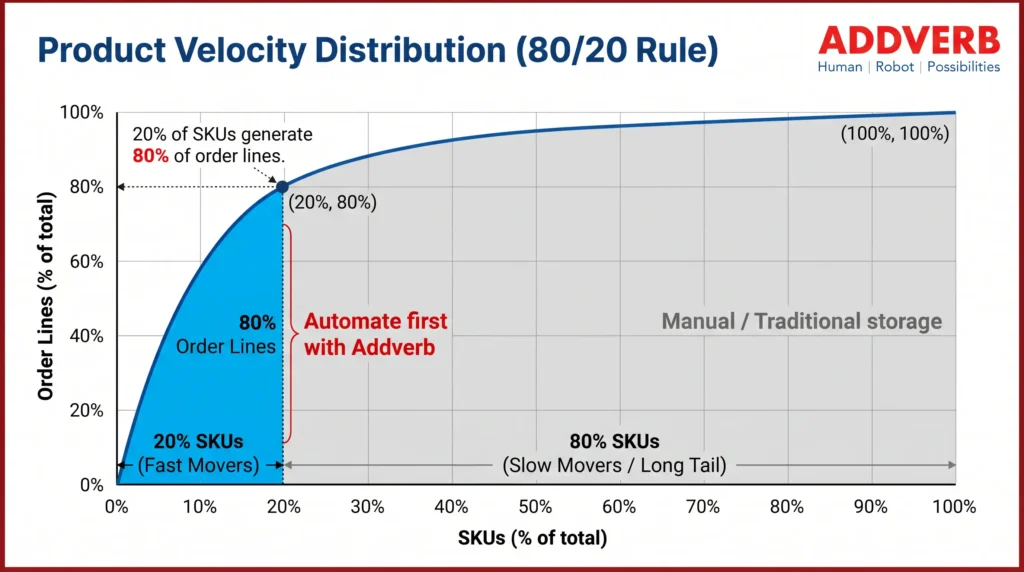
- Slow movers are often about 80% of SKUs but only about 20% of order lines. Picked manually, each one still needs a pick face.
- Pickers in slow-mover aisles walk past many untouched locations per line. Fast-mover zones are already efficient by hand.
- Shuttles, lifts and pick stations are sized to throughput, so automating fast movers buys the most expensive capacity.
- In high labour-cost countries, full-range automation often pays. On a partial budget, start with the tail.
Why does “automate the fast movers first” sound right?
It follows the volume. If 20% of your SKUs produce 80% of your order lines, automating them appears to cover most of the work for a small slice of the range. But order-line share tells you where picks happen. Cost sits in three other places: floor space for pick faces, labour time per line, and the machine capacity you buy. Fast and slow movers sit at opposite ends of all three.
Slow movers take most of the floor
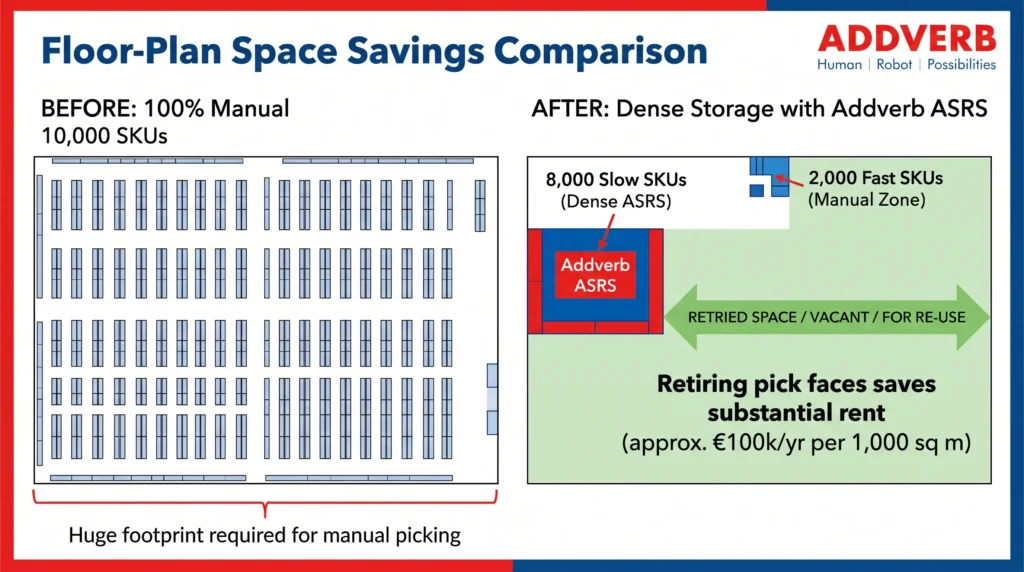
Take an each-picking operation with 10,000 SKUs. Manual picking needs every one at a reachable pick face, at ground level or on expensive mezzanines. If 8,000 are slow movers, 80% of your pick faces and their aisles serve about 20% of your lines.
Move those 8,000 SKUs into dense goods-to-person storage, such as a shuttle system or a
cube-storage system, and their stock goes upward instead of outward. The manual area shrinks to the 2,000 fast movers. In Europe that floor has a visible price. Catella’s European Logistics Market Overview put the average prime logistics rent across 50 European markets at €8.30 per square metre per month in Q2 2026, so each 1,000 sq m of pick face you retire is worth about €100,000 a year at that rate.
The caveat: the gain depends on clear height and on whether you can release or reuse the space.
Where do your pickers actually walk?
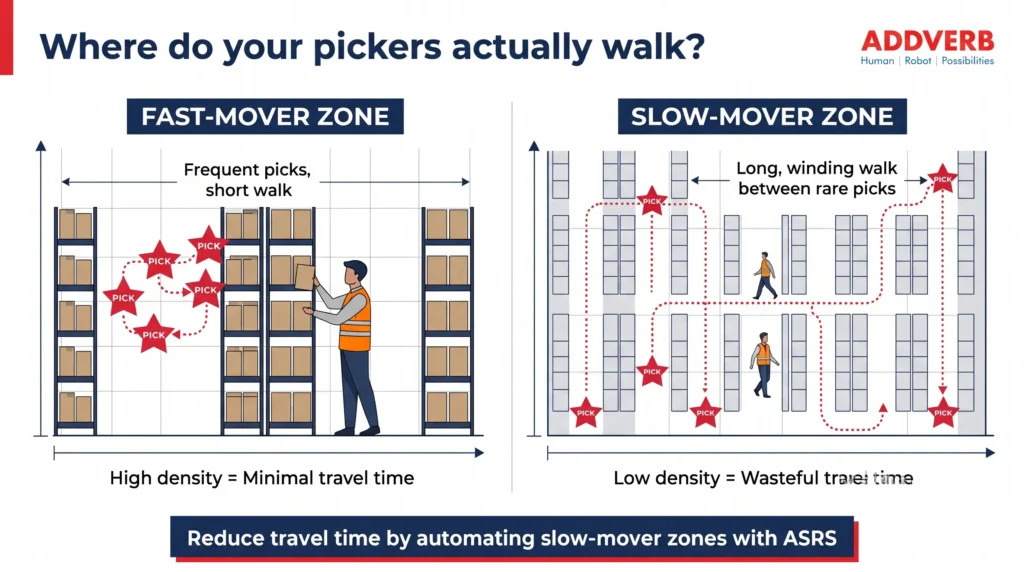
In manual picker-to-parts operations, travel accounts for roughly half of order-picking time, and none of it adds anything to the order. Where that travel happens matters more than the average.
In a fast-mover zone, most locations are touched every wave, so the walk per line is short and manual picking is efficient. In a slow-mover zone, a picker passes location after location nobody ordered today to reach one that somebody did. The walk per line is longest exactly where volume is lowest.
Goods-to-person picking removes that walk, because the tote travels to the operator, and the labour it frees is your least productive. At the 2025 Eurostat EU average labour cost of €34.90 an hour (whole economy), an hour spent walking a slow-mover aisle costs the same as an hour picking, and produces a fraction of the lines.
Also Read: Automated storage and retrieval system: types and functions
Where does the capital actually go?
Most of it goes to throughput. Racking and storage positions are the cheaper part of an AS/RS storage System. Shuttles, lifts, conveyors and pick stations are the expensive part, and how many you need is set by the retrievals per hour the system must deliver.
Put the fast movers into the ASRS and about 80% of the lines come with them, so the machines are sized for most of your peak. Put the slow movers in and you need many storage positions but retrieval capacity for only about a fifth of the lines.
The trade-off: slow movers carry little stock per SKU across many locations. That suits a tote or carton shuttle far better than a pallet system, and bulky or awkward slow movers may not fit a tote at all.
Fast movers vs slow movers at a glance
| Factor | Fast movers | Slow movers |
| Typical share of SKUs | About 20% | About 80% |
| Typical share of order lines | About 80% | About 20% |
| Manual pick efficiency | High: dense picks, short walks | Low: long walks between picks |
| Floor needed for manual pick faces | Small | Large |
| ASRS equipment if automated | High retrieval capacity: more shuttles, lifts, stations | Many storage positions, low retrieval capacity |
| Low-cost manual assistance available | Pick-to-light, flow rack, conveyor | Little; the walking is the cost |
How HUL split its range in Chennai
Some years ago, when Hindustan Unilever (HUL) began delivering eaches directly to small neighbourhood retailers in India, its Chennai distribution centre had to handle 4,000 to 5,500 orders a day and up to 1.1 million eaches on peak days. Addverb and HUL spent six months analysing order data and split the range into A, B and C classes, each with its own storage method.
The C-class SKUs, the slow movers, went into a carton shuttle ASRS feeding goods-to-person stations, each of which works eight customer orders at once. The A and B classes stayed with people, assisted by conveyor and pick-to-light, at 6,500 and 3,500 eaches per person per hour. The HUL case study reports 9,500 picks per hour and orders for 28,000 stores fulfilled within 24 hours.
Note that HUL’s fast movers were not left on paper; they got cheaper assistance instead of shuttles. In a lower labour-cost market, a partial design was the obvious choice. In high labour-cost countries, the economics differ.
When should you automate the whole range?
Automate the whole range when even your efficient fast-mover pickers cost more over the system’s life than the machines that would replace them. In high labour-cost countries, including most of Western Europe, and with hiring hard to sustain, that bar is often cleared, and full-range goods-to-person designs are common.
The consultant’s instinct also holds in two narrower cases: a short range with no real tail, where there is nothing slow to automate, and a fast-mover throughput ceiling you must raise this year.
Also Read: Types of automated warehouse picking systems: high-volume order fulfilment
A decision rule for a partial budget
Pull 12 months of order lines and check three numbers:
- Tail size: what share of SKUs produces the bottom 20% of lines? Well above half means a long tail worth automating.
- Tail footprint: how many square metres of pick face do those SKUs occupy, priced at your rent?
- Productivity gap: lines per labour hour in the slow zone against the fast zone, from your WMS (warehouse management system). A large gap is the walking.
If all three point the same way, automate the tail first and give the fast movers low-cost assistance. Plan for the merge: orders with lines in both zones need a warehouse execution system (WES) that releases both streams in step. Size the ASRS so the fast movers can follow when the labour maths changes.
Frequently asked questions
- What is an ASRS storage system?
- An ASRS storage system is racking plus shuttles, cranes or robots that store goods densely and deliver them to an operator or outbound point on request.
- What are slow-moving SKUs?
- Slow movers are products ordered rarely compared with the rest of the range. In many each-picking operations, about 80% of SKUs generate roughly 20% of order lines.
- Why automate slow movers before fast movers?
- Slow movers take most of the pick-face floor and cause the longest walks per line, yet need little retrieval capacity. Automating them saves space and labour for less equipment.
- Does goods-to-person picking work for fast movers too?
- Yes. Each fast-mover line becomes a machine retrieval, so throughput equipment grows with volume. Where the budget allows, full-range goods-to-person picking is common in high-wage markets.
When is automating slow movers a poor fit? Automating slow movers is a poor fit when your range is short with no real tail, when you cannot release or reuse the floor space, or when items are too bulky for a tote. In those cases the savings shrink, and a throughput fix or low-cost manual assistance for the fast movers may pay back sooner.
Which ASRS type suits slow movers? A tote or carton shuttle system suits slow movers best, because they carry little stock per SKU across many locations. At its Chennai site, HUL put its C-class SKUs into a carton shuttle ASRS feeding goods-to-person stations. Pallet systems fit this profile less well.
How do I know which SKUs to automate first? Pull 12 months of order lines and compare tail size, tail footprint and the productivity gap between your slow and fast zones. If all three point the same way, automate the tail first. An Addverb engineer can model your SKU profile from the same data.
Before you sign off on ASRS storage system
If someone has recommended automating your fast movers first, ask what it does to your floor, your walking hours and your equipment bill. On a partial budget, the faster payback is usually in the long tail nobody looks at. Send us 12 months of order lines and an Addverb engineer will model your SKU profile, showing which velocity classes to automate first.
LinkedIn Post: https://lnkd.in/p/ggx99Dfs
Author : Pieter Feenstra