



ON THIS PAGE
Your capital request is approved, the layout is signed off, and the go-live date is already promised to customers. Most buyers evaluate warehouse automation companies on throughput specs, reference visits and price, then watch the date move anyway.
The slip is rarely a technology failure. It is a scorecard failure. A KPI gap is the distance between what your project manager is measured on and what the integrator’s project manager is measured on for the same project. It is written into the contract months before the first robot arrives.
What follows: where the six gaps sit, the three that move dates, and five questions that expose them before you sign.
Key takeaways
- Only 8.5% of large projects hit their original time and budget, and 0.5% also deliver the promised benefits (Oxford database, 16,000+ projects).
- Client and integrator project managers run six paired KPIs. Each pair is reasonable alone. Three of them fight.
- Change control, milestone billing and undefined quality scope move dates more than technical risk.
- Judge an integrator on governance and manufacturing control, not on the demo.
Why do projects with working technology still miss go-live?
Because most of the stated causes are organizational, not mechanical. PwC’s 2025 Digital Trends in Operations survey of 600 operations and supply chain executives found 69% saying technology investments had not fully delivered what was expected. The most cited reason was integration complexity at 30%, then the technology itself at 28% and people capabilities at 27%, with data issues, vendor capabilities and program leadership close behind. One of those seven is about the machine.
The pattern is not specific to logistics. Bent Flyvbjerg’s Oxford database of more than 16,000 large projects finds 8.5% delivered on time and on budget, and 0.5% on time, on budget and with the promised benefits. A warehouse build sits in that family: multi-phase, often multi-year, and dependent on two organizations agreeing what “done” means.
They rarely agree, because they are paid to define it differently.
The two scorecards, side by side
| Area | Your project manager is measured on | The integrator’s project manager is measured on | Where it breaks |
| Scope | The agreed function, plus what the business asks for later | The contracted function, and refusal of anything outside it | One side calls a late request clarification, the other calls it variation |
| Money | Staying inside approved capex | Margin, and billing to the payment schedule | Approval delays on your side are cash events on theirs |
| Schedule | Business milestones, including after your own delays | Contract dates with the resources that were priced in | Recovery costs money nobody budgeted |
| Quality and safety | Internal protocol and long-term reliability | The contracted standard, and zero incidents | “Internal protocol” is unbounded until somebody names it |
| Satisfaction | Internal leadership, end users, regulators | Repeat business and a reference | Different audiences, different definitions of a good day |
| Risk | Exposure to delay, overrun and compliance findings | Labor, supply chain, subcontractors, statutory approvals | Two registers, no shared owner |
Neither column is wrong. Both are what a competent employer would ask of that role. The gap is structural, which is why it responds to structure and not to goodwill.
Which gaps actually move the date?
Change control priced at closeout instead of at request
Your side is often measured on absorbing change without cost or schedule impact, which rewards deferring the commercial conversation. PMI’s 2018 Pulse of the Profession found 52% of projects had experienced scope creep, up from 43% five years earlier. On an automation build it compounds, because a change to slotting logic in month four rewrites the warehouse execution system configuration, the acceptance test and operator training. Price and date every change request within five working days of it being raised. The argument then happens while it is still cheap.
Payment milestones that are not the same events as delivery milestones
The integrator’s project manager is measured on billing to schedule. When a milestone certificate sits unsigned for three weeks, that is a cash event, then a resourcing decision, then a slip you hear about a month later. Name the individual who signs each certificate, the working days they get, and the delegate who signs in their absence. It is the dullest clause in the contract and one of the few that protects the date.
Quality and safety written as a standard, not as a scope
“As per internal protocol” is infinite scope with no price attached. An integrator prices what the contract names, so name it. ANSI/RIA R15.08 for industrial mobile robots in the US, ISO 3691-4 for driverless industrial trucks, and the acceptance tests, sample sizes and sign-off authority attached to each. Settle it at contract, not at commissioning, when the only lever left is the date.
Also Read: Warehouse Automation Case Studiesand Proven Ways to Handle Picking in High-Volume US Warehouses
What should you ask warehouse automation companies before you sign?
Who manufactures the hardware?
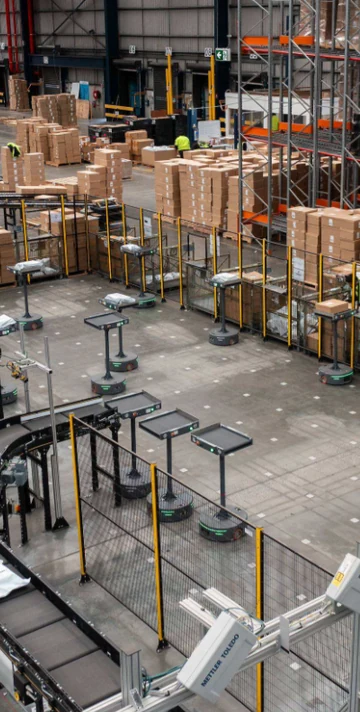
A supplier that owns its factory can compress a schedule. One that assembles other people’s equipment can only escalate. DHL Supply Chain needed a robotic sortation system near Columbus, Ohio against an eight-month go-live. Addverb went from design to delivery in under nine months on its own manufacturing and integration, and the live system runs 1,000 sorts an hour at 99.99% order fulfillment accuracy.
How many companies sit between your control software and the robot?
Every seam is a change request with two owners. Addverb writes its own warehouse management, control and fleet management software (WMS, WCS and FMS) alongside the execution layer, and runs fixed and flexible equipment on it. At S. Abraham and Sons, a US wholesale distribution center, the carton shuttle, multi-level shuttles and conveyors sit under one execution system across 14,400 tote positions, taking 480 totes an hour inbound and delivering 200 an hour to the pick station.
Can you show me a site you built in phases?
Phasing is where alignment shows. At PepsiCo’s largest Indian plant, crane-based automated storage and retrieval systems (ASRS), mother-child shuttles and pick-to-light were fitted into 36,000 sq ft, with 6,200 high-bay pallet positions reaching 30 m and throughput of 300 pallets an hour.
Who owns the joint risk register, and when was it last reviewed?
Ask to see a redacted one from a live project. Separate registers mean you meet the shared risks first at escalation.
What does your team do the week after go-live?
Ramp is where the two scorecards diverge most: one side is measured on business value, the other on contract closure. Put the ramp period, staffing and exit criteria in the contract.
Two honest limits. A single-supplier stack narrows your options later, and if you already run a mixed estate that works, an agnostic control layer over your existing hardware is cheaper than replacing it. And this alignment work costs two to four weeks before kickoff, exactly the window a business under pressure to start will skip.
Draw the map before the project starts
The project does not fail in the escalation meeting. It fails at signature, when two reasonable scorecards are locked in without anyone reading them side by side. The remedy is unglamorous: one charter with a single definition of success, one dashboard both project managers see, one risk register with named owners, and a change process with a clock.
Do one thing this week. Put your six KPIs and your integrator’s six in two columns, and mark every row where a win for one is a loss for the other. Those are the rows to negotiate before signature.
Then look at how comparable work landed. The Addverb case studies give scope, phasing and measured results site by site.
FAQ
What is a KPI gap in a warehouse automation project? It is the distance between what the client’s project manager is measured on and what the integrator’s project manager is measured on for the same project. Both scorecards are reasonable, and the gap between them produces the schedule disputes.
What is the most common cause of automation project delay? Organizational causes outrank technical ones. In PwC’s 2025 survey of 600 operations and supply chain executives, integration complexity was the most cited reason technology investments underdelivered, at 30%, ahead of the technology itself at 28%.
How long does a large warehouse automation project take? A single-function system can run eight to twelve months from design to go-live, as with the DHL sortation build near Columbus, Ohio. Multi-phase sites combining storage, picking and conveyance run longer and hand over in stages.
Should quality and safety standards be named in the contract? Yes. Naming a standard such as ANSI/RIA R15.08 for industrial mobile robots, with acceptance tests and sign-off authority, converts an unbounded obligation into a priced scope.
Does a joint KPI dashboard change anything in practice? It changes what gets argued about. When both project managers see the same schedule variance, cost variance and safety numbers, the argument moves from whose figure is right to what to do about it.