



ON THIS PAGE
Smart warehousing technology is paving the way for large distribution centres to deal with the rising order volumes, shrinking delivery timelines and growing accuracy expectations in a different way. As the supply chains get more complex, the speed, reliability, and scalability demands of a modern warehouse may no longer be delivered by traditional processes.
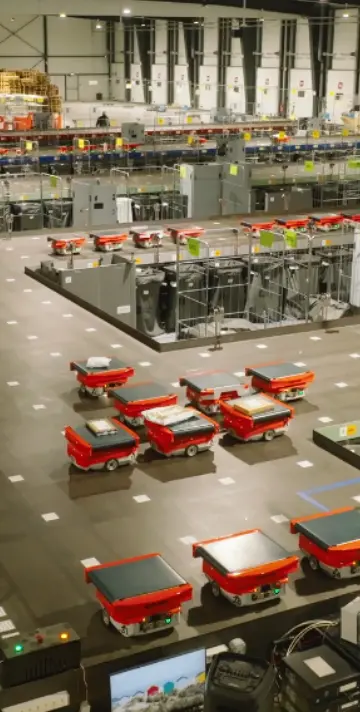
The smart warehousing solution comprises intelligent software, a well thought automation processes, and automated warehouse robots such as Autonomous Mobile Robots (AMRs), picking, storage and sorting robots that redefine how inventory is stored, moved, and fulfilled through data-driven execution. It not only allows the warehouses to operate with more accuracy and higher output but also to maintain the same level of performance at all times across each of the stages within the operations.
According to Mordor Intelligence, the global warehouse automation market was estimated at USD 19.9 billion in 2023. It is expected to reach USD 41.8 billion by 2028 at a CAGR of 16%.
This increase indicates that companies all over the globe are switching to smart warehousing to gain better control over their operations. They want to lower their expenses and also to be able to grow in a way that does not hinder their operations in the long run.
What Is Smart Warehousing?
Smart warehousing is a term that describes the use of a smart warehouse management system along with automated warehouse robots, to digitally orchestrate warehouse activities. It does not depend on manual decisions and static workflows; rather, it uses real-time data, optimisation logic, and system-driven execution.
Inventory placement and storage, order picking, sorting, and dispatch are all done in a unified environment, which allows the advanced distribution & warehousing facilities to operate faster, more accurately, and also with a higher degree of predictability.
How Does It Impact The Warehouse Performance?
One of the key benefits of smart warehousing is automation at a scale. For the big companies, the automation should not be confined to just one location, but rather it should be modular, repeatable, and standardised throughout the whole distribution network.
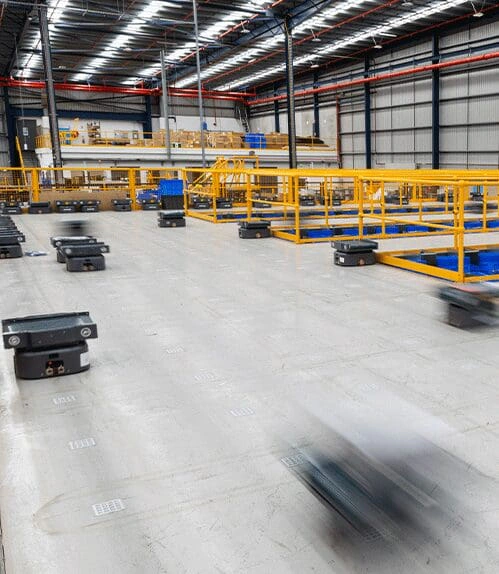
The smart warehouse is designed with a scalable architecture. Automation modules and shuttle systems, including Crane ASRS, sorting robots and picking robots, can be incorporated without affecting the current operations. Software orchestration ensures that new equipment is seamlessly integrated into existing workflows.
Here’s a comparison of manual vs smart warehousing:
| Feature | Manual Warehousing | Smart Warehousing |
| Throughput (Orders per Hour) | Low | Very High |
| Initial Capex | Low | High |
| Labour Hours per Order | Higher as compared to Automated Warehousing | Lesser no. of hours and lesser manual exertion |
| Order Accuracy | Prone to errors | Up to 99.99% accurate |
| Scalability | Limited | Easily Scalable |
| Space Utilization | Standard shelving | High-density vertical storage |
What are the Operational Benefits of Smart Warehousing?
Independent industry analysis acknowledges the vital importance of automated smart warehousing. According to McKinsey, automated warehouses are cutting labour costs by 30–40% while raising order processing at least two times in comparison to traditional setups.
This is because there is a parallel material flow, no manual decision points exist, and the system is continually optimised. When automation is synchronised with an intelligent software suite, warehouses achieve a faster order cycle, better accuracy and output that is predictable.
When a large warehouse transitions from manual operations to smart warehousing, it experiences radical changes in performance like:
1. Increased Throughput along with Predictable Output
The process of automation has made it possible for the material to flow in parallel across multiple zones. Addverb uses digital twin software during the solution design phase to simulate warehouse layouts, robot movements, and material flow scenarios before deployment. This helps optimise the placement of ASRS shuttle systems and mobile robots. As a result, picking, replenishment, and dispatch can occur simultaneously. Thus, throughput remains the same even when the demand is at its highest.
2. Enhanced Precision and Reliability of Orders
The quality of the process is drastically improved when all manual decision points are eliminated through the use of barcodes, sensors, and software-driven routing. Addverb’s Goods-to-Person (GTP) and Pick-to-Light solutions guide workers through the picking process. Visual prompts, organised item presentation, and system-assisted workflows reduce manual errors in order fulfilment that also minimises the occurrence of non-compliance.
3. Use of Space to its Fullest Capacity
Smart slotting, along with high-density storage systems, is the perfect combination that leads to the maximisation of the cubic space. Addverb’s shuttle-based ASRS and multi-level storage systems help warehouses utilise vertical and horizontal space with optimisations like double deep storage, rainbow pallet storage, etc., more effectively. These systems help hold more SKUs in the same footprint, thereby delaying the costly expansion of infrastructure while still ensuring advanced warehousing.
4. Less Dependence on Labour and More Secure Operations
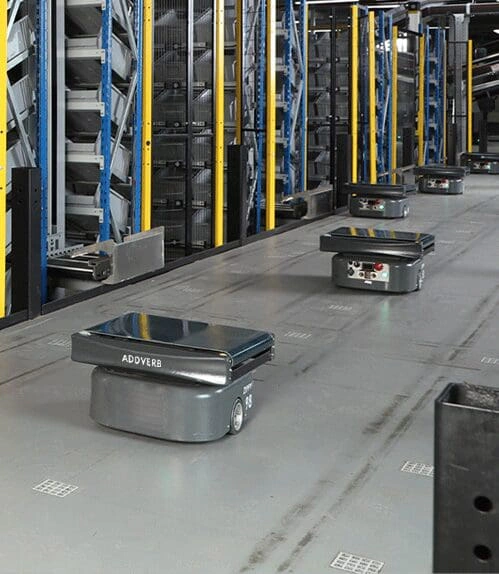
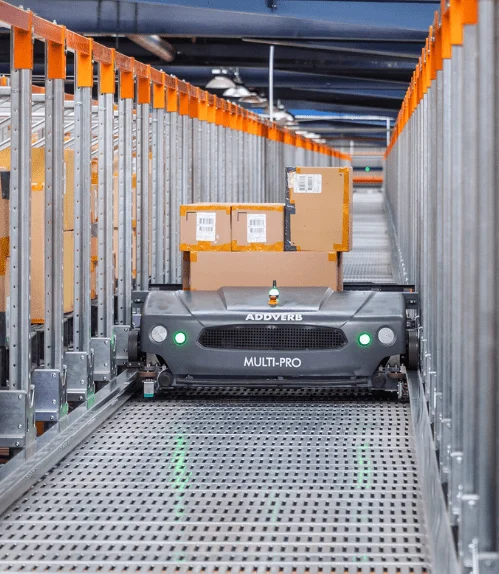
Addverb’s Autonomous Mobile Robots (AMRs), pallet and carton handling shuttles, sorting and picking systems take over repetitive material transport tasks. This creates a safer environment, reduces physical strain, and provides resilience in case of fluctuations in labour markets.These benefits combined allow modern warehouse operations to elevate the service levels without significant increases in floor space or cost.
The large-scale automation will give the companies the capability to be flexible and fast in their responses to seasonal increases, the installation of new networks, and new delivery models, all this while maintaining the same operating logic. As a result of this standardisation, the outcome is centralised monitoring, quicker deployment, and uniform performance across many facilities.
How a Smart Warehouse Management System Enables Intelligent Warehousing?
A smart warehouse management software serves as the backbone of the next-gen warehousing system. It manages inventory placement, allocates tasks, determines picking logic, and plans dispatch. Simultaneously, it improves operational processes using real-time data.
The smart warehouse management solution, Addverb’s Optimus, links various enterprise systems, such as ERP, order management, transport management, and yard management, via API frameworks, enabling real-time data flow. The system creates a self-optimising environment. It does so by dynamically prioritising orders, balancing workloads, and reacting to congestion or equipment malfunctions. This enables operators, both automated and human, to work in a single integrated system.
How Does Addverb’s Smart Warehousing Framework Work?
The platform uses a modular business logic for inbound, outbound, inventory, and task planning, respectively, thus giving the warehouses the liberty to define rules according to SKU behaviour and operational priorities. The execution layer puts these plans into real-time action: directing storage, movement, picking, and sorting.
The Fleet Management and Execution Systems bring together the coordination of robots, conveyors, ASRS, and sortation solutions. A unified interface gives complete visibility regarding things like throughput, inventory status, key performance indicators, etc. Thus, the automation is ensured to be directly in line with the company’s performance objectives. This supports modern warehouse operations.
Real-World Case Studies: How Smart Warehousing Delivers Measurable Gains
Addverb’s smart warehousing solutions are applied to large-scale and high-volume operations, thereby demonstrating significant performance benefits.
The Automated Distribution Centre case study reveals that Addverb’s systems for warehouse management and execution result in quicker order processing, better accuracy, and elastic scalability. The facility is capable of dealing with high-volume omnichannel fulfilment with a steady throughput, reaching a dispatched throughput of 2.7 lakh units per day, expanded storage capacity to 1.5 crore units, and 99.99 % order fulfilment accuracy.
Addverb’s installation of ASRS solutions at S. Abraham & Sons’ automated wholesale distribution centre enabled seamless inventory movement. This also led to the cutting down of manual handling, thus making order processing even more reliable across a wide range of SKUs,managing 14,400 tote positions, enabling 480 totes per hour, and delivering up to 200 totes per hour picking efficiency while enhancing space utilisation by up to 400 %.
The Automated Brake Parts Distribution Centre is another instance that showcases the positive impact of automation and software integration on throughput and, at the same time, on the accuracy of challenging material handling operations. This resulted in a throughput of 1,250 cases per hour, processing 10,000 orders daily, and increasing picking productivity by 25% with AMRs and robotic sorters coordinating 144 sort destinations.
More deployments across industries like grocery, can be explored in Addverb’s warehouse automation case studies.
Conclusion
In line with India’s modernisation of the logistics and warehousing sector, enterprises are increasingly adopting smart warehousing to support the growth of omnichannel and customers’ increasing expectations.
Large facilities no longer have the option of not having intelligent warehousing. Through automation at scale, companies gain the speed, accuracy, and flexibility required for sustained competitiveness.
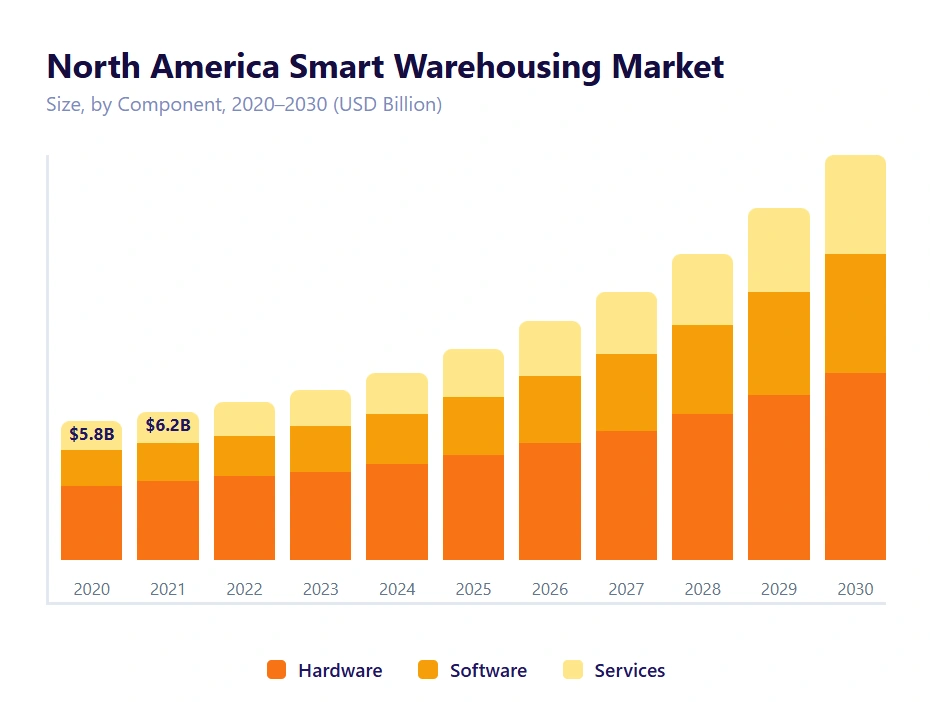
Addverb’s smart warehousing framework shows the way automation, data-driven control, and immediate orchestration would allow warehouses to improve performance. Due to the steadily increasing complexity of supply chains, smart warehousing remains vital for robust, long-term operations.
FAQs
1. What does a smart automated warehouse mean?
Smart warehousing uses automation processes, robotics, and a smart warehouse management system for controlling inventories, orders, and movement of materials with minimal manual assistance.
2. What are the advantages of smart warehousing?
The benefits of smart warehousing include better accuracy, proper space utilisation, increased throughput, less dependency on labour and scalable operations.
3. How can good automation help with reducing operational costs?
Good automation reduces operational costs by minimising manual labour, errors, and wasted time, enabling faster and more accurate task completion. It also ensures optimal use of space, energy, and resources, thereby reducing running costs in warehouse operations.
4. How does automated warehousing improve operational efficiency?
Automated warehousing supports parallel workflows, eliminates manual decisions, and utilises software-driven execution to reduce errors and boost accuracy and speed at a lower cost.
5. What are the four functions of warehousing?
The functions of warehousing are to receive goods, store them, process orders, and dispatch them. Smart warehousing enhances each function through automation and real-time system control.