



ON THIS PAGE
With ever-increasing complexity in warehouse costs such as land, square footage, operational labor, safety and compliance, a warehouse operations leader today has a lot to manage. But every challenge comes with new opportunities – opportunities for superior decision-making, operational efficiency and accuracy optimisation, opportunities for scaling existing and future business initiatives, and of course, opportunities for increasing bottom-line revenues. At the core of all this lies a fundamental question:
“How do I maximize my operations and space to get the most for clients, business goals and employees?”
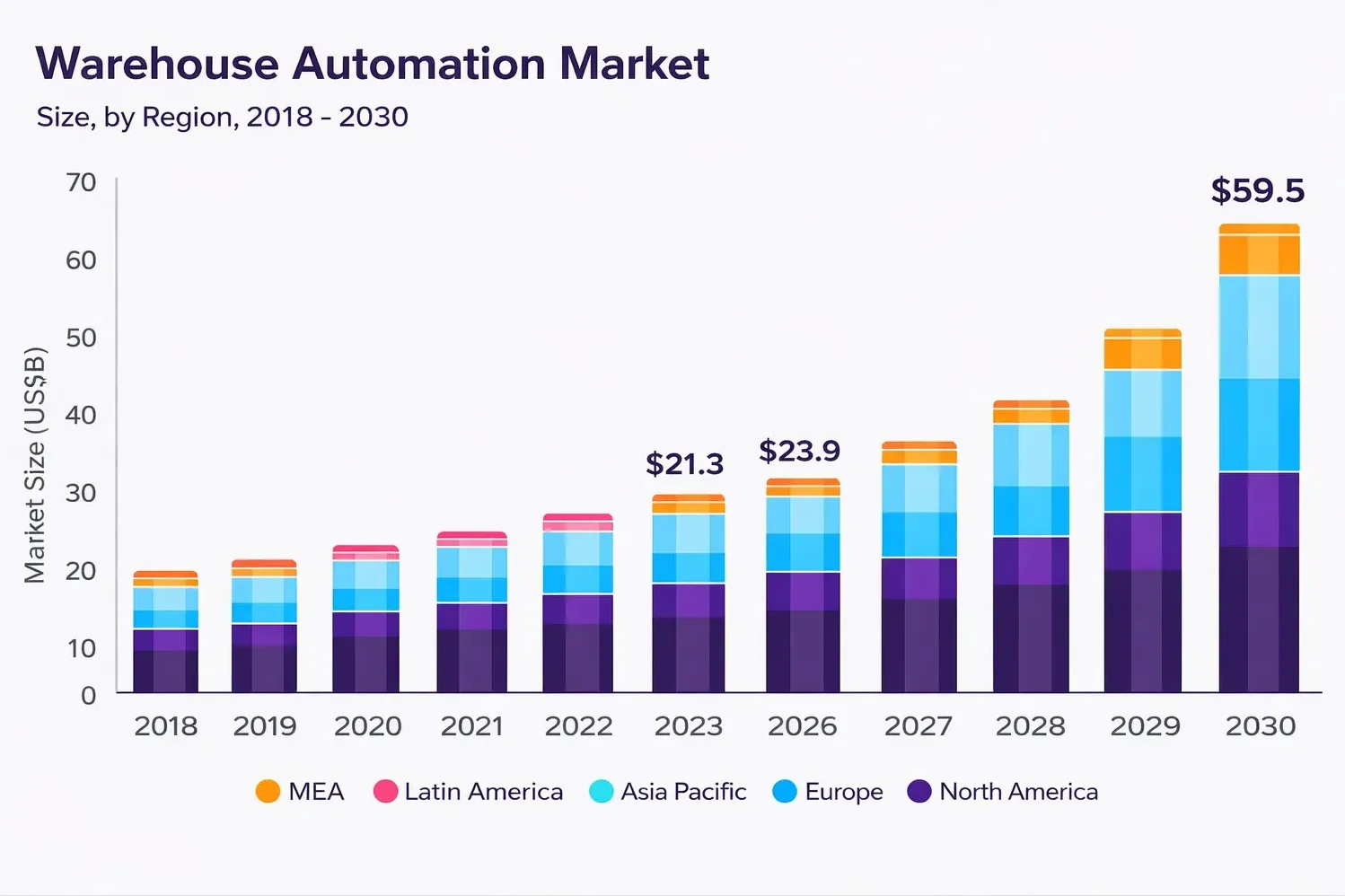
The global warehouse automation market was valued at approximately USD 19.23 billion in 2023 and is expected to grow to USD 59.52 billion by 2030, representing a CAGR of 18.7% from 2024 to 2030. Warehouse automation in US involves advanced technologies and machinery to automate and optimize various operational tasks within a warehouse environment, whether going for a greenfield vs brownfield projects of warehouse automation.
Automating an Existing Brownfield Environment
A brownfield site refers to an existing warehouse, distribution, industrial, manufacturing, or commercial property that includes operational infrastructure. This might include resources such as existing racking, gravity lanes, pallet and tote racks, shelving, and more.
Automating in a brownfield environment has its own set of challenges. Tight spaces, low ceilings, and existing / unused infrastructure are often common elements faced when installing new solutions for clients specially in North America or overall US regions.
Benefits of automating in a brownfield environment:
Here are some key value points that clients often experience when automating brownfield sites with Addverb:
- Automating a brownfield environment allows for a phased strategy, enabling your business to maintain production during implementation.
- Automating within an existing building is often more cost-effective for warehouse distribution, manufacturing, and industrial businesses that want to avoid the heavy costs associated with new builds.
- Existing system integration is critical as software is the brain behind any warehouse distribution or manufacturing facility, and Addverb’s warehouse software stack allows for brand agnostic integrations that are configurable to your business needs across the board.
- Speed matters, because often in a brownfield environment in US, we automate only one or two areas initially, such as picking or material movement. Having a thorough yet speedy implementation is key to our clients’ success.
Automating a Greenfield Environment
For the purposes of this discussion, a greenfield site refers to a brand-new or recently built commercial warehouse distribution or manufacturing facility constructed on unused land.
Greenfield warehouse automation in US is clearly a more costly approach upfront, but for businesses that can afford it, automating a greenfield environment can deliver significant rewards. These rewards can come in the form of operational efficiency and accuracy, scalability, cross-department optimization, reduced labor dependency, lower training costs, and more.
Benefits of automating in a greenfield environment:
- Automating a greenfield warehouse facility allows clients to “paint a blank canvas” of exactly how their operations should run for optimal success, both today and 10–15 years into the future.
- Space is king in warehouse distribution. Automating a greenfield facility enables near-total space utilization, creating short and long-term benefits and scalability that are difficult to achieve in brownfield environments.
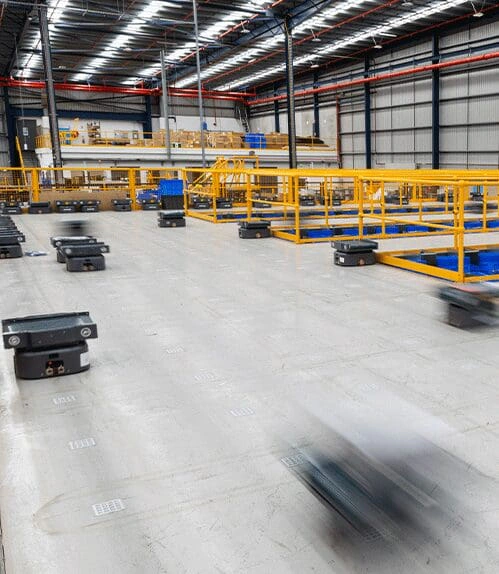
- Lights-out and 24/7 automation capabilities become possible as when automating a greenfield environment with Addverb, clients can implement a continuous 24/7 operational approach for picking, sorting, storage, material handling, conveyance, and software integration – turning operations into true revenue generators.
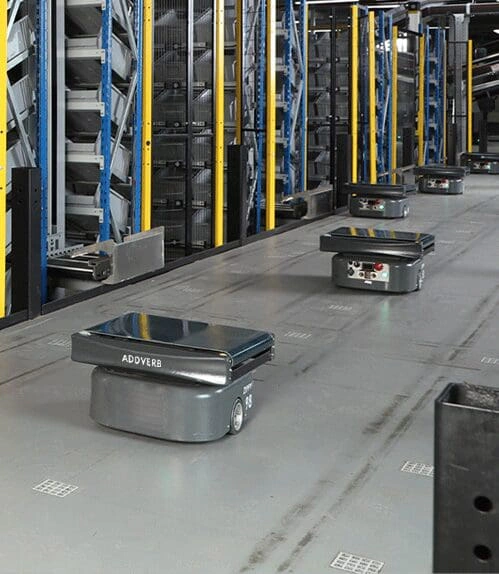
- Utilize the power of fixed and flexible automation, since, with greenfield automation, clients can combine the speed and efficiency of fixed solutions such as ASRS storage and conveyance with the flexibility and scalability of AMR and AGV robotics.
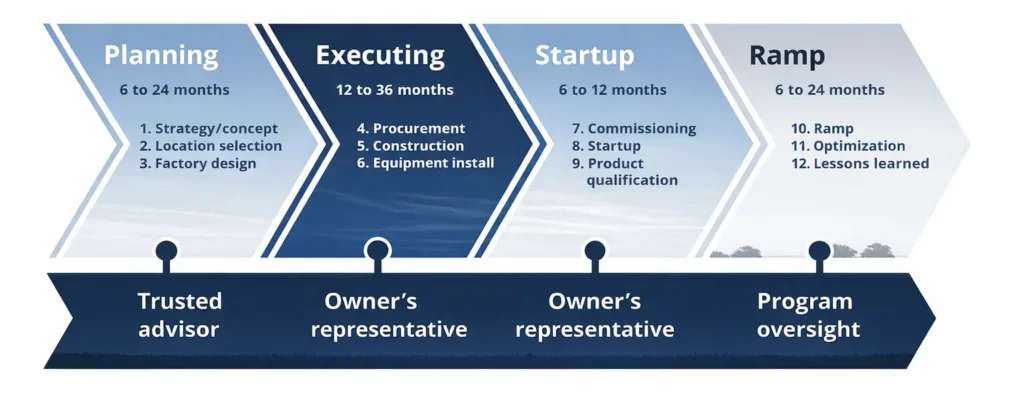
According to Deloitte, greenfield developments often require three to five years to complete, covering planning, approvals, construction, and commissioning, although these timelines are generally associated with manufacturing plants.
Conclusion
Whether you are looking to automate a specific operation within an existing brownfield warehouse facility in US or planning to automate an entire greenfield project, Addverb is ready to help you solve your biggest challenges and achieve your operational and business goals.
FAQ
1. What is the difference between brownfield and greenfield warehouse automation?
Brownfield warehouse automation refers to the automation of an existing warehouse setup that has already installed infrastructure like racking, shelving or material handling systems. On the other hand, Greenfield warehouse automation entails building automation for a newly constructed warehouse located on previously undeveloped land. In this case, it becomes possible to create an entire system from scratch, which is future ready.
2. Is warehouse automation possible in an existing (brownfield) warehouse?
Indeed, warehouse automation is definitely possible with an existing brownfield warehouses. Automation could be implemented on a phased basis for optimising select operations such as picking, warehousing and materials movement while keeping the facility operational through the implementation process. Brownfield automation is usually much more economical than greenfield automation involving the construction of a new automated warehouse.
3. Which is more cost-effective: brownfield vs greenfield warehouse automation?
When it comes to warehouse automation, brownfield projects are relatively cheaper on the investment front, since they involve repurposing existing infrastructure, meaning no construction costs. Greenfield projects are expensive on the investment required but have greater potential for future gains, such as better space utilization and automation capabilities.
4. What are the benefits of greenfield warehouse automation?
The greenfield model of automation in warehouses makes it possible to organize business operations in a way that maximizes efficiency. The advantages of this model include nearly complete utilization of the space available, ability to scale up to accommodate growth over a period of 10 to 15 years, reducing dependence on human labor, the possibility of automated warehouse running 24/7, as well as the flexibility to integrate fixed automation solutions like ASRS system along with solutions like AMRs and AGVs.
5. How do I decide whether my warehouse needs brownfield vs greenfield automation?
The choice would depend upon considerations such as costs, space requirements and business expansion plans. Brownfield automation would be most suitable for businesses requiring optimization of efficiency in an existing setup, while greenfield automation would benefit businesses that are planning for scale expansion through automation.