Highlights
• Sortation is now the warehouse layer most exposed to volatility, SKU proliferation, and carrier change.
• Flexible sortation has driven up to 300% fulfillment speed gains and 25–50% lower fulfillment cost in early deployments (BCG, McKinsey).
• Inside: four use cases, three-layer architecture, Zippy portfolio, five customer deployments.
Sortation directs every item, tote, and parcel through your warehouse – from receiving to dock door, across picking zones, pack stations, carriers, and returns. It's also the layer most exposed to today's order volatility, SKU proliferation, and carrier complexity.
Sortation, Reimagined shows how robot-led flexible sortation absorbs that volatility – across four use cases, with a three-layer architecture that combines conveyor throughput with robotic flexibility, without ripping anything out.
The shift isn't theoretical. Deployments at Maersk, Lenskart, DHL, Mondial Relay, and Landmark Group demonstrate measurable throughput, accuracy, and cost gains across apparel, eyewear, retail, 3PL, and parcel networks – under both peak and 24/7 conditions.
Why fixed sortation is hitting a wall?
The environments that built the case for fixed conveyor sortation are becoming rarer. E-commerce has pushed SKU counts up by orders of magnitude, compressed peak windows, and pushed reverse logistics into a permanent operational stream - $890B in U.S. retail returns in 2024, with an average e-commerce return rate of 20.4%. At the same time, 78% of warehouses report labour shortages driving operational costs up 15–25% (BCG).
Fixed systems bake routing logic into hardware. Every new carrier rule, SKU class, or service level becomes a capital project, and reconfiguration windows are measured in months, not days.
What flexible sortation delivers?
Benchmarks from companies that have moved to flexible sortation:
- Up to 300% improvement in order fulfillment speed (McKinsey)
- 20–50% service level improvement and 25–50% fulfillment cost reduction (BCG)
- By 2030, 50% of new warehouses in developed markets will be robot-centric (Gartner)
Two named outcomes from the case studies inside:
- Lenskart cut order consolidation time from 2–3 days to 2.5 hours and now handles 150,000 orders/day at 99.99% accuracy.
- Mondial Relay expanded sortation destinations from 6–7 to 280, hitting 3,000+ sorts/hour within weeks of go-live with a fleet of 72 Zippy robots.
Check out our customer case studies — each documented with the operational challenge, the deployed configuration, and the post-deployment results.
Inside the whitepaper
Four use cases – batch picking and de-batching, order consolidation, outbound distribution, and reverse logistics – and the operational pattern, throughput math, and routing rules behind each.
A three-layer architecture (fixed sortation, flexible robotic sortation, software-defined orchestration) with the trade-offs articulated: fixed conveyors still win on cost-per-sort at steady-state volume; mobile robots earn back their premium on flexibility, uptime, and reconfiguration speed; the orchestration layer is where the two stop competing and start compounding.
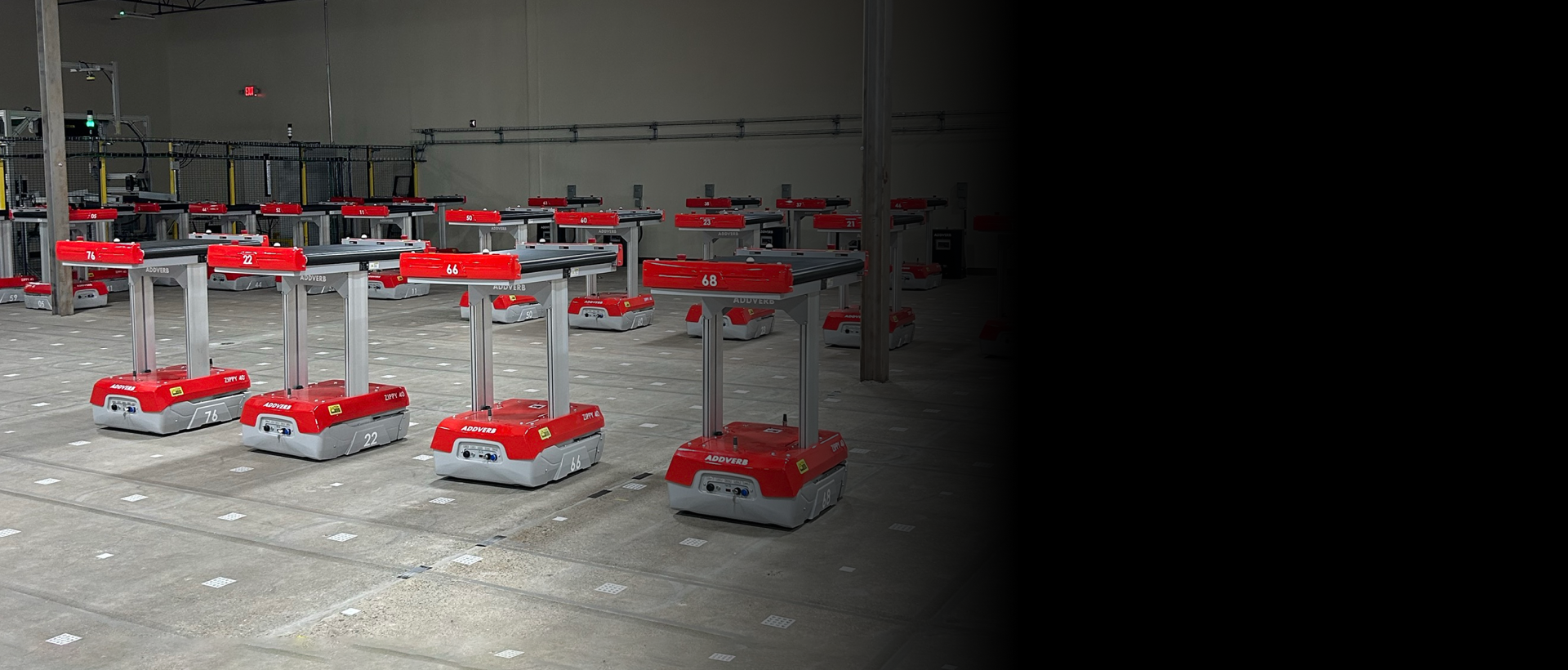
The Zippy portfolio has five variants from table-top (Zippy 6, 10) to floor-based heavy-duty (Zippy 30, 40) to scissor-lift multi-level (Zippy X) with the parcel size and use-case fit for each.
Who is this for?
- Warehouse and Operations Leaders rethinking sortation capacity for peak events and 24/7 operations.
- Supply Chain and Logistics Executives weighing how flexible automation reduces multi-carrier outbound risk and returns-handling cost.
- 3PL Strategy and Network Design Teams designing for rapid new-account onboarding and frequent carrier or service-level changes.
- Automation Decision-Makers assessing where robotic sortation fits alongside existing fixed-conveyor investments.
What Addverb does that fixed systems don't?
The Zippy family of robotic sorters — table-top and floor-based, payloads up to 40 kg, multi-level handling, interchangeable attachments — is paired with the Concinity Warehouse Execution System, the orchestration layer that runs fixed and flexible sortation as a single operation.
The combination changes three things a fixed system can't:
- Capacity scales by adding robots, not rebuilding lanes. A new throughput target is met with fleet, not a six-month conveyor rebuild.
- Routing rules update overnight, not next quarter. New carriers, SKU classes, and service levels become configuration changes – not capital projects.
- The same robots run multiple use cases. A Zippy that runs outbound during the day can run returns sortation at night , on the same fleet, on the same software.
Production deployments live across apparel, eyewear, 3PL, parcel, and retail networks.