
Table of Contents
Battery manufacturing is entering a phase where scaling production is no longer just about increasing output, it’s about maintaining precision at every step. As electric vehicles and energy storage systems drive unprecedented demand, manufacturers are being forced to rethink how batteries are produced, handled, and moved across the battery manufacturing process. Even small inefficiencies in material handling, traceability, or process flow can directly impact yield, safety, and overall performance.
The global battery manufacturing market size was estimated at USD 154.12 billion in 2025 and is projected to reach USD 554.83 billion by 2033, growing at a CAGR of 17.7% from 2026 to 2033, the real challenge is not just scaling faster, but doing so without losing control over quality, consistency, and operational stability.
Why Does Battery Manufacturing Become More Complex as Production Scales?
Battery manufacturing begins with electrode preparation, one of the most critical stages in the entire battery manufacturing process. Active materials are coated onto thin metal foils, dried under controlled conditions, and compressed to achieve the required density.
At this stage, even the smallest variation in coating thickness, a trace of contamination, or minor handling damage can impact battery performance. These are not issues that can be corrected later; they carry through the entire lifecycle of the battery.
As production volumes increase, maintaining uniformity across batches becomes significantly more challenging. Manual methods at this stage introduce variability that directly affects yield and reliability.
Once electrodes are prepared, the process moves into cell assembly, including stacking or winding, electrolyte filling, and sealing. This is followed by formation and aging within the battery production process flow.
Formation is where the battery is charged and discharged for the first time to stabilize its chemistry. It requires precise control, detailed monitoring, and complete data tracking. Aging follows, ensuring performance consistency before the cell moves to final testing.
Across these stages, complexity continues to build:
- Materials remain highly sensitive to environmental conditions
- Cells carry increasing energy levels, making handling more critical
- Process timelines extend, requiring structured battery manufacturing process flow management
- Even small gaps in traceability can lead to large-scale inefficiencies and increased safety risks
How Do Addverb’s Pallet-Based Automation Solutions Support Battery Manufacturing?
In battery manufacturing, the core challenges revolve around unstructured material flow, storage constraints, and lack of traceability. Addverb’s pallet-based automation solutions address these directly by creating a connected and scalable system.
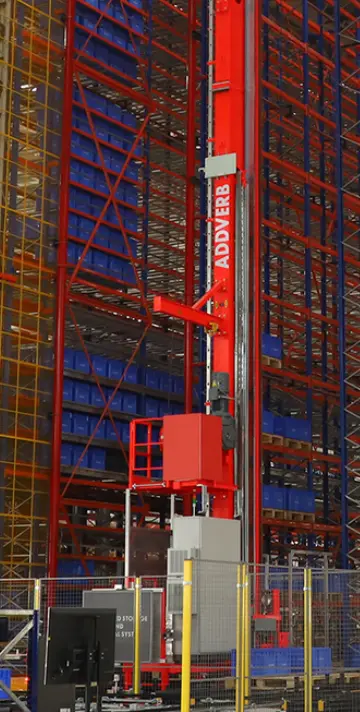
- Crane-based ASRS (Skyron) solves storage and safety challenges by enabling high-rise storage (up to 40m), automated crane-based pallet handling, and high payload capacity. It ensures precise placement and retrieval with minimal human intervention, making it ideal for safely storing battery cells during critical stages like formation and aging while maximizing vertical space utilization.
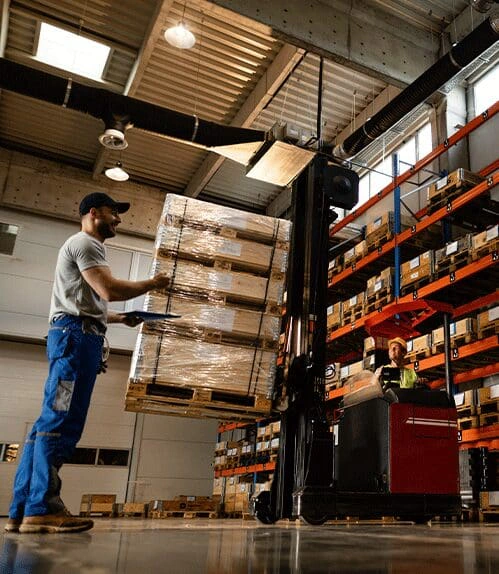
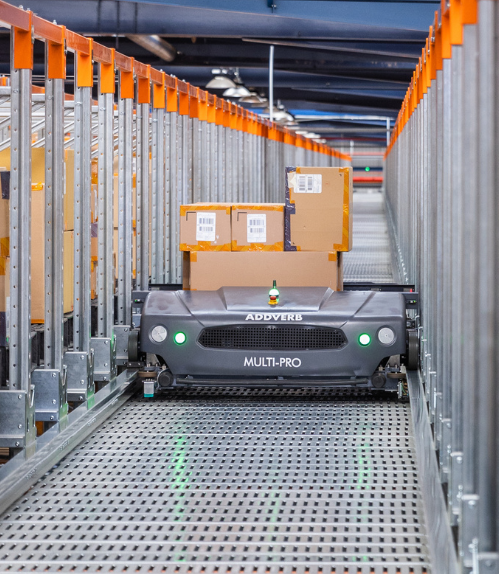
- 4-Way Pallet Shuttle systems address throughput and flexibility challenges with bi-directional shuttle movement combined with vertical lift integration, enabling multi-level and deep-lane storage. This allows high storage density, faster pallet movement, and flexible layout design, making it suitable for handling fluctuating volumes in battery manufacturing.
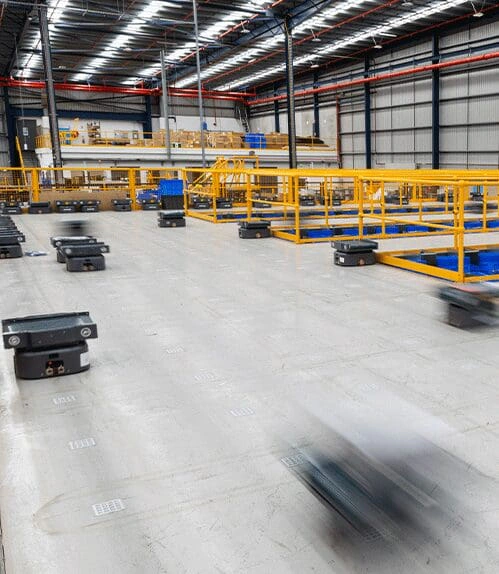
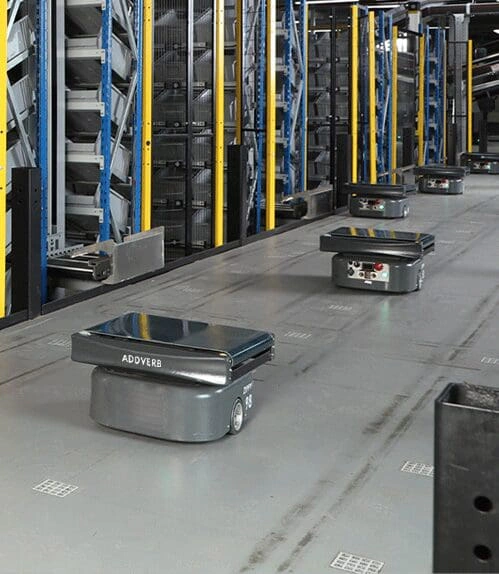
- AMRs (Dynamo) eliminate inefficiencies in material movement using SLAM-based navigation, dynamic path planning, and fleet orchestration. They enable flexible, point-to-point pallet or material transport without fixed infrastructure, ensuring smooth movement across production stages in controlled environments.
- Integrated software systems (WMS/WES/WCS) resolve traceability gaps through real-time inventory tracking, system-wide visibility, and seamless integration with production workflows. This ensures synchronized operations, accurate tracking of battery cells, and complete process control across formation, aging, and testing cycles. Together, these solutions ensure efficient material flow, safe storage, and end-to-end traceability, enabling battery manufacturing operations to scale with control and consistency.
What Will the Future of Battery Manufacturing Warehousing and Automation Look Like?
Automation in battery manufacturing is evolving beyond efficiency, it is becoming the foundation of how modern battery warehouses operate. As production scales, the focus is shifting toward building systems that ensure control, consistency, and adaptability across every stage.
In the future, battery manufacturing warehousing will be defined by:
- Structured Material Flow
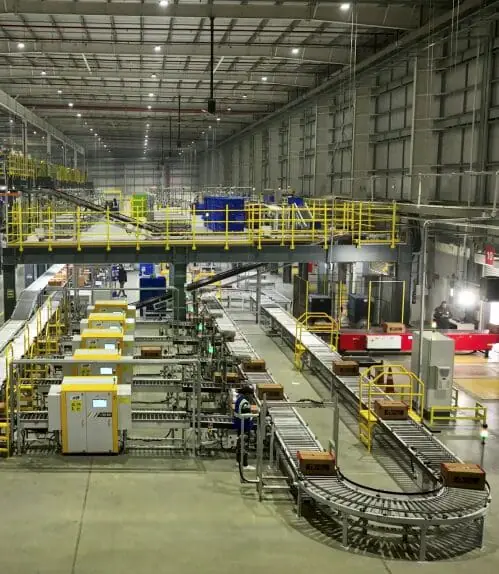
Automated systems will ensure seamless, contactless movement of heavy payloads across production and storage zones, reducing contamination risks and delays. - End-to-End Traceability
Every battery cell will be tracked across stages, from storage to testing, enabling complete visibility and tighter process control. - High-Density, Automated Storage
Advanced systems like ASRS will maximize vertical space while ensuring safe handling of sensitive and high-energy battery cells. - Scalable and Flexible Operations
Warehouses will be designed to adapt to changing production volumes without disrupting ongoing operations. - Data-Driven Decision Making
Real-time visibility across inventory, movement, and processes will enable faster and more accurate operational decisions.
As battery manufacturing continues to expand, automation will not just support operations, it will define how efficiently, safely, and reliably battery warehouses function at scale.
Why Does Battery Manufacturing Need a Strong Automation Strategy?
Battery manufacturing is not just another production line. It is a high-precision, high-stakes environment where consistency defines success. As demand continues to accelerate, the ability to scale without losing control will separate the leaders from the rest.
The right battery manufacturing automation strategy, supported by structured material flow and pallet-based systems, enables manufacturers to maintain control, improve efficiency, and scale operations with confidence.
FAQs
1. What is battery manufacturing automation?
Battery manufacturing automation refers to the use of automated systems to manage material movement, storage, and process flow across the battery production lifecycle, improving efficiency, traceability, and consistency.
2. What challenges exist in battery manufacturing without automation?
Common challenges include inconsistent handling, contamination risks, poor traceability, process inefficiencies, and difficulty scaling production.
3. How do ASRS systems support battery manufacturing?
ASRS systems enable high-density storage, safe handling of battery cells, and efficient material flow across production stages, improving overall operational efficiency.
4. What role do AMRs play in battery manufacturing?
AMRs help automate material movement between stages, ensuring smooth flow and reducing manual handling in controlled environments.
5. What is the future of battery manufacturing?
The future will focus on automated, data-driven, and scalable operations with high levels of visibility, safety, and process control.