



ON THIS PAGE
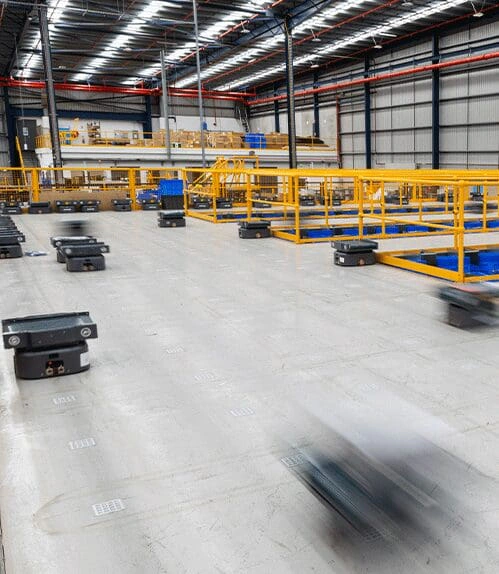
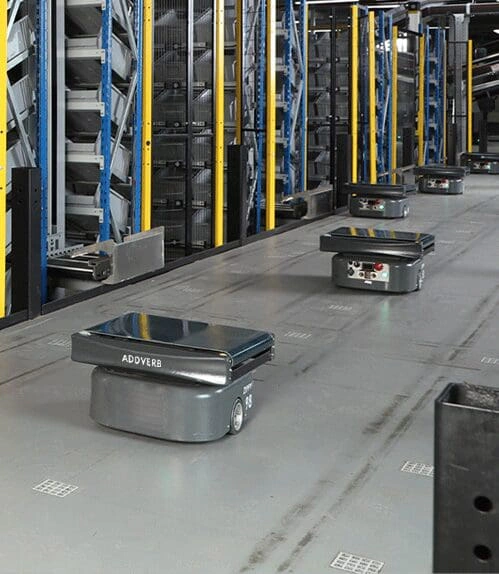
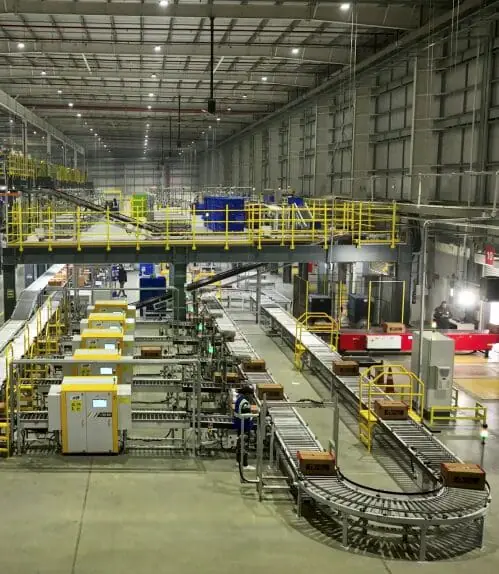
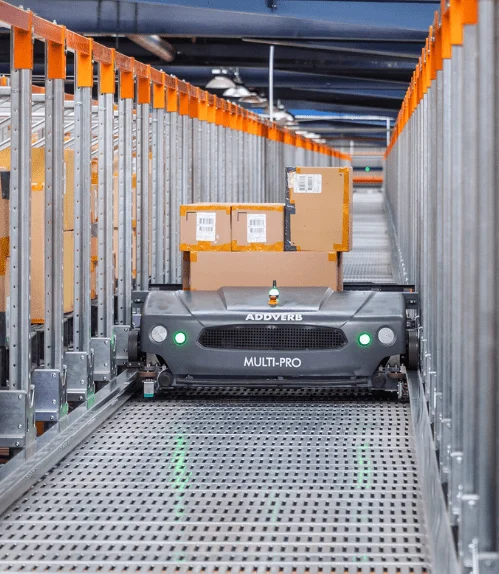
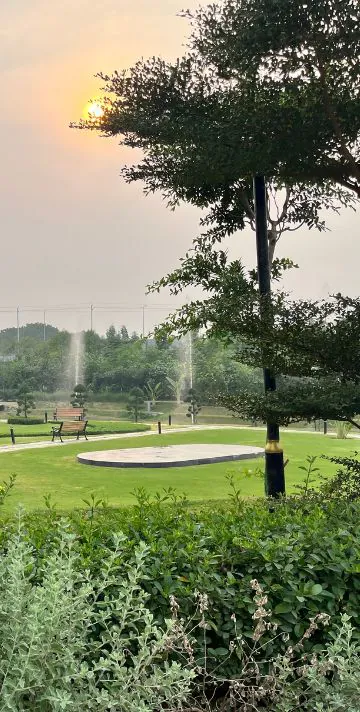
If you visit our state-of-the-art Bot-Verse facility today, you will encounter a striking contrast. Beyond the high-precision manufacturing lines producing 60,000 warehouse robots annually, a dense, thriving stretch of green awaits you.
This isn’t a decorative lawn or a manicured garden. It is a Miyawaki micro forest, a self-sustaining, high-density ecosystem that transforms how we approach industrial sustainability.
Why We Chose the Miyawaki Approach
The Miyawaki method was originated in Japan in the 1970s through the work of botanist Dr. Akira Miyawaki. His research was focused on understanding what native forests looked like before urbanisation changed natural landscapes.
His conclusion was very simple but equally powerful. If you want to restore degraded land, you should not beautify it. You should rebuild the ecosystem that originally belonged there.
The technique differs significantly from conventional plantation drives. In this technique, trees are not planted in neat rows or with wide spacing, but instead Miyawaki micro forests are think, dense and layered. The method of plantation involves:
- Planting native and climate-suitable species
- Generate a very high-density plantation, by almost planting three saplings per square metre
- Creating forest layers such as shrubs, sub-trees, canopy trees
- Enriching soil with organic biomass before starting the plantation
- Avoiding use of chemical fertilisers and pesticides
As the saplings are planted close together, they compete for sunlight absorption. This competition encourages vertical growth and stronger root development. Over time, the forest becomes self-sustaining and requires minimal maintenance. In many cases, growth of the forest is significantly faster than any conventional plantation methods, even biodiversity recovery is quicker than any conventional methods.
What appealed to us most was this method does not create a manicured garden which only looks good. But it creates a fully functioning ecological system.
What We Built at Bot-Verse
At our manufacturing facility, we developed a micro forest with around 3,500 trees covering more than 25 native species. The diversity was intentional to occupy different layers and support different forms of wildlife which supports the entire concept of Miyawaki micro forest scheme.
The preparation stage took some time as ensuring soil health was a priority. The land was loosened and enriched with organic biomass to improve water retention, aeration process, and microbial activity. Healthy soil ensures strong root systems thus determining long-term survival of the plantation.
Saplings were planted densely, at least three per square metre. This density might appear crowded at first, but it mirrors how forests grow in natural ecosystem. The close spacing allows trees to support one another while competing for light, which accelerates upward growth.
The Biodiversity Mix
We chose a deliberate mix of shade-giving, flowering, and fruit-bearing trees, including:
Michelia champaca & Ficus varieties (Canopy density and wildlife shelter)
Cassia fistula & Delonix regia (Vibrant flowering for pollinators)
Neem & Pongamia (Air purification and hardiness)
Rapid Transformation
The land changed rapidly. Within three months, visible greening began. By the six-month mark, the site felt like a young forest. Today, this space supports over 30 native wildlife species, including local pollinators and frequent bird visitors.
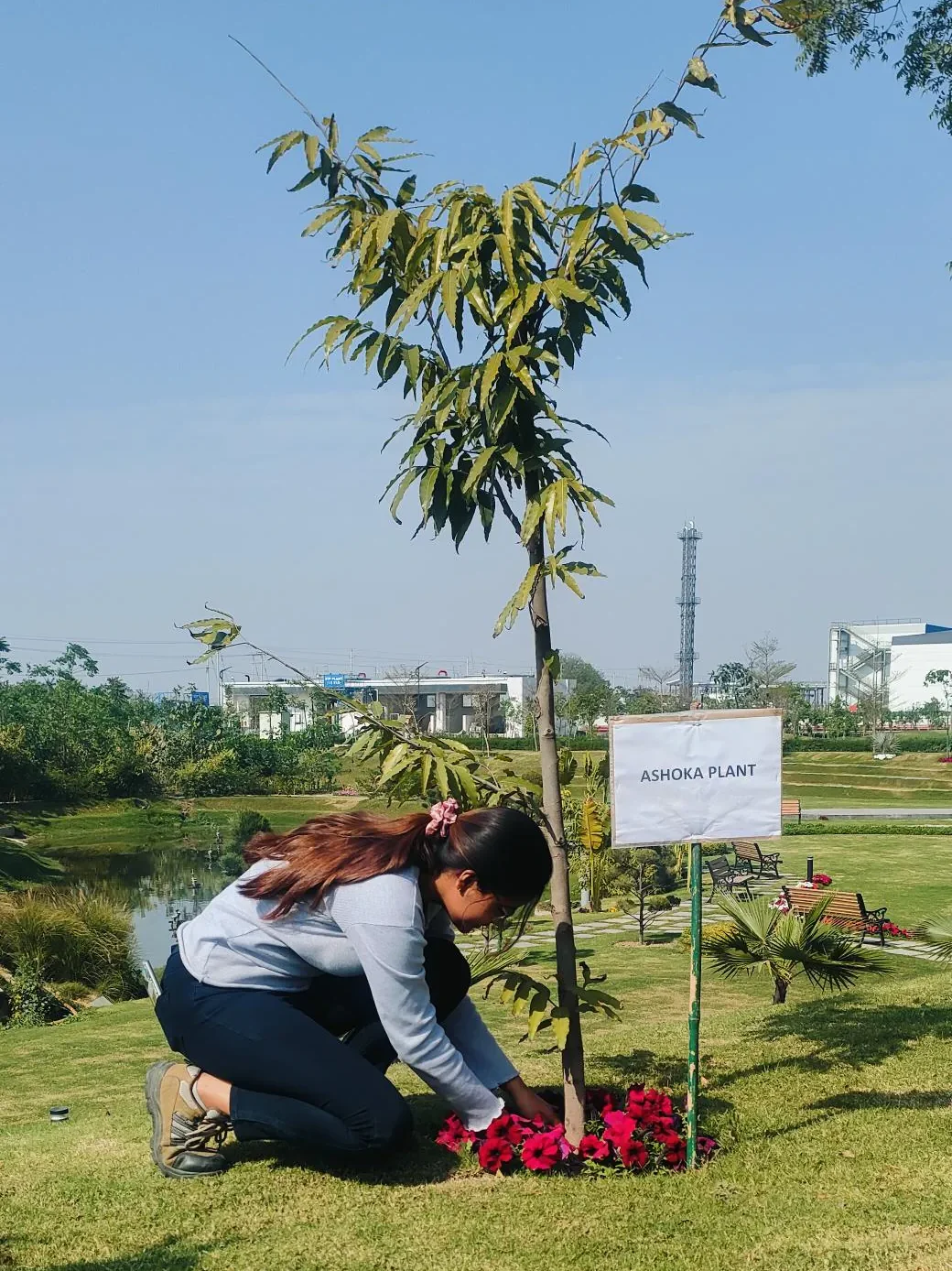
of 2025 at Bot-verse
Preservation in Action: Relocating the Mango Trees
One part of the project required additional planning and patience. The mango trees.
Unlike the other saplings, these were not freshly planted, but they were carefully relocated from another location and planted again into the micro forest. Transplanting established trees is always more complex than planting new ones. The root ball must be preserved carefully. The soil at the new site must be prepared in such a way that it reduces transplant shock. After relocation to new site, the trees need consistent observation and care during the adaptation phase.
Transplanting established trees requires precision. We carefully preserved the root balls and prepared the new soil to reduce transplant shock. Today, these thriving trees provide height variation and seasonal fruit, representing our commitment to circular sustainability: we retain and honour the life that already exists.
Measurable Ecological Impact
The micro forest provides more than just a “green view.” It delivers tangible environmental benefits to our manufacturing site:
| Metric | Observed Impact |
| Temperature | Ambient temperature has dropped by approx. 2°C |
| Air Quality | Significant reduction in suspended dust particles |
| Water Retention | Soil retains moisture far more effectively than before |
| Carbon Sequestration | Higher CO₂ absorption due to dense, layered biomass |
Dense micro forests are known to absorb higher levels of carbon compared to sparse plantations due to their biodiversity and layered growth. Over time, as the canopy thickens and root networks grow, the environmental impact is expected to increase exponentially.
There is also a human impact that cannot be captured fully through data. The air feels cooler when walking past the patch. The soundscape has changed. Leaves rustle where there was once open ground. Employees often spend some time walking around it to release stress in their spare time. The complete space feels calmer.
Automation Inside. Ecosystem Outside.
At Addverb, we believe that industrial innovation and ecological resilience must coexist. Technology drives our efficiency, but nature restores our balance.
Bot-Verse is built around warehouse robotics, precision engineering, and advanced manufacturing systems and the micro forest exists just outside that structured environment. Yet it does not feel out of place.
As the trees grow taller each season and the canopy becomes denser, the forest continues to take shape on its own. What began as a sustainability initiative has now become a living and breathing part of the manufacturing facility.
Our Miyawaki micro forest is a living reminder that we do not measure progress solely by output, but by the ecosystems we successfully bring back to life.