



WhatsApp 채팅

Automatic forklift systems are redefining how warehouses handle pallet movement and storage at large scale. According to Market Growth Reports, automatic forklifts reduce average order cycle times by up to 34%. They improve inventory accuracy to nearly 97%. This is a clear reflection of their impact on material handling and distribution performance.

With the rise in order volumes, greater labour shortages, and tighter service-level agreements, warehouses are moving past manual material handling. The option between a hand operated forklift and an autonomous forklift progressively determines the operational efficiency, safety output, and expandability potential of modern intralogistics.

This comparison focuses on exploring how automatic forklifts perform against a traditional forklift in high-volume automation-driven environments. It will provide logistics leaders with a picture of where to invest in strategic automation.

What Are The Operational Differences In Manual Vs Automated Material Handling?

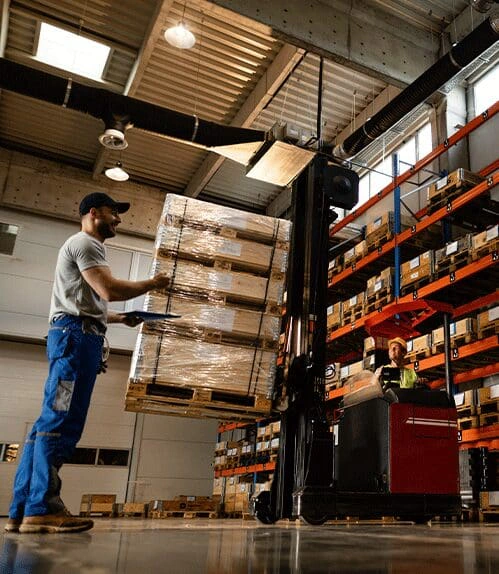
A Traditional Forklift relies on a trained operator to execute every movement. This includes driving, lifting, stacking, and unloading. Even though the conventional forklifts are flexible, their performance depends very largely on human skills and site conditions. In contrast, automatic forklifts use LiDAR, cameras, safety sensors and navigation software to perform the same tasks autonomously with repeatable precision material handling.

Driverless forklifts and self-driving forklift platforms operate on predefined routes. They are integrated with Warehouse Management Systems while maintaining consistent cycle times. This removes operator variability from pallet movement. It is especially useful in narrow aisles and high-rack storage zones.

How Throughput, Accuracy, and Material Flow Consistency Improves?

While manual forklifts seem to work fine in low-volume environments, they simply cannot keep up with the pace during peak operation, disturbing operational consistency to a large degree. The operator is required to manage safety, navigation, and load stability all at one time, increasing error and delay risks.

Driverless forklifts move at specific strategic speeds, guided by specialised route optimisations. This guarantees an expected material flow along with a given positioning of the pallet itself, particularly in FMCG, pharmaceutical, and e-commerce fulfilment centres.

According to the 2023 MHI Annual Industry Report, warehouse automation can boost productivity by around 30%. It can also significantly speed up operations and reduce error rates by up to 99%.

Manual vs Automated Forklift Performance Comparison

Here’s a comparison of Manual vs Automated Forklift performance:

기능Manual ForkliftAutomated Forklift
처리량 Limited, depends on the operatorHigh, consistent material flow
Cycle ConsistencyVariable, affected by fatiguePredictable, system-driven
정확성Prone to errorsHigh accuracy
확장성한정 쉽게 확장 가능
안전Higher risk of collisionsReduced risk through sensors and safety zones

Key Safety Advantages of Autonomous Forklifts in High-Traffic Warehouses

Forklift-related accidents are one of the most widespread causes of injuries in warehouses across the globe. Manual driving of forklifts requires constant effort on the part of the driver. Regardless of the driver’s experience level, it can still cause collisions within the warehouse.

An automated forklift system uses various safety interlocks such as obstacle detection and speed zoning to prevent collisions with people, racks, or goods. This system is away from potential hazards caused by operator fatigue, distraction, or human fallibilities associated with erratic driving. Driverless forklift trucks offer the level of safety many warehouses need.  

How Does Addverb’s Autonomous Forklift System Architecture Work?

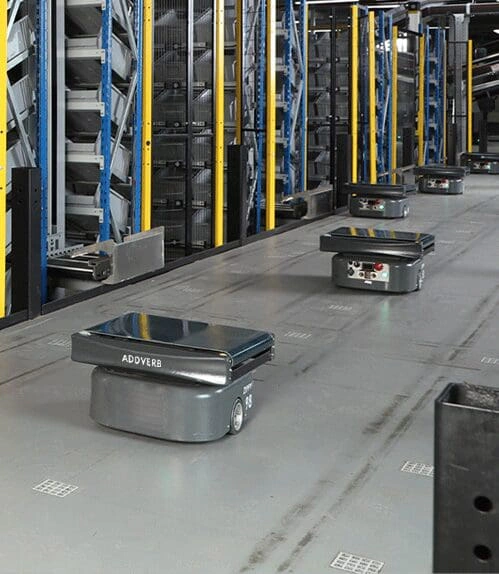
Addverb’s Autonomous Forklift is designed specifically for warehouse environments with high-density and high-throughput. These environments usually require accurate pallet handling without manual intervention. As a result, they need autonomous forklifts. 

System Architecture

The solution includes integrating LiDAR-based navigation, real-time obstacle detection, and intelligent fleet management software. Each self-driving forklift communicates with a centralised control system that assigns route-optimisation and task-allocation functions.

소프트웨어 통합

The platform smoothly integrates with WMS, WES, and ERPs to orchestrate in real-time tasks, synchronise inventories, and prioritise orders. APIs enable synchronisation with conveyors, ASRS, and robotic arms, etc.

Operational Impact

The autonomous forklift system ensures reliable throughput by maintaining precise rack alignment, reducing picking and putaway errors. It does so while improving space utilisation. Built-in safety zones and speed controls minimise collision risks. This stays true even in mixed human-robot environments.

Addverb Case Studies: Automation in Action

A few cases where Addverb has deployed its automation solution in use cases similar to forklift-driven warehouses are as follows: 

In the Piramal PGP Automated Glass Distribution Centre project, Addverb modernized a traditionally manual glass warehouse by implementing an 11-floor multi-deep storage system with shuttle- and lift-based pallet handling. The solution reduced manual effort involved in vertical stacking and long-distance pallet movement. Automated pallet transfers improved handling speed, inventory accuracy, and damage control for fragile glass products, resulting in smoother inbound storage and safer dispatch operations.

In the Par Pharma Multi-Deep Storage System project, Addverb transformed a manual, space-constrained pharmaceutical warehouse. They deployed a crane-based ASRS with pallet shuttles and integrated conveyors. The solution automated storage and retrieval processes. There was an integration of warehouse control software to ensure real-time visibility and control. This automation improved traceability, maximized high-density storage positions, and enhanced overall pallet movement efficiency. This resulted in reduced throughput times and boosted the effectiveness of operations.

Costs And ROI Considerations For Autonomous Forklifts:

While a traditional fork system is definitely a lower-cost solution at the outset, the ongoing expenditures include workforce, training, insurance, and accidents. On the other hand, automated pallet mover solutions are an expensive undertaking, yet they guarantee a sizeable return-on-investment through workforce optimisation, reduction of errors, and increase in throughput.

Why Manual Forklifts No Longer Make Sense?

Hand-operated forklift systems are becoming less suitable due to:

  • Inconsistent productivity caused by human fatigue
  • Higher risk of accidents in busy warehouse environments
  • Slower pallet movement compared to automated systems
  • Dependence on skilled operators and labour availability
  • Limited scalability during peak demand periods

Automation will soon become more important than just a technological upgrade. In the future, it will be considered a strategic factor once order volumes and expectations rise.

결론

The decision whether to use a manual or an automated forklift will depend on the size of the warehouse. Things like throughput requirements and the long-term goal of automating the warehouse will also play a role. Manual forklifts perform well in their operations and are good for labor saving in smaller or limited circumstances. Automated forklifts support high-volume environments by providing consistency, which is essential to imparting safety and scalability. With labor scarcity increasing, mandating safety, and setting higher operational expectations, one must reason that forklift automation has shifted from being only about operational improvement to a concerted strategic investment.

자주 묻는 질문

1. What is the difference between manual and automatic forklifts?
Manual forklifts require a human operator to go about each move, whereas automatic forklifts operate on their own through navigation and software, consistently with precise movements. The performance is more reliable and is not just dependent on the skill or availability of the operator.

2. What is the 3m rule for forklifts?
The 3-meter rule is for securing a safety zone around operational forklifts so as to lessen the possibility of collisions and enable visibility for the pedestrians and the operator. It ensures warehouse safety in busy zones.

3. How automatic forklifts improve warehouse productivity
Cycle time variability is reduced, route optimisation is improved, and operator fatigue is eliminated. This allows for uninterrupted, faster, and more uniform material handling, which directly gives support to a higher throughput and better order fulfilment.

4. What are the limitations of traditional forklifts during high-volume operations?
With increasing order volumes and throughput demands, manual systems face difficulty in maintaining consistency, safety norms, and scalability. These challenges can translate into higher labour costs and operational inefficiencies.

5. What is the impact of automation on material handling speed and consistency?
Automation guarantees predictable speed of movement, correct positioning, and steady throughput across shifts. Such certainty is a must in order to meet stringent service-level agreements.

6. What are the safety benefits of autonomous forklifts in warehouses?
They use sensors, safety zones, and collision-avoidance systems, which have hugely cut the risk of accidents occurring, so workplace injuries are reduced, thus protecting both personnel and infrastructure.

추천 블로그