



ON THIS PAGE
Thanks to today’s effective Warehouse Management Systems (WMS), the entire warehousing process has rapidly evolved for businesses selling online. The advancement of supply chains, characterised by increasing order volumes, higher expectations for delivery speed, and growing demands for accuracy, has led to this evolution.
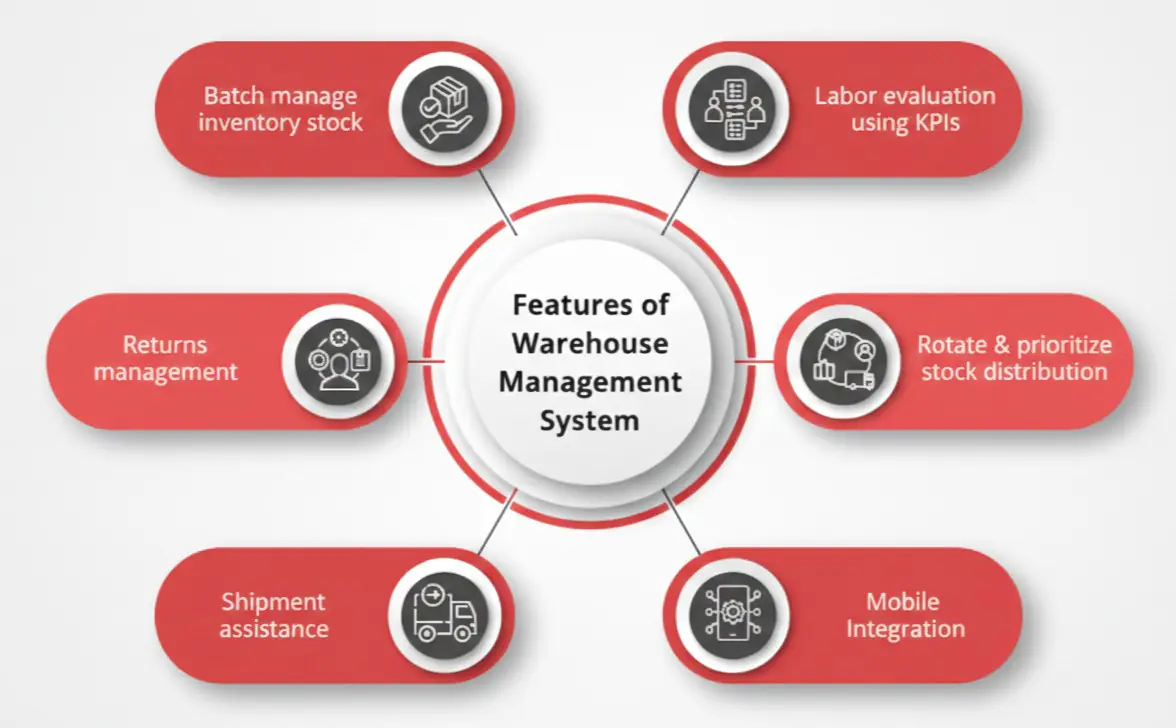
A solid WMS is engineered to manage storage, movement, and fulfillment activities. To select the right one for your business’s efficient scaling, it’s important to understand the key features of Warehouse Management Systems, their core functions, and their functional requirements.
According to Grand View Research, the global Warehouse Management System (WMS) adoption is estimated at USD 2.88 billion in 2024 and is projected to grow to USD 8.38 billion by 2030, at a CAGR of 19.9%. This fact highlights that more and more organisations are using smarter software tools to boost their operational performance.
What are the 3 core features of a modern WMS?
Real-Time Inventory Visibility: Provides live end-to-end tracking of stock from inbound receipt to outbound dispatch.
Intelligent Slotting & Storage: Employs AI algorithms to determine optimal SKU placement, maximizing space utilization.
Automated Picking Strategies: Orchestrates wave, zone, and batch picking to reduce manual travel time and error rates.A high-performing Warehouse Management System typically centres around three core features:
How does WMS Improve Warehouse Efficiency?
Organisations looking to upgrade choose Warehouse Management Systems that do more than simply support activities like receiving, put-away, picking, packing, and dispatch. A good WMS also optimises how these processes work together. This is how it’s done –
- AI is woven into operational decision-making for a good WMS, which uses machine learning to optimise the logic inside these modules.
- Technically speaking, data from analytics returns optimised decisions back into WMS processes. This creates continuous improvement loops in the data collected from WMS tasks, robots, labor, and inventory.
- Employing smart storage logic and automated allocation to enable even new staff to operate faster and more accurately.
- Collaborating with WES (Warehouse Execution System) to feed data-driven decisions into execution, adjusting flows dynamically depending on congestion, delays, and equipment status.
- Fewer manual checks are required, providing clearer instructions, reducing search time, decreasing paperwork, and reducing cognitive load for workers by digitising routine decisions and eliminating redundant steps.
By bringing such capabilities together, the core functions of a Warehouse Management System result in a more integrated, consistent, and predictable operating environment.
Selection of a WMS: Important Factors
In weighing their options for good warehousing solutions, a business needs to consider the following critical factors:
- An ability to scale is important because warehouses grow rapidly – almost overnight – due to fluctuating market demand.
- Integration capability is equally crucial. The system should be able to interface with ERP, OMS, TMS, and the automation equipment.
- The WMS should be automation-friendly if a warehouse intends to implement AMRs, conveyors, ASRS, or sorting systems sometime in the future.
- System reliability, ease of training, reporting capabilities, and support for mobile devices are also crucial in many ways.
- Often overlooked is the total cost of ownership, which includes licensing, support, training, and upgrade costs. A system that meets advanced Warehouse Management System functional requirements ensures long-term value by preventing frequent reinvestments.
Addverb’s Optimus – A Modern and Scalable WMS Solution
Addverb’s Optimus is a strong example of a contemporary and advanced Warehouse Management System. Optimus is an unbeatable, flexible, and automation-enabled WMS that is able to undertake all the major tasks performed in a Warehouse, such as receiving, put-away, storage, picking, packing, and dispatch.
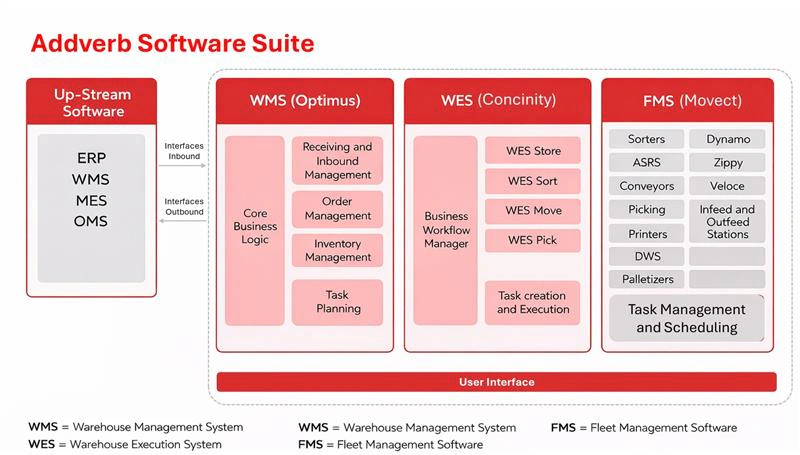
One of the defining characteristics of Optimus is the seamless integration between its Warehouse Execution System, its Fleet Management System, and its Warehouse Control System. Such integration allows for a much stronger coordination of processes and a full view of the operations lifecycle.
Here’s how the entire stack works for Optimus:
1. The WMS solution connects and integrates other systems like the Enterprise Resource Planning System, Order Management System, Transport Management System, and Yard Management System through the API integration framework. This provides a systematic and organized way of flowing data in and out of the solution and helps in efficient demand planning and execution readiness without affecting upstream or downstream systems.
2. The heart of the Optimus platform revolves around its modular business logic that handles receiving and outgoing operations, order management, inventory management, and task planning. Each module of the system operates independently, yet in an efficient manner that enables warehouses to create their own rules and logic for operations in relation to their SKU profiles.
3. The WMS increases the efficiency of warehouses by optimizing material flow, workload management, and real-time inventory analysis. The highly adaptable nature of the Addverb’s WMS enables easy repurposing to cater to different operational needs, making it ideal for both Greenfield and Brownfield automation environments.
4. Additionally, the Warehouse Execution System is responsible for the translation of plans to executable tasks in real-time, using a business workflow manager. It dynamically performs actions related to stores, sort, move, and picks, taking into account the live environment on the floor. The Fleet Management System and Warehouse Control System support both fixed and flexible automation solutions through planners, robot managers, and task schedulers.
5. The physical devices, such as conveyors, sorters, ASRS, palletisers, and other material handling devices, perform all this on the ground with constant status update feedback being fed back into the system. The unified user interface layer lies atop this entire stack, allowing operators as well as supervisors to access all key performance factors, as well as statuses, at all times.
Real-world Examples of How WMS Improves Operational Productivity
Addverb’s WMS, Optimus, is not merely a theoretical tool; its effectiveness has been validated in high-stakes, real-world operations.
For instance, Optimus is a key player in HUL’s automated distribution centre, where it assures better order accuracy, faster inventory movement, and elastic operations. HUL achieved a 10 times higher pick rate at 9,500 picks per hour, facilitating order fulfilment within 24 hours.
Likewise, in ITC’s vertical storage system, Addverb’s application not only gives real-time stock access but also makes vertical space usage smarter, thereby achieving inbound throughput of 135 pallets/hour from the production plant and outside vendors.
Optimus directly boosts throughput by using an event-driven architecture that reacts instantly to order arrivals, inventory movements, and congestion on the warehouse floor. This reduces manual work, increases speed, and delivers higher accuracy.
Conclusion
India’s warehousing and logistics sector witnesses 203% investment surge in 2024, as reported by The Economic Times. This reflects the importance of efficient warehousing for businesses looking to scale.
For modern supply chains, a Warehouse Management System is no longer an option but a basic driver of accuracy, speed, and efficiency across every stage of warehouse operations. Understanding the functions of Warehouse Management Systems, their general features, and core goals helps businesses find the perfect solution for their needs.
Addverb’s Optimus illustrates quite nicely how advanced warehouse software can be integrated with automation to achieve drastic performance improvements. As warehousing grows increasingly complex, scalability and intelligence are deciding factors for WMSs in achieving sustainable, long-term operational excellence.
FAQs
1. What is the main purpose of a Warehouse Management System?
A WMS helps a warehouse run smoothly. It tracks inventory, boosts order accuracy, and gives real-time updates so teams can work faster and with fewer mistakes.
2. How does Optimus manage all core warehouse tasks?
Optimus connects with the Enterprise Resource Planning, Order Management System, Transport Management System, and Yard Management System via API to manage all core warehouse tasks and coordinate their execution. This is done by collaborating with the Fleet and Control Management Systems, providing users with real-time visibility through a UI.
3. Can a WMS help reduce operational costs?
Yes, absolutely. By cutting manual work, reducing picking errors, avoiding stock imbalances, and speeding up order cycles, a WMS saves both time and money in the long run.
4. What features should I prioritise when selecting a WMS?
Look for real-time visibility, AI-driven storage, and pick-path optimisation, automated picking, and seamless integration with ERP and automation systems. Prioritise scalability, mobile access, and strong reporting tools. These ensure smarter decisions, faster fulfilment, and long-term warehouse efficiency.
5. How long does it take to implement a Warehouse Management System?
It depends on your setup. A small warehouse may take a few weeks; larger or multi-site operations can take a few months. Clear processes and proper training make the rollout much smoother.