



ON THIS PAGE
Designing Warehouse Automation Solutions today isn’t about the adding newest products – it’s about putting together the right mix of technologies, so all systems create a harmony. Solution design is a structured process where data science meets engineering with creativity and careful cost management balancing each other out.
Addverb’s solution design teams know that the strongest solutions are built methodically – from data analysis, material flow, layout creation to finally a validation through simulation and software orchestration. At Addverb, the Solution Design process follows a structured approach to ensure accuracy, feasibility, and customer alignment.
This insider’s guide breaks down how Warehouse Automation Solutions are crafted, and why each step matters. In the United States, the warehouse automation market warehouse automation market is forecasted to reach nearly USD 16.6 billion by 2030, growing at an estimated 19.2% CAGR from 2024 through 2030, which highlights the rapid acceleration of automation adoption across American supply chains.
Start With Data Analysis: You can only improve what you can measure
Data is the lens into the operation of a warehouse. Before designing anything, we dig into:
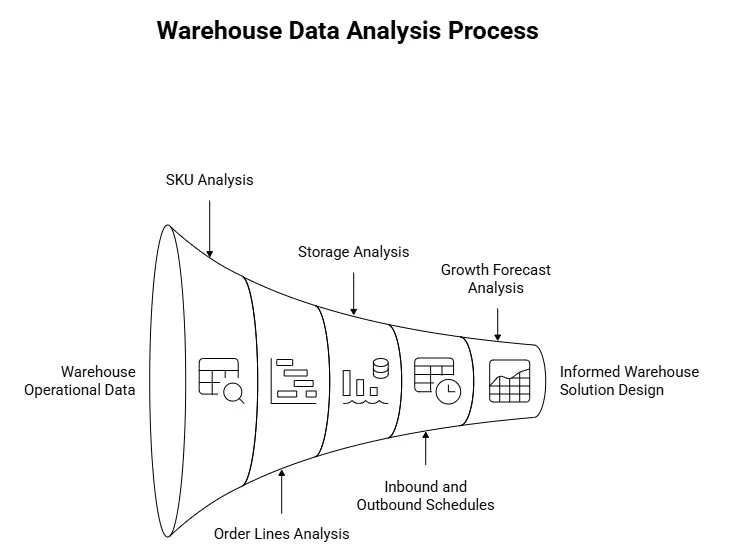
- Number of SKUs and their velocities
- Order lines per order
- Storage characteristics and days on hand
- Inbound schedules and outbound peaks
- Forecasts for growth or seasonal spikes
This analysis highlights where the real constraints are, whether it’s throughput, storage, replenishment, or travel distances. It also sets the required performance baseline: how fast everything moves, how much it must store, and how efficiently it must operate. In many cases, data also shows where automation isn’t needed, helping avoid unnecessary capital expenditure. This disciplined approach is critical for Warehouse Automation Solutions deployed across the US, where facilities often manage high SKU complexity and seasonal variability.
How Does Material Flow Mapping Strengthen Warehouse Automation Solutions?
Once the numbers are clear, we convert data into a flow diagram. Material Flow Mapping or Material Flow Diagram (MFD) is a visual chart or diagram that shows the main processes in the warehouse. The process flow illustrates how goods are received, the processes they go through, where they are stored, and any stages in between. It also shows in what quantities and rates these goods move at.
Typical Flow Diagram includes:
- Number of storage areas and storage locations
- Receiving throughput
- Putaway throughput
- Picking throughput
- Outbound/ Shipping throughput
This allows us to identify bottlenecks, travel paths, excessive touches, and non-value-added steps. The flow mapping can also reveal unexpected insights, such as the need for more buffers or better sequencing. The mapping becomes the blueprint for deciding which products in the automation portfolio can fix these bottlenecks and/or improve productivity.
Which Robotic Technologies Power Warehouse Automation Solutions?
A major advantage of having a broad product portfolio such as Addverb’s is the ability to design around the customer instead of forcing a one-size-fits-all solution.
- Pallet shuttles offer dense storage, high-throughput pallet handling, and efficient buffering.
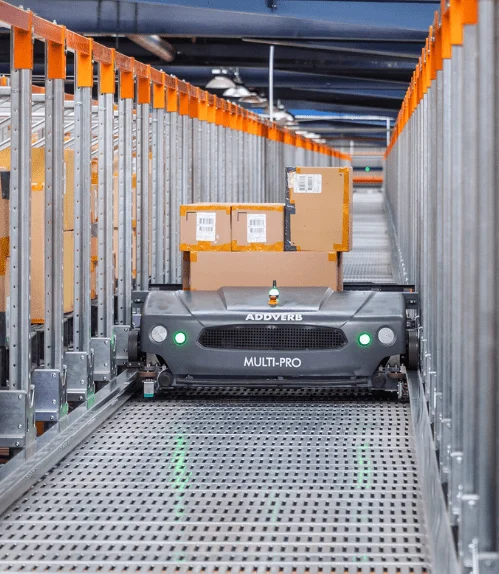
- Case shuttles are good for high-SKU, high-access operations – perfect for e-commerce, retail, and manufacturing.
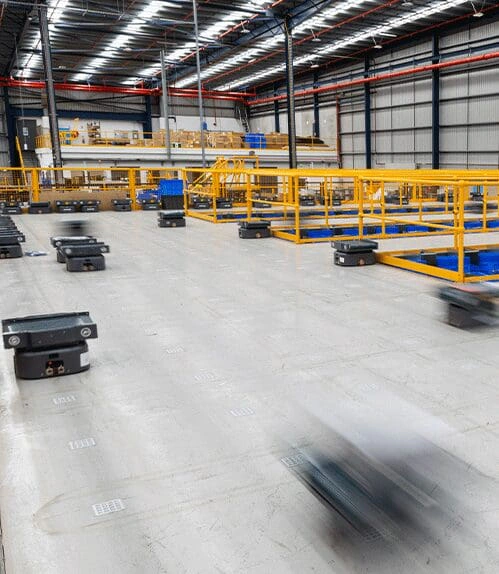
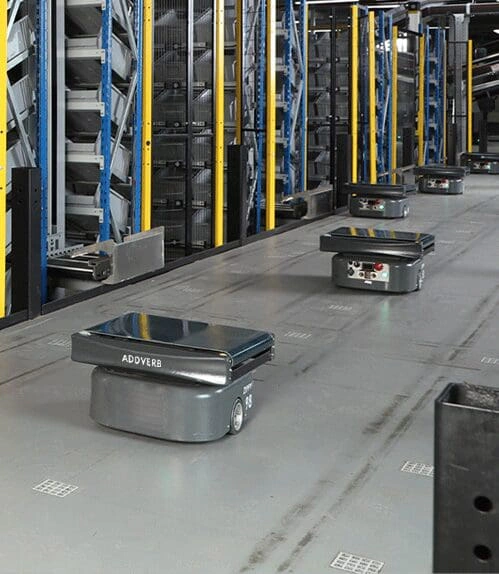
- AMRs provide flexible tote or carton movement without fixed infrastructure.
- AGVs deliver repeatable, safe pallet transport when paths and workflows are stable.
- Conveyors and sorters bring structure where predictable movement is needed.
- Pick stations and decant stations add human touchpoints into the system.
Having multiple tools lets us mix and match, building a system that is tailored to the warehouse’s DNA. This flexibility is especially important for Warehouse Automation Solutions in the United States, where distribution centers range from high-volume e-commerce fulfillment hubs to complex manufacturing facilities.
Augmenting With 3rd Party Equipment When Needed
No single automation vendor can (or should) do everything. The true power of an automation vendor comes from their ability to extend the system with complementary 3rd party equipment.
While Addverb’s strengths lie in storage, fixed and flexible automation, many workflows require specialized equipment that fills process gaps in the solution. By integrating peripheral systems such as print-and-apply labelers, carton erectors, case sealers, pallet stackers, and palletizers, Addverb can deliver a complete, turnkey solution that handles everything from dock to dock.
By strategically integrating proven 3rd-party peripheral equipment, we can:
- Broaden system capability
- Deliver turnkey automation, installation and service
- Increase customer value by having one vendor responsible for the entire solution
- Create modular, scalable, end-to-end solutions
Why ROI is the central driver in designing Warehouse Automation Solutions?
Budgets and ROI shape reality. Strong solutioning incorporates cost discipline throughout the process by:
- Designing for phased implementation
- Reducing equipment count where possible
- Leveraging existing infrastructure
- Using flexible automation over fixed automation (depending on the need)
- Utilizing manual operations within automation
Good design balances performance with financial constraints and timeliness of installation. The best solution isn’t the most expensive one, it’s the one that delivers the needed value within realistic economic boundaries and aligns with the customer’s timeline (as realistically as possible).
Turning Strategy Into Reality: Layout Development
Once the solution and product level decisions are made, the physical layout brings everything to life. Rack positions, shuttle aisles, AMR/AGV travel paths, and charging/maintenance spaces are all mapped onto the layout.
One step further, simulation brings the solution to life. A simulation uses real physics engines to replicate the solution as it would function in reality, and it helps answer critical questions:
- Can the system meet peak throughput?
- How many shuttles or robots are actually needed?
- Where do bottlenecks appear?
- What happens during extreme peak events?
Animation adds another dimension to the solution. It transforms the layout into a visual experience stakeholders can understand.
The WES Layer: The Brain That Orchestrates Everything
Robots move materials. The Warehouse Execution System (WES) makes decisions and orchestrates the robots through a Fleet Management System (FMS) layer.
A Warehouse Execution System (WES) is one of the most critical components in any warehouse automation ecosystem. Even the best hardware, like pallet shuttles, case shuttles, AMRs, AGVs, conveyors, cannot achieve peak performance without intelligent orchestration. The WES is the brain that makes automation work as one cohesive, efficient, and high-throughput system.
A WES:
- Orchestrates all subsystems
- Translates business logic into real-time operational decisions
- Maximizes throughput and asset utilization
- Enables sequencing, buffering and complex flows
Provides real-time monitoring and visibility
How Do Warehouse Automation Solutions Come Together?
Warehouse automation solutions designing is an engineered craft that requires deep understanding of customer operations, careful engineering, cross-functional coordination, and iterative validation.
Automation is a high investment for a customer, and mistakes in design can lead to major operational failures. A systematic design process ensures that the automation solution is not only feasible and scalable, but also aligned with customer goals and operational realities across the US (United States) logistics landscape.
Frequently Asked Questions?
1. What are warehouse automation solutions and how can they improve my warehouse performance?
Warehouse automation solutions combine robotics, storage systems, conveyors, and intelligent software to automate inventory movement, storage, picking, and order fulfillment. By reducing manual processes and optimizing material flow, they help warehouses increase throughput, improve order accuracy, lower labor dependency, and scale operations efficiently, especially in high-volume environments across the United States.
2. How much does a warehouse automation solution cost in the United States?
The cost depends on factors like warehouse size, order volume, storage density, level of automation, and the type of robotics and software required. Instead of a fixed price, companies typically evaluate the investment based on expected ROI, labor savings, throughput improvement, and long-term operational efficiency.
3. What ROI can companies expect from warehouse automation solutions?
Most companies achieve ROI in 2–5 years through labor savings, higher throughput, reduced errors, and better space utilization. High-volume e-commerce operations often see faster payback due to labor shortages and peak demand.
4. Which industries benefit most from warehouse automation solutions?
Industries with high SKU counts and order volumes benefit the most, including e-commerce, retail distribution, manufacturing, 3PL logistics, grocery, and pharmaceuticals.
5. How do I know if my warehouse needs automation?
You likely need automation if you face labor shortages, frequent picking errors, space constraints, delayed order fulfillment, seasonal demand spikes, or rising operating costs, these are the most common triggers companies search solutions for.