



ON THIS PAGE
You have specified the racks and lifts for a new pallet shuttle system, and penciled in a floor-level forward pick zone in front of the rack face for your fast movers. It is the default layout, and it is why, a year after go-live, the lifts become the throughput ceiling and part of your floor belongs to forklift aisles.
A forward pick area is a small, quick-to-reach store of your most-picked SKUs (stock keeping units), restocked from denser reserve storage. The question is where it should live. Our position: inside the reserve storage itself, on the ground level of the shuttle racks, connected straight to the pick stations, so lifts move stock for replenishment and almost never for picking. Below are the mechanism, where it breaks, and a decision rule for your next layout review.
In short
- In a lift-served layout, every fast-mover pick costs two lift moves. On the ground level it costs none.
- An open floor zone needs truck aisles (10.5 feet or more for standard counterbalance trucks) and a second pick process to consolidate.
- Embedded forward pick is capped by ground-level positions and ground-level shuttle capacity. Size those first.
- Give each fast mover enough ground-level pallets to last the peak pick window, so every replenishment lift move falls off-peak.
Why does the lift become the constraint?
The lift becomes the constraint because, in a standard layout, it touches every pick. In a shuttle AS/RS (automated storage and retrieval system), shuttles run horizontally on each rack level and vertical lifts carry pallets between levels and the station conveyors. If a fast mover sits on level six, the lift brings it down for each pick and takes it back up afterward.
Illustratively, a pallet that serves 20 order lines before emptying costs 40 lift moves. Slotted on the ground level, it costs one: the trip down when it replenished the ground lane. Every lift move spent presenting a fast mover is one unavailable for putaway or outbound full pallets.
What an open floor-level forward pick area costs you
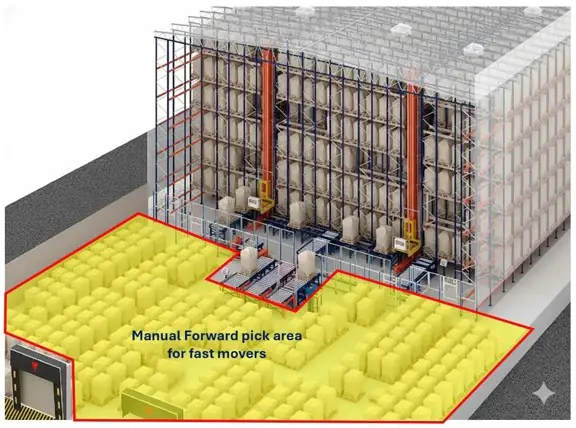
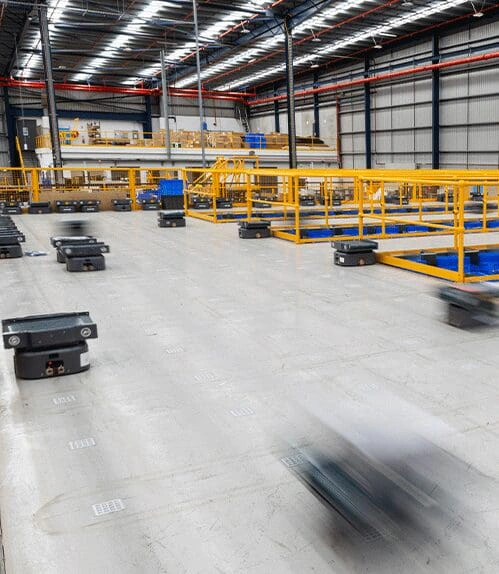
Shuttle AS/RS with an open, floor-level forward pick area for fast movers in front of the rack face
The usual fix is to stage a few days of fast-mover stock on the floor, where pickers work directly off pallets. It works, with three costs that surface after go-live.
Floor space goes to truck aisles
Floor pallet positions need forklift access. Toyota Material Handling puts standard counterbalance aisles at 10.5 feet or wider, and narrow-aisle reach trucks still need 8.5 to 10.5 feet. Inside shuttle racks there are no truck aisles; shuttles travel in the storage lanes themselves. Every floor slot gives ground-level footprint to access instead of storage.
Orders split across two pick processes
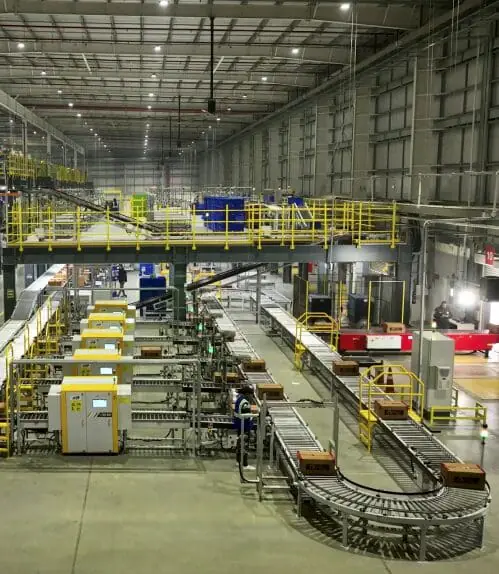
An order with lines from the floor zone and the AS/RS gets picked twice, in two places, and merged before it ships. That merge needs staging space and a warehouse execution system (WES) that releases both streams in step. One late floor pick holds the whole order.
Replenishment becomes a forklift job
Each restock pallet leaves the AS/RS outfeed and a driver carries it to a floor slot, often while pickers are working the same aisle. Restocking a forward area is real headcount. In Bartholdi and Hackman’s study of forward pick areas, one drug-store chain’s distribution center ran 20 restockers for 6,000 fast-moving SKUs, and the authors estimated that better space allocation might have cut that to 14. Their case was carton flow rack, not pallets, but the work is the same: people moving stock forward.
Also Read: Brownfield automation: retrofitting US warehouse layouts without downtime
How does forward pick inside reserve storage work?
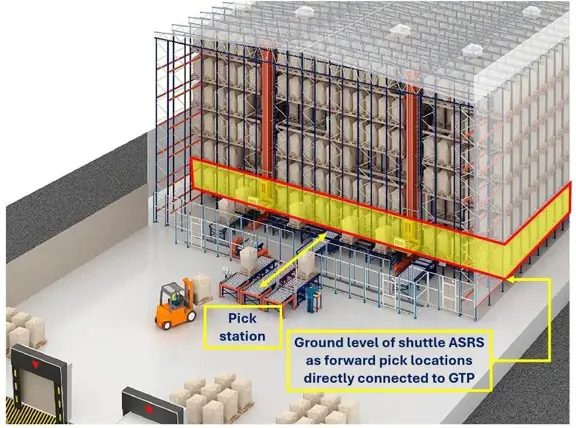
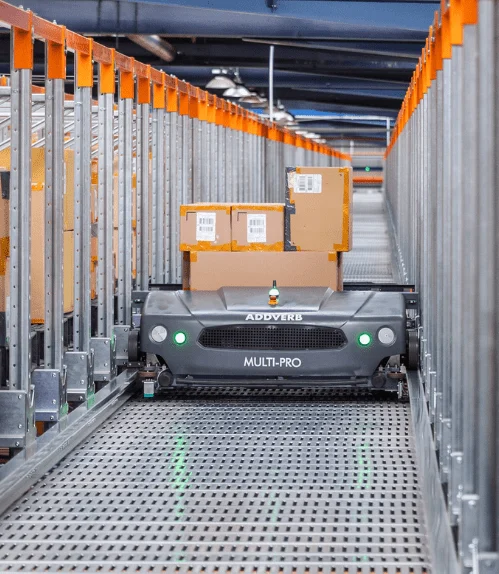
Pallet shuttle AS/RS with its ground level used as forward pick locations connected directly to a goods-to-person pick station
You reserve the ground level of the racks for fast movers and hold a defined cover period of their stock there, while slow movers fill the upper levels. Ground-level lanes connect by conveyor to goods-to-person (GTP) pick stations, so a fast-mover pallet travels lane to station and back on one level, with no lift involved. Slow movers take the normal route: shuttle to lift, lift to station.
When a ground lane runs low, the system pulls a reserve pallet from an upper level and the lift brings it down. Replenishment becomes an internal transfer scheduled by the warehouse control system, and because it is a machine move, it can run in shift breaks or overnight, away from the pickers.
On Addverb’s Cruiser 360 4-way pallet shuttle, rated for pallets up to 3,300 lb at 4.9 ft/s, the ground level is an ordinary storage level. What changes is mostly slotting logic and the conveyor interface at the rack face.
Open vs embedded forward pick at a glance
| Factor | Open floor-level zone | Embedded ground-level zone |
|---|---|---|
| Space for access | Truck aisles of 8.5 to 10.5+ ft | No truck aisles inside the rack |
| Lift moves per fast-mover pick | None; restocks leave via the outfeed | None; lift moves only on replenishment |
| Replenishment | Forklift driver, outfeed to floor slot | Shuttle and lift, schedulable off-peak |
| Consolidation | Two pick streams merged before shipping | One stream from one system |
| Concurrent pickers | As many as the floor allows | Limited to stations at the rack face |
| SKU mix change | Re-slot by forklift | Re-slot by lift, off-peak |
Where does embedded forward pick break down?
It breaks down when the fast-mover set outgrows one level. If your fast movers, multiplied by the cover period you want, exceed the ground positions, the overflow goes upstairs and the lift moves come back. All fast-mover traffic also lands on the ground level’s shuttles, so a fault there hits your busiest SKUs first. Plan spare shuttle capacity for that level specifically.
Two cases favor the open floor outright. If peak needs more simultaneous pickers than you can fit stations along the rack face, a floor zone scales labor where stations cannot. And if your fast-mover list churns weekly, every re-slot is a lift move.
How should you size the ground level?
Size it to cover the peak pick window, not to cut the number of restocks. With whole-pallet replenishment, the restock count is fixed by consumption: every pallet a fast mover uses means one lift move down, however much space you give it. Bartholdi and Hackman, citing van den Berg and colleagues, note that for unit loads, extra pallets stored forward save no restocks, but they do let restocks be deferred until picking is over. So give each fast mover enough ground-level pallets to last your peak window, and the lifts replenish in the quiet hours.
The common shortcut of equal days of supply per SKU deserves suspicion where you restock in less-than-pallet quantities, such as a carton flow zone fed from the shuttle. Bartholdi and Hackman showed it needs the same total restocks as giving every SKU equal space, and that allocating by the square root of each SKU’s flow does better. At a Revco Drugstores distribution center, they projected 40% fewer restocks in the same 325 bays.
Also Read: Proven ways to handle picking in high-volume US warehouses
A decision rule for your next layout review
Lean toward the embedded ground level if:
- fast movers are picked as cases at stations, not shipped as full pallets
- the fast-mover set at your target cover fits the ground positions with headroom
- your simulation shows lifts saturating before shuttles
Lean toward an open floor zone if peak needs more pickers than stations, your fast-mover list changes weekly, or an existing rack has no way to bring conveyor to the ground level.
Frequently asked questions about forward pick areas
What is a forward pick area in a warehouse?
A forward pick area is a small, easy-to-reach store of your most-picked SKUs, restocked from denser reserve storage so pickers spend less time walking and more time picking. Bartholdi and Hackman describe it as a cache of products that must be replenished from bulk storage. The size you give it decides how much restocking work you take on.
Where should a forward pick area go in a pallet shuttle system?
Place it on the ground level of the shuttle racks, connected by conveyor to goods-to-person pick stations, so fast-mover picks need no lift moves and the lifts handle replenishment only. On Addverb’s Cruiser 360 4-way pallet shuttle, the ground level is an ordinary storage level, so the change is mostly slotting logic and a conveyor interface. An open floor zone in front of the rack face is the alternative.
How many lift moves does a fast-mover pick cost in a shuttle AS/RS?
In a standard lift-served layout, each fast-mover pick costs two lift moves: one to bring the pallet down to the station and one to return it to its rack level. A pallet picked 20 times before it empties therefore uses 40 lift moves upstairs. On the ground level, the same pallet uses one, the trip down when it replenishes the lane.
When is an embedded forward pick area a poor fit?
An embedded ground-level zone is a poor fit when peak demand needs more simultaneous pickers than you can seat at stations along the rack face, or when your fast-mover list changes weekly. It also fails where an existing rack cannot take a conveyor at ground level. In those cases an open floor zone scales labor better, at the cost of truck aisles and a second pick process.
How do you size the ground level of a forward pick area?
Size the ground level so each fast mover has enough pallets to last your peak pick window, rather than trying to cut the total number of restocks. With whole-pallet replenishment, consumption fixes the restock count, so extra pallets forward only let you defer restocks until picking ends. Check that your fast-mover set at the target cover period fits the ground positions with headroom.
Planning a pallet shuttle layout? See how the ground level works on Addverb’s Cruiser 360 4-way pallet shuttle, then bring your order profile to a layout review with our US team.
Read the Original Post: https://www.linkedin.com/pulse/forward-pick-inside-reserve-storage-shuttle-asrs-vinayak-shete-6j3qc
Author : Vinayak Shete