






Frequently Asked Questions
-
What is a robotic pallet mover?
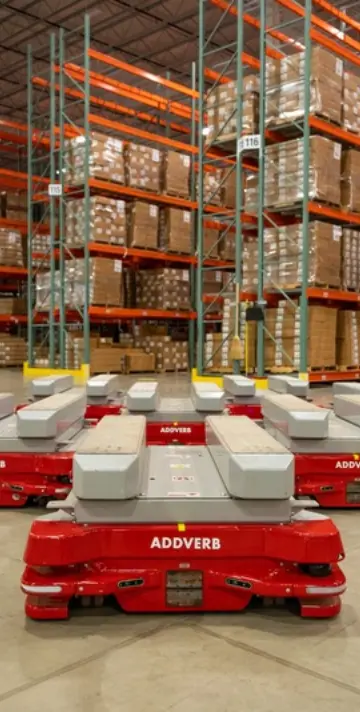
A robotic pallet mover is an autonomous mobile robot (AMR) that carries pallets, carts, totes and cases around a warehouse on its own, using LiDAR, safety sensors and onboard maps instead of a forklift driver. Addverb's Dynamo uses natural navigation to plan routes, steer around people and equipment, and dock at stations within ±0.4 in (±10 mm). A fleet management system assigns jobs and manages traffic across the fleet. -
What is the difference between an AMR and an AGV?
An AMR plans its own path and reroutes around obstacles in real time, while an AGV follows fixed guides such as magnetic tape or floor markers and stops when something blocks its route. That makes AMRs easier to redeploy when your layout changes, because you remap the floor in software instead of re-taping it. AGVs suit simple, repetitive routes. Addverb builds both: Dynamo uses natural navigation, while the Dash assembly line robot follows ground markers. -
How much weight can a robotic pallet mover carry?
Addverb's Dynamo robotic pallet mover comes in six models rated from 220 lb (100 kg) up to 5,500 lb (2,500 kg), so one platform covers everything from light tote runs to heavy pallet and cart moves. -
How much does a robotic pallet mover cost?
The cost of a robotic pallet mover depends on payload, fleet size, attachments and how deeply it integrates with your WMS, so Addverb sizes and prices each Dynamo fleet after simulating your material flows. -
Are autonomous mobile robots safe to work alongside people?
Yes, autonomous mobile robots are built to share floor space with people: Addverb's Dynamo uses 2D LiDAR and safety sensors to detect obstacles, slow down and stop before contact, then reroute around the blockage. Safety zones and speed limits are set for your facility during commissioning.