
Table of Contents
Driven by the need for ever-faster, ever-smarter and cost-efficient fulfillment, warehouses in 2026 feel the pressure of employing sorting robotics. With order volumes on the rise and continued SKU diversity expansion, the demand for advanced robotic sorting solutions stronger than ever.
Two years ago, around 40% of companies had no plans to use robots. That number has come down to 8% according to the annual Intralogistics Robotics Survey from Peerless Research Group, MHI and The Robotics Group.
Such a shift has pushed sorting robotics from optional innovation to core operational strategy. Modern warehouses depend on automated systems that increase output while removing errors for a more predictable workflow. This new level of efficiency and precision in business operations now trickles throughout entire supply chains, as sorting robots continue to gain widespread adoption at an increasing pace.
Addverb has been at the forefront of this transformation by designing intelligent logistics robots that streamline material flow and sorting. Its technology bridges the gap between speed, accuracy and scalability, enabling facilities to move from manual bottlenecks to fully optimized workflows.
This article will focus on the warehouse sorting robots, how they upgrade operational accuracy and the role of robotics in material handling, specifically elaborating on the automation portfolio of Addverb.
Factors Creating the Need for Sorting Robots in a Warehouse
Sorting robots are fast-becoming essential in warehouses due to increasing order volumes when a business scales. These robots bring predictable speed to the operations. Apart from this, the factors that creates need for sorting robots in a warehouses are:
- Customer expectations for same-day and next-day delivery.
- E-commerce growth has led to an increase in SKUs, making manual identification and segregation inefficient.
- Labour shortages and high attrition rates push warehouses to depend more on robotics to automate repetitive tasks.
- Peak-season spikes require scalable systems that can ramp up instantly – something that robots can manage easily.
- Rising operational costs encourage automation to optimize accuracy and reduce rework.
- Complex multi-channel fulfilment needs smart and tech-driven routing that robots deliver consistently.
- Increased return volumes make reverse logistics more demanding and error-prone.
Benefits of Using Sorting Robots in Warehouses
Warehouses of today must be agile to maneuver the changing needs. Robotic solutions for sorting offer higher accuracy and speed. They can be scaled, distributed in a fraction of the time, and effectively reduce the amount of physical area used and the long-term labor cost.
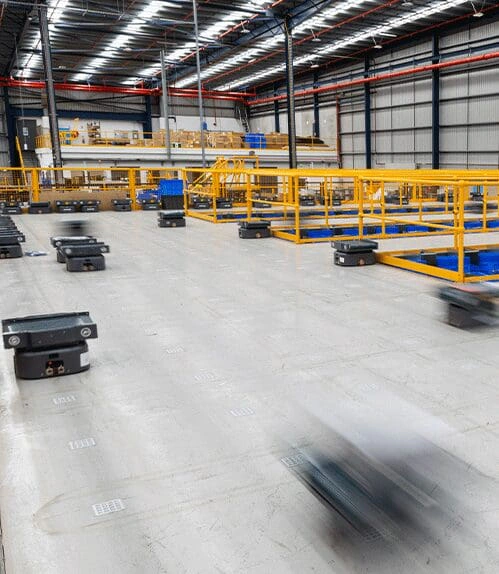
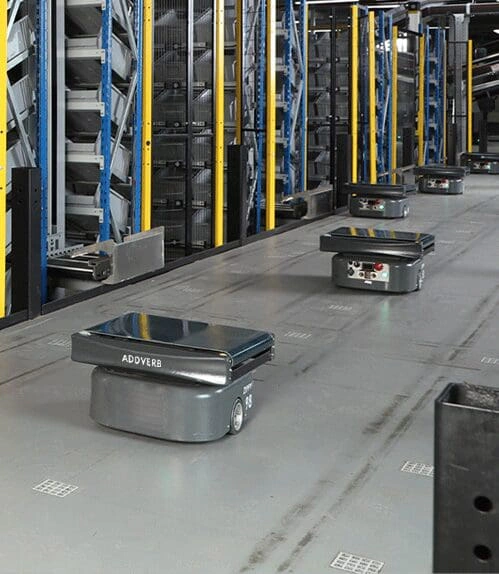
Addverb’s robotic sorter, Zippy 6 can perform up to 30,000 sorts per hour with 99.9% SKU-level accuracy, a benchmark impossible to match through manual sorting. This level of automated precision minimises human error, reduces rework, and ensures faster order turnaround.
Addverb has successfully delivered robotic sortation system to DHL within a time frame of 8 months, leveraging Addverb’s in-house manufacturing and integration capabilities.
Vertical sortation robots, SortIE, add another layer of capability by enabling robotic sortation across multiple height levels. This maximises warehouse space usage while speeding up put-away and returns processing.
Impact of Sorting Robots on Enhanced Operational Accuracy
Accuracy is a crucial aspect of warehouse operations, especially in e-commerce and
fast-moving consumer goods. Manual sorting is highly error-prone due to human limitations. Our robots are equipped with vision systems, barcode readers with or without barcodes and closed-loop feedback to ensure that each item is routed accurately.
SortIE uses dedicated tracks and multi-height destinations to maintain consistent accuracy across vertical robotic sortation. With speeds up to 3 m/s and 400 sorts per hour, it enhances precision in workflows that traditionally see high error rates, such as reverse logistics and put-away.
Manual vs. Automated Sorting Workflows
Manual sorting is highly dependent on human judgment, and thus, the throughput and error rates can fluctuate. Warehouse sorting robots, by contrast, perform repetitive tasks at a fixed rate and precision. A precise comparison between the two shows:
| Aspect | Manual Sorting | Automated Sortation |
| Reliability | Dependent on human judgement; fluctuating accuracy | Performs repetitive tasks at fixed precision and consistency |
| Throughput | Slower cycle times; variable output | Predictable throughput at high speed |
| Error Rates | Higher likelihood of mistakes | Low error rates with consistent quality |
Case Studies of Successful Sortation Robot Deployments
Deployed across various use-case scenarios, Addverb has helped several firms to cater to an increased SKU load.
Maersk struggled to manage diverse SKUs, seasonal fluctuations and complex omnichannel fulfilment with existing warehouse processes. Addverb implemented a flexible mix of AMRs, ASRS and sorting robots, resulting in higher accuracy, improved space utilisation and smoother end-to-end operations.
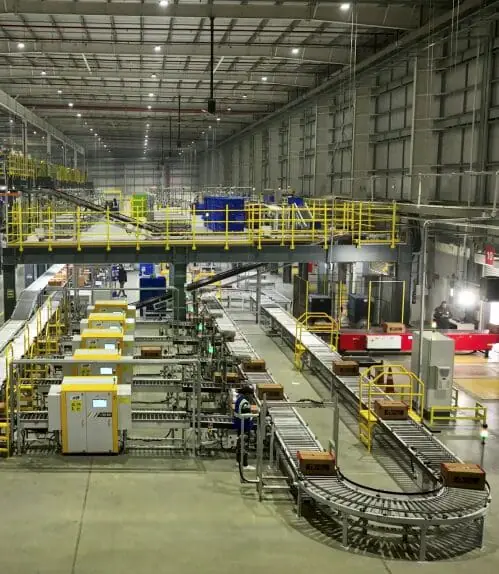
Similarly, Landmark struggled with slow, manual e-commerce fulfillment and needed a flexible system to handle diverse SKUs with high accuracy. Addverb’s patented Quazzy solution, an unique system to handle table top sortation and meshes seamlessly with Addverb’s Warehouse Management System (Optimus) and the Fleet Management System (Movect) to provide for end-to-end orchestration. This helps to coordinate item identification, sorting route, and downstream packing to minimize delays and exceptions.
These case studies show the benefits of deploying logistics robots and sorting robots, including the creation of steady and scalable performance with automation.
Future Trends on Automation in Warehouse Sorting
Sorting robotics with AI, edge computing and improved human-robot cooperation could hold promise in major material handling projects. Prominent among these trends is AI-vision mixed with heterogeneous object identification, plug-and-play robot modules for instant deployment and hybrid systems mixing AMRs with fixed sorters.
Addverb is currently investing significantly in creating smart algorithms and sensor fusion, empowering robots in a learning context through operations, so that they can change routing strategies dynamically. The evolution of these technologies reflects a vision of autonomous and self-programming in future sorts within warehouse settings.
Addverb’s Role in Advanced Sorting Robotics
To achieve overall operations, Addverb creates fully integrated solutions in terms of the mechanical and software aspects.
Our Robotic Sorter has 5 variants:
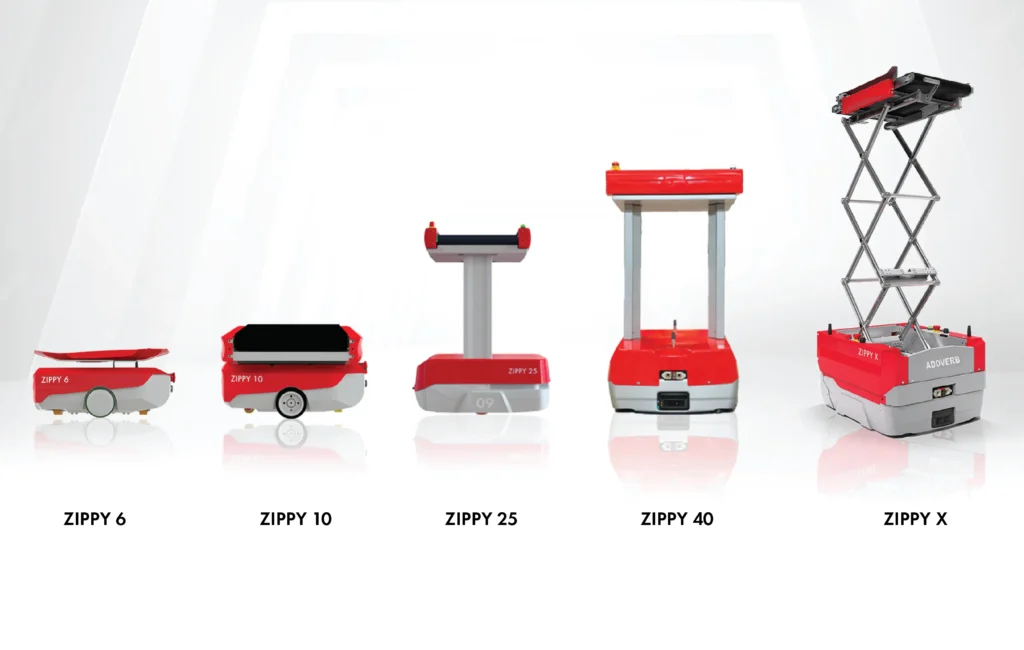
- Zippy 6 – Payload of up to 6 kg
- Zippy 10 – Payload of up to 10 kg,
- Zippy 25 – Payload of up to 25 kg
- Zippy 40 – Payload of up to 40 kg
- Zippy X – Payload of up to 15 kg (which utilises vertical lifting capabilities for flexible material handling) facilitates high-speed sortation tasks, enabling rapid distribution of small items across multiple lanes.
- For fixed parcel sortation, we have SortIE – Payload of up to 10 kg
Robotics in material handling is usually accompanied by Addverb’s WMS (Optimus) and WCS (Mobinity) for accurate recognition, real-time presentation of routing and rapid handling of discrepancies. Addverb stands firm on its rapid deployment of outrun, operational resilience and measurability of ROI.
Conclusion
Sorting robots are not optional additions anymore; they are the basis of an operationally sound fulfilment function. Automated systems increase the throughput, accuracy, safety and scalability and reduce manual and operator overhead. Moreover, even big companies like FedEx are employing robots that improve parcel sorting (Source).
The portfolio of warehouse sorting robots and all-around integrated software that Addverb provides showcases working examples of how modern warehouses can effectively migrate from reactive manual processes to data-driven decision-making processes.
With the rise of robotic selection in logistics, companies will benefit from faster move-in and an overall decrease in error rates, thus augmenting customer satisfaction. Addverb will be aligned to lead this change by providing some turnkey sorting solutions in line with broader intralogistics directives.
FAQs
1. What are the advantages of using warehouse sorting robots?
Sorting robots maximize throughput, reduce error rates and create great scalability.
2. How do sorting robots improve operational accuracy?
They incorporate a vision system, real-time verification and co-ordinates with FMS to make sure the correct routing is controlled.
3. How does manual sorting differ from automated sorting workflows?
Manual sorting depends on the person and the need for high labor, while automated sortation provides speed and accuracy measurably.
4. What do you think future trends will be in warehouse sorting automation?
In order to rapidly scale, the field would take AI-driven vision, hybrid systems incorporating AMRs, fixed sorters and plug-and-play robotics modules with it.
5. What factors should warehouses consider before adopting sorting robots?
Warehouses must assess their SKU volumes, order profiles, existing WMS readiness, floor layout as well as scalability requirements to ensure the sorting robots integrate smoothly.
Founded in 2016, Addverb offers complete robotics solutions for warehouse and industrial automation, with a strong global presence through its subsidiaries worldwide. The company provides a range of in-house automation products, including Mobile Robots, ASRS, and picking systems. It serves over 350+ clients, including well-known companies such as Coca-Cola, Amazon, and DHL.