



ON THIS PAGE
It’s 10:40 on a Monday. A pallet is parked in the cross-aisle, the tugger route feeding your pack stations has stopped, and someone on the floor is asking whether warehouse AMRs would have just driven around it.
They would have. An autonomous mobile robot (AMR) is a self-navigating vehicle that carries loads through a facility using onboard sensors and a software map, with no tape, wire or rails on the floor. When an aisle is blocked, it plans another way through. Most mobile robots built for live aisles can do this today.
The harder question is whether that rerouting still works at 2 p.m. on your peak day, when the whole fleet is rerouting at once. That depends far more on the fleet software than on the robot, and this post covers how to test it before you buy.
Takeaways
- Fixed-path systems stop when the route is blocked, and changing a route means changing the floor.
- Warehouse AMRs reroute on their own, so a layout change becomes a map edit.
- At peak, the fleet manager decides throughput: task allocation, traffic control, charge scheduling and the link to your WMS.
- On stable, high, constant-volume routes, a conveyor still moves more material per dollar.
Why do fixed paths break down when the floor changes mid-shift?
A fixed-path system, whether a conveyor run or an automated guided vehicle (AGV) following wire, tape or magnets, does one route very well. Its cycle times are predictable because nothing about the route is negotiable. That is also how it fails. An AGV that meets a stray pallet stops and waits for someone to clear it. A new pick zone or a re-slotted fast-mover area means re-laying floor markers and reprogramming routes, which usually means downtime and a contractor.
For an operations manager, the cost shows up in two places: the minutes lost each time a person walks over to clear a path, and the layout changes you quietly stop proposing because the floor work isn’t worth it.
How do warehouse AMRs navigate without a fixed route?
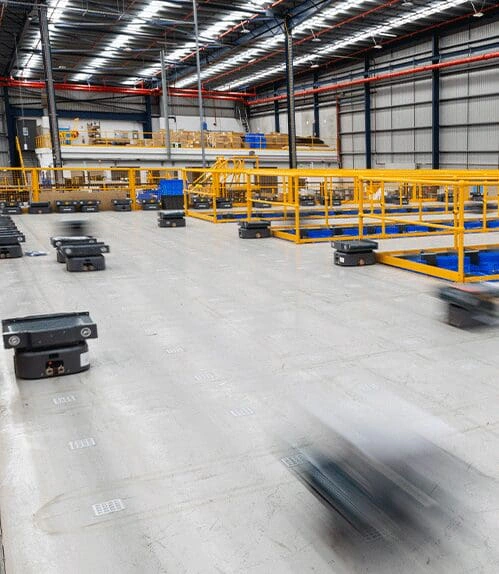
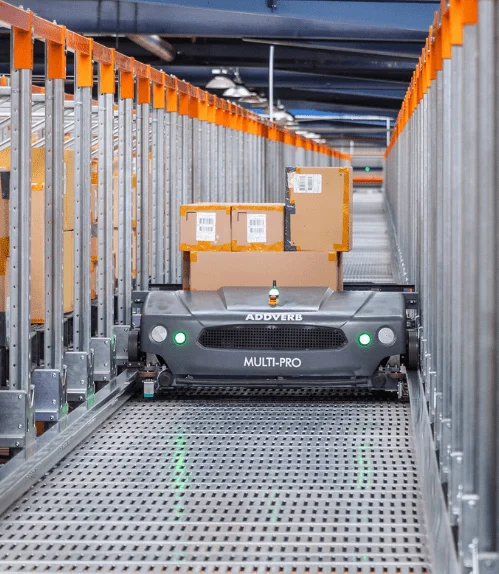
An warehouse AMR maps the facility with laser scanners (LiDAR) and cameras, then uses simultaneous localization and mapping (SLAM) to place itself on that map in real time. Operators teach pickup and drop-off points through the robot interface and set speed zones, preferred lanes and restricted areas. When a forklift or a person blocks the planned path, the robot recalculates around it or holds until the lane clears.
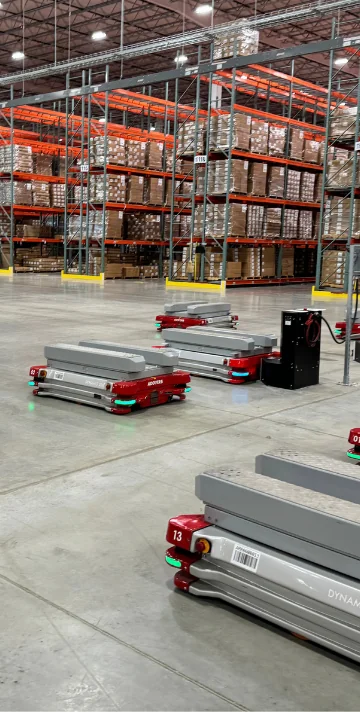
Addverb’s Dynamo robotic pallet mover works this way, moving loads of up to 3,300 lbs at up to 4.9 ft/s. The practical consequence is that moving a pick zone is a change made in software, over a shift change, with no floor work.
Also Read: Fixed and Flexible Automation: Intersecting Efficiency with Scalability
What happens when the whole fleet is rerouting at once?
Rerouting is a local decision. One robot sees one blocked aisle and takes the next-best path. At 9 a.m. with six robots running, that is enough. At peak, with the fleet doubled and forklifts working the same cross-aisles, every local decision pushes traffic into another robot’s route. Twenty robots each choosing their own next-best path can build a jam nobody planned.
The fleet management system is what prevents that. It assigns each task to the nearest available robot, manages traffic at intersections, schedules charging, and reports status back to your WMS. Charging matters more than it looks. Addverb lists an 8-minute charge for Dynamo 100 against a run time of up to 4 hours, so opportunity charging has to be planned around your peak window. If half the fleet heads for the chargers at 2 p.m., your rerouting capability is irrelevant.
Fixed-path vs AMR material movement at a glance
Factor | Fixed path (conveyor or AGV) | AMR fleet |
How the route is set | Physically, with wire, tape, magnets or steel | In software, on a LiDAR and SLAM map |
Blocked path | Stops until someone clears it | Reroutes or holds, per fleet rules |
Layout change | Re-lay markers or move equipment | Edit the map and zones |
Adding capacity | Extend or rebuild the line | Add robots; fleet software reallocates tasks |
Peak behavior | Predictable, if it was sized for peak | Depends on traffic and charge management |
Best fit | Stable routes, high constant volume | Changing layouts, SKUs or volumes |
What two US deployments show about fleet software
At an automated brake parts distribution center in Bedford Park, Illinois, pickers were walking long distances and lifting heavy products, and turnover was high. Addverb deployed Dynamo AMRs rated for up to 1,100 lbs each alongside 25-plus robotic sorters, and integrated its fleet management software with the site’s warehouse execution system. Robots, voice-picking devices and staff now work from one task flow. The AMRs handle 80 to 100 carts a day, each holding 12 orders, and picking productivity rose 25%.
At The Wooster Brush Company in Wooster, Ohio, the starting point was a paper-based picking process. Addverb put 13 AMRs on the floor that follow pickers through the aisles, so associates place product straight onto the pallet the robot carries. One fleet management system coordinates all 13. The site now dispatches 15,000 cases a day through the AMRs, twice the capacity of the manual process.
In both sites the robots are the part visitors notice. The integration between the fleet software and the system issuing work is what keeps the carts arriving on time.
When is a fixed path still the better choice?
If your routes never change and volume is high and constant, a conveyor or fixed shuttle will usually move more material per dollar than an AMR fleet. Warehouse AMRs also struggle on badly damaged floors, steep grades and very long one-direction hauls, where you end up adding robots faster than you add throughput. If forklift traffic is unmanaged or aisles are routinely blocked, AMR travel times will climb until floor discipline improves.
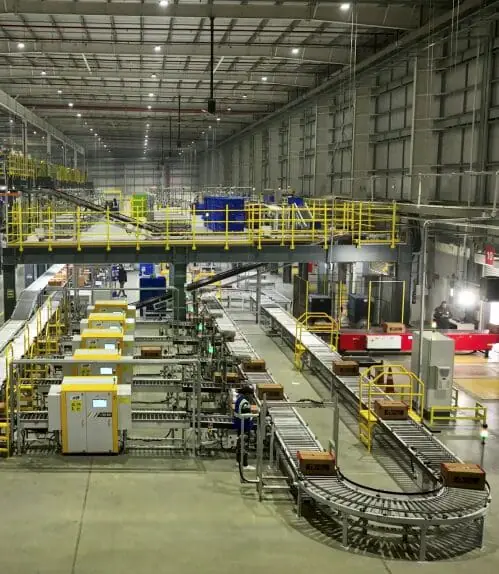
Many sites end up running both: fixed conveyance on the stable trunk routes, AMRs on the parts of the floor that keep changing. That blend is how Addverb approaches material movement across fixed and flexible equipment, with one software layer over both.
Four questions to ask before you trust an AMR fleet at peak
- Can you show me the fleet at its busiest hour? Ask for traffic data from a live site at peak density, rather than a demo with three robots in an empty aisle.
- How is charging scheduled around my peak window? Get the charge time, run time and the rule that decides which robot charges when.
- What does the fleet manager exchange with my WMS or WES, and who owns that integration? Integration is usually the longest item on the schedule.
- How will you support ANSI/A3 R15.08? The R15.08 safety standard for industrial mobile robots now has three parts. Part 3, new in 2026, covers safe day-to-day use, which is your team’s job after go-live.
See it running in a site like yours
Rerouting around a blocked aisle is table stakes for any warehouse AMR. What you are really buying is the software that keeps rerouting orderly when the fleet doubles for peak. Before your next vendor meeting, pull last year’s peak-day volume by hour and ask each vendor to show their fleet handling that curve. Then look at how it played out on real floors: Addverb’s US warehouse automation case studies list the robot counts and daily volumes for each site.
FAQs
What is the difference between an AMR and an AGV? An AGV follows a fixed path set by wire, tape or magnets and stops when blocked. An AMR navigates with onboard sensors and a software map, so it reroutes around obstacles and a route change is a software edit.
Do AMRs need changes to the warehouse floor? They need no tape, wire or magnets. They do need reasonably flat, undamaged floors, charging stations sized to the fleet, and sometimes transfer stands at pickup and drop-off points.
How do warehouse AMRs connect to a WMS or WES? The fleet manager receives tasks from the WMS or warehouse execution system through an API and returns status updates. At the brake parts site, this integration let AMRs, voice picking and staff share one task flow.
How long does an AMR deployment take? Mapping a facility and commissioning a small fleet takes weeks, and WMS integration is usually the longest item. Addverb has installed more than 500 robots across North America since entering the market in 2022.
Are warehouse AMRs safe to run alongside people? AMRs detect people and obstacles with LiDAR and slow down, stop or reroute. In the US, the ANSI/A3 R15.08 series sets safety requirements for the robot, its integration and its day-to-day use.