



ON THIS PAGE
The discussion surrounding AGV vs AMR in warehouses and fulfilment centres is gaining momentum for all the right reasons. Why depend on human resources to transport materials when these tasks can be easily automated and allow employees to focus on higher-value tasks?
AMRs are leading the warehouse automation market, with expectations to exceed $40 billion in the next five years, boasting a projected annual growth rate of 15%, according to a recent LogisticsIQ report.
By automating the transportation of materials, organisations can optimise productivity and schedule deliveries more efficiently to reduce bottlenecks in the production process. However, when it comes to choosing between AMR vs AGV, it is essential to understand how they are different and which one will serve your needs better.
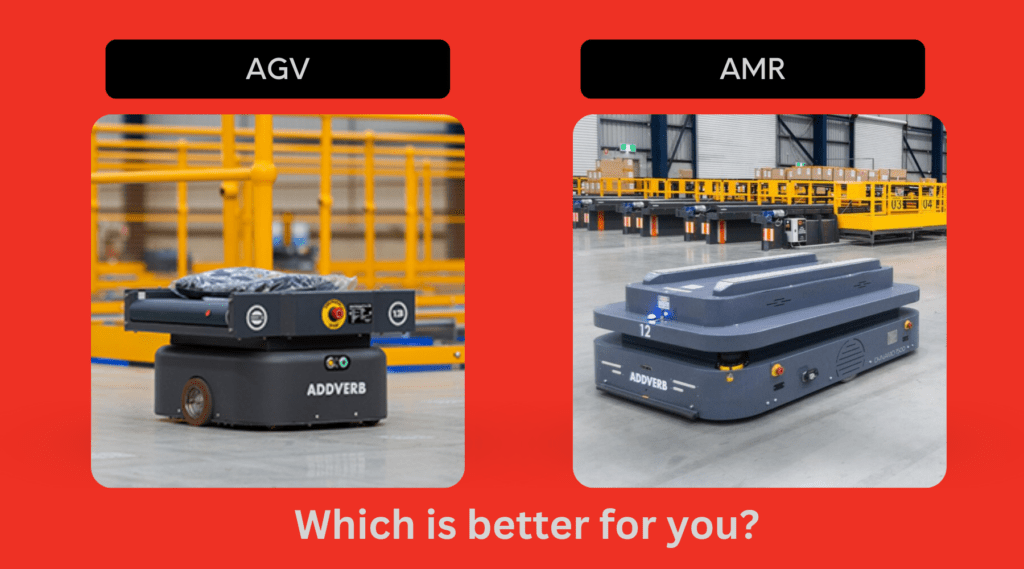
What do AGV and AMR stand for?
AGV stands for Automated Guided Vehicle-which is another type of robot used for transporting materials along fixed paths or tracks. On most occasions, these vehicles use the infrastructure ofQR codes, magnetic strips, wires, or painted lines to navigate.
Compared to advanced systems, AGVs generally have fixed paths programmed into them, eliminating their flexibility in comparison to newer technologies such as Autonomous Mobile Robots. Such vehicles exist in surroundings where the layout does not change for any reason and there is hardly any human interaction.
AGVs (Automated Guided Vehicle)
A robot that moves along fixed tracks or paths for transporting materials, usually requiring changes in the infrastructure like wires or magnetic tapes.
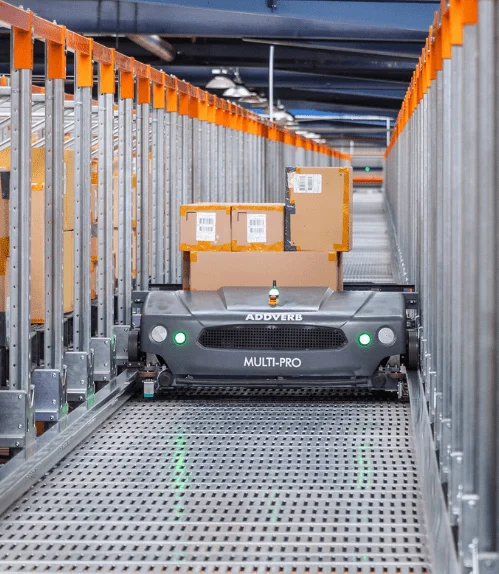
Addverb’s Sorting Robots – AGVs are
Vertical Sortation Robot – SortIE
Mobile Robotss
A robot that functions autonomously and is flexible enough to navigate in anuncontrolled environment without the need for fixed tracks or paths.
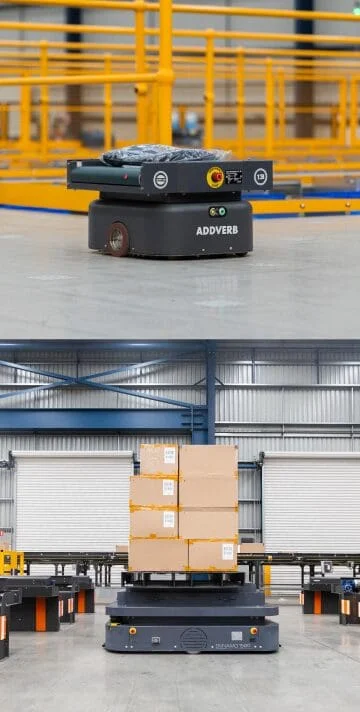
Addverb’s Mobile robots are
Autonomous Mobile Robot – Dynamo
Multi-carton Picking Robot – Veloce
Understanding the Difference: AGV vs AMR
Automated Guided Vehicles and Autonomous Mobile Robots are robotic solutions that are used for material handling in warehouses, manufacturing facilities, and distribution centres. These devices are used for moving materials from one location to another and making material flow more accurate, quick, and efficient.
Following are some of the parameters based on which the differences can be determined:
- Navigation
- Safety
- Obstacle avoidance
- Flexibility
- Applications
- Responsiveness
- Deployment
- Ownership cost
- Maintenance
Here’s a concise comparison of AGV vs AMR across key aspects to help you make informed decisions based on your specific priorities and needs:
| Aspect | AGVs | AMRs |
| Navigation | Typically follow fixed lines or paths using magnets, wires, or markers | Use cameras, advanced sensors, and mapping algorithms for dynamic navigation |
| Safety | Need physical zones/barriers for human separation; standard safety practices | Built-in safety features; Collaborative robots, safely work with humans |
| Obstacle Avoidance | Basic obstacle detection; may require human intervention | Advanced obstacle avoidance; Real-time adaptability to autonomously avoid obstacles |
| Flexibility | Less flexible; changes in paths or layout need physical alterations | Highly flexible; easily accommodates changing layouts without physical changes |
| Applications | Common in manufacturing and warehousing for material transport | Widely used across industries such as logistics, healthcare, and agriculture |
| Responsiveness | Fixed routes with less adaptability to real-time changes. | Quick responsiveness to changing tasks and conditions |
| Deployment | Complex installation with dedicated infrastructure | Quick setup with dedicated infrastructure; plug-and-play |
| Ownership Cost | Lower upfront costs; relatively higher long-term costs | Higher upfront costs; potential for lower long-term costs due to adaptability |
| Maintenance | Regular maintenance due to mechanical parts and fixed infrastructure | Lower maintenance requirements with fewer mechanical components |
Given below is the detailed comparison, where we have broken down the key differences between AGV vs AMR to help you develop a better understanding of the two:
Types of Mobile Robots – What to use where? – Also Read
Navigation
Navigation is one of the key factors that distinguishes an Autonomous Mobile Robot from an Automated Guided Vehicle.
Autonomous Mobile Robots are integrated with advanced sensors and mapping capabilities that enable them to understand their surroundings and navigate easily. This implies that AMRs can avoid obstacles and environmental changes without requiring physical guidance or magnets. To learn in detail about AMRs, you can read here – AMR Robots – Complete Guide.
On the other hand, Automated Guided Vehicles have to follow a fixed path. Older AGVs rely on induction paint lines or underground wiring. These days, AGVs come equipped with sensors just like AMRs and these sensors allow AGVs to become alert in the face of an obstacle, but they won’t be able to change the route.
Safety
Both AGVs and AMRs are equipped with safety features such as cameras, sensors, and emergency stop buttons. However, Autonomous Mobile Robots have the ability to detect obstacles and navigate around people which makes them safer than Automated Guided Vehicles.
AGVs are preferably used in areas secluded from humans to ensure safety. It also means they have to move in long distances to perform the tasks, which can lead to faster wear and tear.
Obstacle Avoidance
The primary difference of AGV vs AMR lies in obstacle avoidance. AMRs can navigate around obstacles autonomously by continuously scanning their surroundings and building a map of the environment. On the other hand, AGVs can detect obstacles but cannot change their route; they simply stop and wait for the obstacle to be removed.
Flexibility
AGVs are devised to move on a specified route while AMRs can be configured to work around obstacles and alter routes as per the requirement. Thus, if the layout of the facility has to be changed or expanded, it is way easier to reconfigure the AMRs than to change the navigation layout for AGVs.
Furthermore, AGVs are mostly limited to performing just one task, such as transporting material from one point to another, while AMRs can be configured to perform different tasks. Despite changes in the surroundings, the sensors and GPS systems used in AMRs, allow them to operate continuously. In contrast, AGVs can become redundant due to changes in the environment. Because of these factors, AMRs are considered more flexible than AGVs.
Planning to upgrade your warehouse operations with efficient and hi-tech mobile robots? Check out Dynamo, Addverb’s intelligent mobile robot that is enabled with 2D/3D LiDARs and powered by SLAM algorithms that help it navigate complex landscapes in warehouses and factories. Make your warehouse future-proof today!
Applications
AMRs have a broader range of applications, including retail, healthcare, logistics, and more, thanks to their ability to navigate around obstacles and interact with people. AGVs are primarily used in industrial settings where human interaction is limited. Both AGVs and AMRs find applications across various industries, including logistics, e-commerce, warehousing, manufacturing, healthcare, biotech, food and beverage, and more.
An Autonomous Mobile Robot will automatically avoid objects in its way and divert to the best alternative route in real time. In contrast, an Automated Guided Vehicle will immediately stop upon detecting an obstacle and wait for that obstacle to be removed, which as a result makes the operations stagnant and impacts efficiency.
Demystifying Warehouse Robotics: Functions and Applications of Mobile Robots : – Also Read
Deployment
The time-frame to deploy an AMR depends on factors like the size of the site and its complexity. Generally, AMR deployment can be swift and cause little disruption.
A major advantage of Autonomous Mobile Robots (AMRs) is that they do not need special infrastructure or wiring, which makes them versatile for deployment in various environments. Moreover, as they can navigate around obstacles safely, they can start working instantly without extensive programming or training.
Traditional AGVs often require extensive integration into existing infrastructure and workflows, involving special wiring or magnetic tape for navigation and specific route programming.
Ownership Cost
The ownership cost of an AMR is usually lesser than a conventional AGVs because they are relatively low maintenance. While AMRs incorporate more advanced technology, they are a more cost-effective deployment solution. AGVs often require expensive infrastructure changes, such as magnetic tape, stripes, or wires for navigation, resulting in higher upfront costs and longer revenue realisation times.
Maintenance Cost
AGVs that are traditional, call for some degree of continuous maintenance checks to ensure the proper functioning of magnetic tape whereas AMRs do not require such infrastructural maintenance except periodic maintenance, including sensors and battery upkeep and software updates.
Although, some level of maintenance is required in mobile robots, they can still offer considerable benefits over conventional methods of operations.
Concluding Remarks
Autonomous Mobile Robots offer real-time route planning, obstacle avoidance, and seamless collaboration with humans for material movement and handling activities. Their adaptability, agility, and minimal maintenance requirements make them suitable for a wide range of tasks compared to AGVs. Although AGVs have been around longer, AMRs are emerging as the preferred option for various applications.
If you are considering integrating mobile robot solutions into your facility, it is essential to carefully evaluate the advantages and disadvantages of both, know why AGV vs AMR matters to your industry and determine the best fit for your specific needs.