



ON THIS PAGE
Walk into a busy warehouse, and you will quickly see where time gets lost. Workers move back and forth looking for inventory, forklifts travel through aisles, and the space above the racks sits unused. As SKU (stock keeping unit) counts rise and fulfillment windows get tighter, conventional storage makes these problems harder to manage.
This is where an AS/RS storage system can make a real difference. An AS/RS (automated storage and retrieval system) is a combination of dense racking, shuttles or cranes, and control software that stores and retrieves loads without a person traveling to the location. According to Global Market Insights, the North America AS/RS market was valued at USD 3 billion in 2025 and is expected to grow from USD 3.2 billion in 2026 to USD 4.5 billion by 2035, at a CAGR of 3.9%.
That growth does not mean every AS/RS fits every building. The payoff comes from matching the system to your load type and throughput.
Key takeaways
- AS/RS pays off when the system matches the load: pallet shuttles for pallets, carton and multi-level shuttles for totes and cartons.
- The U.S. accounted for 85.2% of the North American AS/RS market in 2025, according to Global Market Insights.
- High upfront cost and complex integration are the main barriers to adoption, so plan for both early.
How widely is AS/RS storage system being adopted across U.S. warehouses?
The U.S. is leading the AS/RS movement in North America. Global Market Insights puts the U.S. at 85.2% of the region’s AS/RS market in 2025, which makes it the biggest driver of the region’s move toward automated storage and retrieval.
The same report points to e-commerce order volumes, the rising cost of industrial real estate, and the shortage of warehouse labor. In an AS/RS warehouse, shuttles take over the repetitive travel between rack and workstation, so your team spends its time picking and packing instead of walking.
Also Read: 6 Reasons Your Warehouses Need ASRS Systems
Which AS/RS categories are most relevant to U.S. warehouse operations?
There is no single AS/RS system that works for every warehouse in the USA. A facility storing thousands of pallets has very different needs from one moving cartons all day. The right choice depends on what you store, how much, and how often it moves.
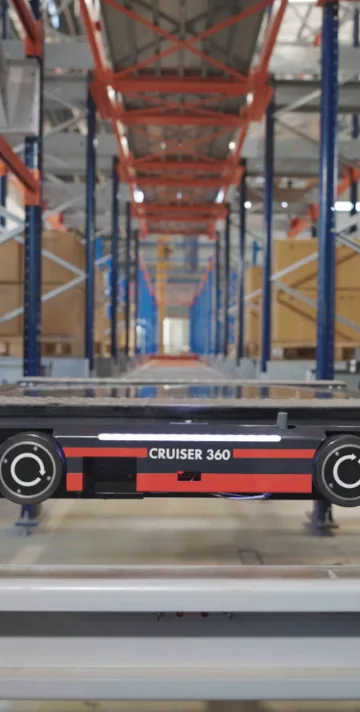
Robotic shuttle-based systems are a strong fit for warehouses that need high-density storage and automated movement. Addverb’s pallet shuttles show how the options differ:
- 4-way pallet shuttle, Cruiser 360: The Cruiser 360 moves in multiple directions, so it can reach any lane in high-density racking. It carries up to 3,307 lbs, travels at up to 4.92 ft/s, and positions loads to within +/- 0.08 inches.
- 2-way pallet shuttle, Cruiser: The Cruiser runs pallets deep into a storage lane, which reduces the aisle space needed. It carries up to 3,307 lbs at 3.61 ft/s, with a throughput of 60 pallets per hour on a 98 ft (30 m) track.
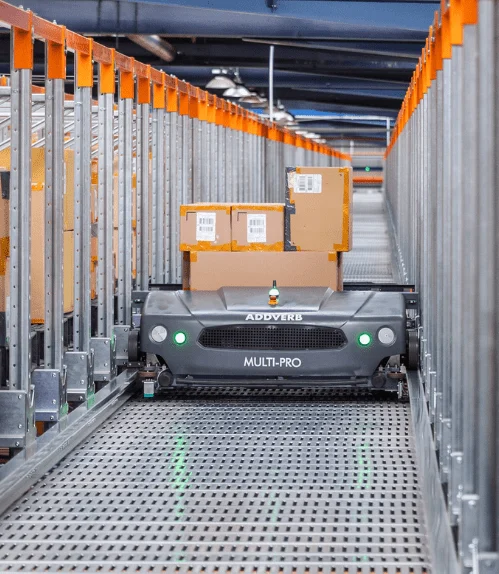
- Mother-child shuttle AS/RS, Multi-Pro: Multi-Pro supports multi-deep pallet storage for large volumes, plus sequencing and cold storage down to -22°F. It handles up to 2,205 lbs and moves 73 pallets per hour on a 98 ft (30 m) track.
Start with the warehouse, not the technology. If you store a few high-volume SKUs in deep lanes, a 2-way shuttle is usually the simplest fit. If you need any pallet from any lane, the 4-way shuttle’s multidirectional movement earns its cost. If you also need sequencing or cold storage at scale, a mother-child system is worth the extra complexity.
Why should warehouses consider AS/RS where conventional storage still works?
Conventional racking keeps working as inventory grows, but it rarely solves the space problems that come with expansion. Before adding floor-based storage, check how well you use the space you have.
- Limited floor space: Adding more conventional racks consumes floor area and leaves less room for movement, picking, and other warehouse activities.
- Unused vertical capacity: Warehouses with enough clear height may have significant storage capacity above existing floor-level configurations.
- Growing inventory volumes: Higher SKU counts and larger inventories make conventional storage harder to scale without expanding the facility footprint.
Addverb’s Multi-Level Shuttle AS/RS, Medius, automates the storage and retrieval of cartons and totes across multiple levels. It handles up to 66 lbs at up to 10.17 ft/s, with a throughput of 103 totes per hour on a 98 ft (30 m) track. It puts to work the cube that floor-based storage leaves empty. The caveat: you need the clear height. In a low-ceiling building the density gain shrinks, and a deeper pallet lane may do more for you than going vertical.
Where AS/RS changes day-to-day operations
The biggest change with AS/RS is what happens when unnecessary movement starts disappearing.
When inventory is retrieved automatically, workers spend less time walking or driving to find goods.
| Operational area | Conventional storage | AS/RS |
| Manual picking effort | Higher travel and manual movement | Reduced repetitive travel |
| Picking accuracy | Greater dependence on manual handling | More controlled storage and retrieval |
| Floor space utilization | More floor space required for storage | Higher-density configurations use vertical space |
| Role of the team | People walk to the goods | Goods come to people at a workstation |
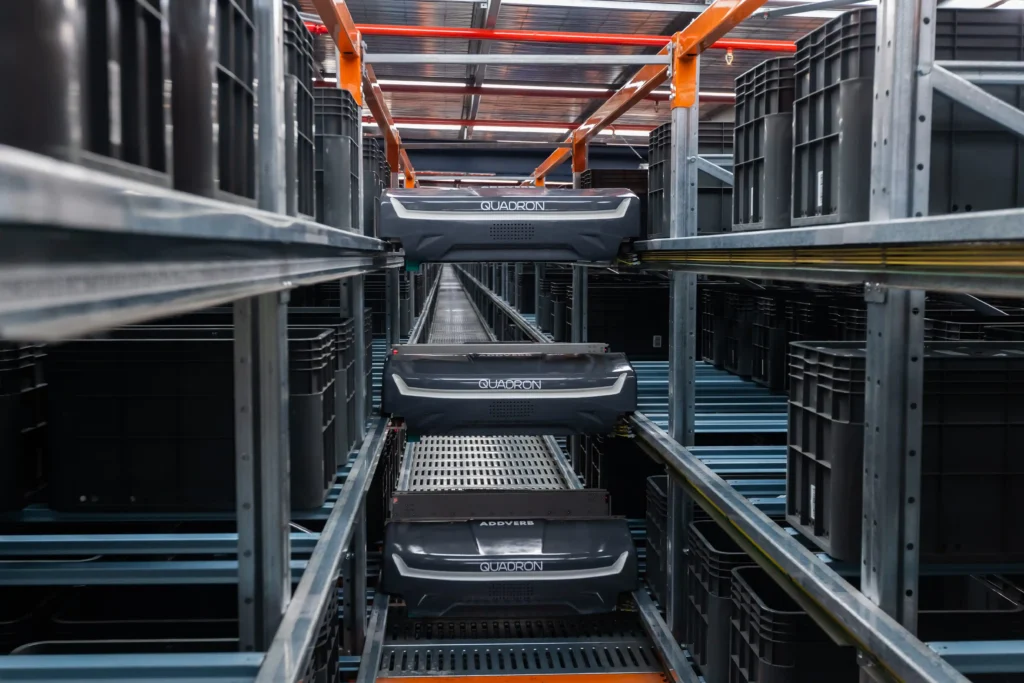
For smaller loads and frequent movements, Carton Shuttle AS/RS, Quadron, supports storage, picking, and sequencing in compact configurations. It handles up to 110 lbs at 13.12 ft/s, with a throughput of 115 totes per hour on a 98 ft (30 m) track. That suits operations with compact footprints and constant, high-frequency order movement.
What should warehouses consider before switching to AS/RS?
AS/RS is not a plug-and-play purchase. Work through these before you request a quote:
- Inventory profile: Load types, SKU characteristics, storage requirements, and movement frequency.
- Throughput: Expected inbound, storage, retrieval, picking, and outbound volumes.
- Available space: Existing floor area, clear height, and opportunities to use unused vertical capacity.
- System integration: How automated storage will interact with your existing WMS (warehouse management system) and ERP (enterprise resource planning) infrastructure.
- Workforce readiness: The skills needed to operate, monitor, maintain, and manage automated processes.
Be honest about the cost side too. Global Market Insights lists high capital outlay, long payback periods, and complex integration as the main brakes on adoption, especially for small and mid-sized operators. The system has to fit your workflows, not force the operation to adapt around the technology.
Also Read: 6 Benefits of AS/RS systems and which ASRS is right for you?
Case study: how Addverb’s AS/RS handled space limits at S. Abraham and Sons
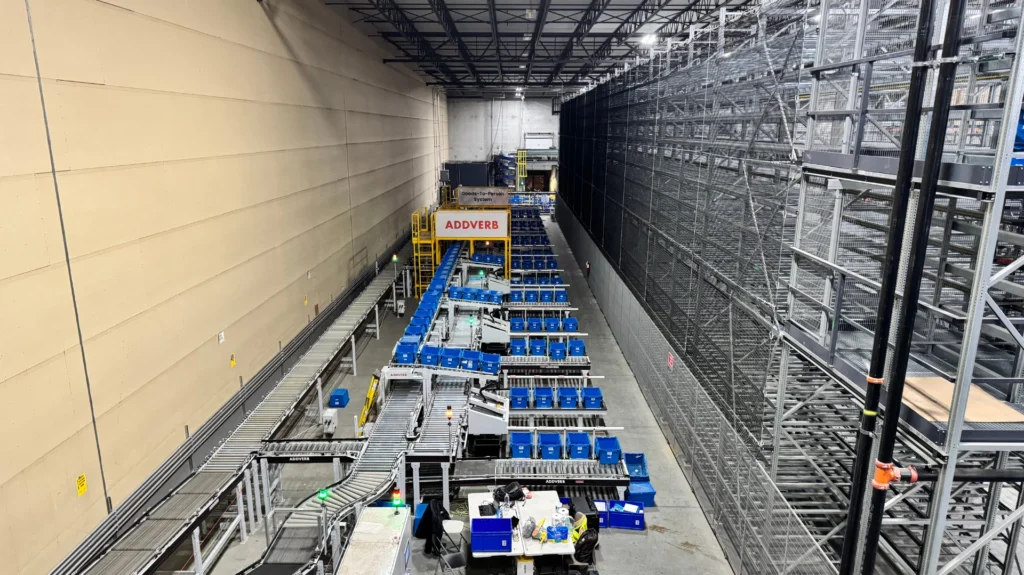
Abraham and Sons, a convenience distributor and division of Imperial Trading with warehouses in Indianapolis and Grand Rapids, partnered with Addverb to automate its wholesale distribution center. Operators walked long distances across scattered inventory zones, which raised rental costs. Addverb deployed a Carton Shuttle AS/RS to manage 14,400 SKU totes across three aisles and 4,800 order totes in a dedicated aisle, and combined it with Multi-Level Shuttles for accurate picking across storage zones. The result was storage and retrieval across 14,400 tote positions supporting 1,300 SKUs, and space utilization improved by up to 400%.
Where to start
Automating everything is rarely the answer. The right AS/RS is the one that matches your loads, space, and throughput. A useful first step costs nothing: pull a month of order data and sort your SKUs by load type and lines picked per day. That split tells you whether you are looking at a pallet shuttle, a carton shuttle, or both. Once you have it, talk to an Addverb engineer about your site.
FAQs
What are the main benefits of AS/RS over traditional racking? AS/RS improves storage density and picking accuracy and cuts the time workers spend traveling to storage locations. At S. Abraham and Sons, an Addverb carton shuttle system improved space utilization by up to 400%.
What is the ROI timeline for an AS/RS investment? There is no single ROI timeline, because payback depends on labor cost, storage capacity, throughput, and system scope. Model payback against your own volumes before committing, since high upfront cost and long payback periods are the most common barriers for small and mid-sized operators.
How does AS/RS help with labor shortages in North America? AS/RS takes over repetitive storage and retrieval travel, so your existing team can handle more volume at goods-to-person workstations instead of walking aisles.
How does AS/RS integrate with a WMS or ERP system? The AS/RS control software receives storage and retrieval tasks from your WMS, which keeps inventory in sync with your ERP. At S. Abraham and Sons, Addverb’s Warehouse Execution System (WES) manages inventory movement in real time.
How does AS/RS support e-commerce and fast fulfillment? AS/RS brings goods to the picker on demand and can sequence totes in order, which shortens the time between order release and dispatch. A carton shuttle such as Quadron moves 115 totes per hour on a 98 ft (30 m) track.