



ON THIS PAGE
If you’re working in a warehouse that utilises a robotic fleet for day-to-day operations, then you are part of a team that is focused on scale of operations and relies on their fleet for order accuracy. But let’s say you see your productivity falling and you want to see if investing in additional robots make sense – What is the best way to answer this question?
Virtual robots fulfil this end goal – predict warehouse productivity with in a real robotic fleet. These virtual agents mimic the activities of a live robot in a Fleet Management System (FMS), giving warehouse managers an experience of how a real world fleet will react to each movement, reaction, or decision of a new additional robot to the fleet.
What Are Virtual Robots?
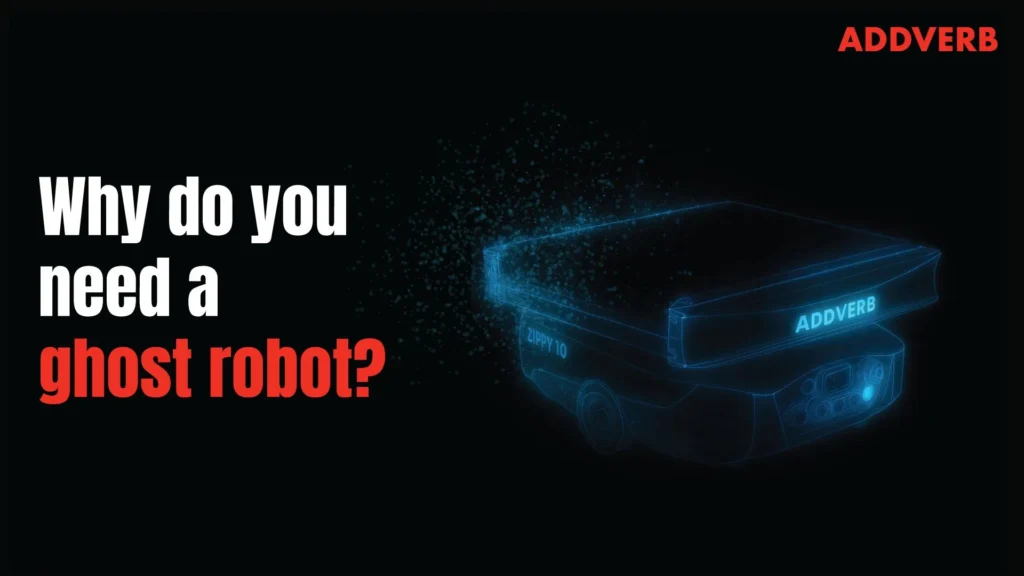
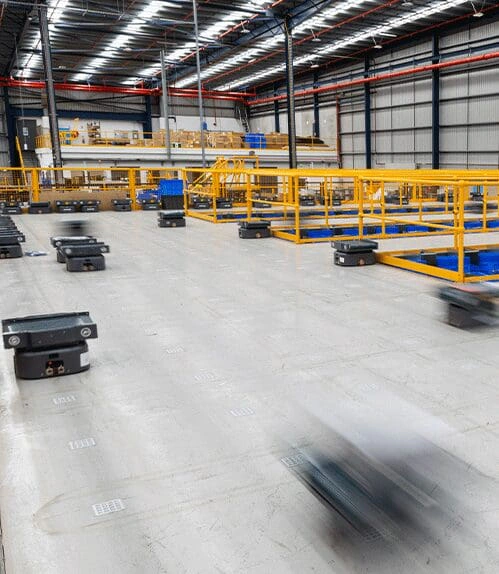
In simplest words, Virtual robots (also called ghost robots) are virtual sensations of the real robotic fleet in a warehouse. They exist as part of the FMS environment and carry out simulated operations on a highly detailed digital replica of the physical warehouse space. Virtual agents move, pick, drop, and charge just like the physical robots, but only exist in the simulation layer.
Virtual robots or virtual agents are virtual robots that behave like a real robot. Picture this, you are evaluating a new warehouse layout, adding more robots, or altering routes, but you don’t want to stop any real operations or purchase any hardware.
What is groundbreaking about Virtual robots is that the real robots are able to interact with the Virtual agents. The FMS utilises this hybrid simulation to show larger fleet sizes, new routes, or layout changes. This allows operations teams to assess the change’s effect on overall throughput without spending money or interrupting operations.
How are these Virtual robots different from a simulation?
It is easy to confuse between virtual agents and digital twins as they are very similar concepts. If we put it in simple words, while digital twin systems are simulations – the ghost robots are emulation.
A digital twin is a digital replica of an existing warehouse or a system which acts, reacts and simulates output basis the changes provided in the code or design. It then helps businesses predict the impact of these changes in the virtual world; there by creating a sandbox like environment for testing.
A Virtual robot, on the other hand, exists in the real world along with the robotic fleet – though it is only visible in the fleet management system. The other robots on the real-world robotic fleet behave as if they have an actual robot and leave space for it in their day-to-day operations. It is different from a simulation as it considers real-world scenarios like friction, congestion etc.; creating a prediction which is much closer than the simulated outcomes.
How Virtual Robots Work in FMS?
Virtual agents are created and placed within the warehouse layout.
- These agents perform tasks like picking, dropping, and charging that are realistic.
- The FMS allows physical robots to operate with these Virtual agents, in real time as if they are a combined fleet.
- Engineers can conduct multiple “what-if” simulations by changing fleet size, routing logic and traffic rules.
- Then the system provides analytics in the form of heatmaps for congestion, graphing throughput, and observing traffic patterns.
This allows the warehouse system to estimate points of congestion, test throughput with other configurations, and determine the impact of adding robots – all without interference with or into the physical assets.
Real-World Case Study: Virtual Robots in Action
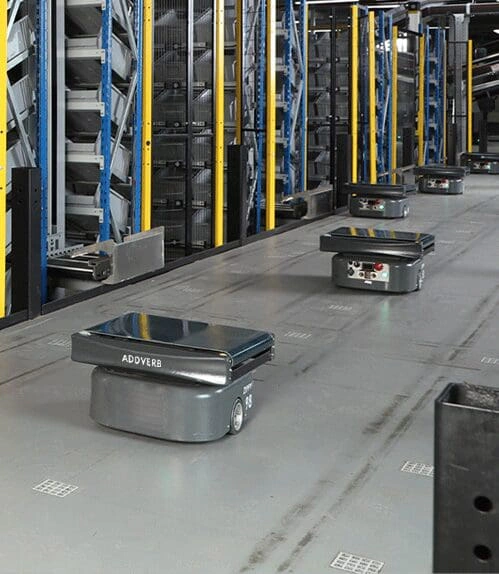
A leading e-commerce company employing Addverb’s Zippy robotic fleet needed to improve throughput to accommodate increasing order volumes. Their first thought was simple – add more robots. But the question was – will adding more robots create an increase in throughput, create a new bottleneck, or both?
Using the Virtual Simulation functionality in the FMS, Addverb’s engineers reported some virtual experiments:
- Virtual agents were added to the live map of the warehouse, and the real robots were made to respond to them as if they were together in real-time.
- With the digital environment, various fleet sizes and routing strategies were applied.
The results proved to be remarkably accurate when the FMS simulation was compared to physical implementations, showing greater than 99% accuracy.
This data-driven validation gave the client confidence to scale operations efficiently, without unnecessary capital expenditure. Virtual robots turned what could have been a costly experiment into a precise, predictable decision.
Is your FMS evolved to provide virtual agents as a functionality?
Fleet management systems have evolved from their roots in logistics and transportation. In the 1960s, Automated Guided Vehicles (AGVs) began revolutionising material handling. It wasn’t until years later, when Autonomous Mobile Robots (AMRs) entered the spectrum, that the concept shifted from a simple Fleet Monitoring System to a sophisticated Fleet Management System, enabling the coordination of humans, machines and data-driven algorithm entities.
Fast-forward to today, and an FMS acts as the brain for controlling the movement of robots in a warehouse. A warehouse FMS creates and deploys tasking for all robots, tracks their location, manages charging functions, reduces the potential for collisions, and optimises throughput across the system.
These efficiencies go a long way as many warehouses worldwide begin to utilise advanced software such as Addverb’s Movect for fleet management, capable of managing thousands of robots at once, and driven by intelligent, dynamic decision-making capabilities.
Why Virtual Robots Are a Breakthrough for FMS
Virtual robots transform how an FMS can be utilised; it moves from a tool to monitor existing operations to a predictive, experimental environment. Their impact goes far beyond simply simulating operations:
- Cost-Saving Experimentation: Before making robots stronger or redesigning layouts, warehouses can perform realistic virtual tests to predict outcomes. This reduces risk and improves capital forecasting.
- Data-Led Decision Making: Whereas an FMS can generate metrics, throughput, congestion, and task time, Virtual robots will generate empirical data that will give engineers evidence-based confidence.
- Hybrid Coordination: Virtual robots enable physical and virtual robots to work together, making the physical-digital hybrid system more flexible and intelligent.
- Predictive Optimisation: Virtual robots tell the warehouse in real-time with generated heat maps, simulation playback (using the Replayer feature), and traffic breakdowns, helping to avoid congestion or deadlocks before they develop.
- Scalability Without Halting: Virtual robots allow for expansion plans without ceasing current operations, a considerable benefit within large 24/7 facilities.
Conclusion: Virtual Robots — From simulation to emulation
FMS Virtual robots mark a new era in warehouse intelligence. They bring the power of prediction, experimentation, and optimisation into a single digital platform, where ideas are tested safely before reaching the floor.
By creating a digital twin of every robot, every route, and every task, Virtual simulations transform warehouse management from reactive problem-solving to proactive innovation.
As seen in Addverb’s real-world success story, Virtual robots don’t just help managers make smarter decisions; they redefine what’s possible in automation. In the future, these virtual agents could become the silent architects of warehouse performance, guiding fleets toward higher efficiency, sustainability, and precision, one simulation at a time.